

TM Owner Bayer
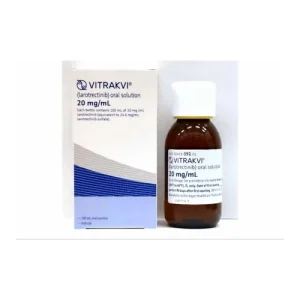
Vitrakvi 20 mg/mL Oral Solution
Global Shipping : Reliable Global Distribution Network
Express Delivery : Priority Shipping for Every Order
Secure Payments : Trusted Payment Protection System
 Disclaimer

Secure Handling
24/7 Worldwide Support

Global Access
Worldwide Access to Health

Cold-Chain Expert
Excellence in Cold-Chain

Trusted Supply
Certified Medical Supply
Indications & Clinical Uses
- Vitrakvi 20 mg/mL oral solution contains larotrectinib, a targeted cancer medicine (a TRK kinase inhibitor).
- In the US it is indicated for adults and children with solid tumours that have an NTRK gene fusion without a known acquired resistance mutation, that are metastatic or where surgical removal would cause severe complications, and that have no satisfactory alternative treatments or have progressed after treatment; the fusion must be confirmed by an approved test.
- In the EU the authorisation is conditional (September 2019) for the same type of NTRK fusion tumours.
- The dose is 100 mg twice daily for adults and for children with a body surface area of 1 m2 or more, and 100 mg/m2 twice daily for smaller children.
- The oral solution is measured in millilitres, whereas the capsules come in 25 mg and 100 mg, so check mg against mL.
Side Effects
- Very common side effects in the EU leaflet (more than 1 in 10 people) include nausea, vomiting, constipation, muscle pain, tiredness and weight gain; taste changes and muscle weakness are common.
- In the US label, reactions in at least 20% of patients were raised liver enzymes (AST/ALT), anaemia, low albumin, musculoskeletal pain, raised alkaline phosphatase, low white cell counts, low calcium, fatigue, vomiting, cough, constipation, fever, diarrhoea, nausea, abdominal pain, dizziness and rash.
- Serious risks are nervous system effects such as dizziness, liver injury, harm to an unborn baby and bone fractures.
- The label carries no boxed warning.
- Report jaundice, new confusion, severe dizziness, bone pain or any injury that is slow to heal.
Precautions & Warnings
- Liver function tests are required before starting, every 2 weeks for the first 2 months, and then monthly.
- Do not drive, cycle or use machines if you feel dizzy or tired.
- Vitrakvi can harm an unborn baby: use effective contraception during treatment and afterwards (1 week after the last dose in the US label; at least 1 month in the EU leaflet), and men with partners who can become pregnant should also use protection in the EU.
- Do not breastfeed during treatment and for 1 week after the last dose.
- Report any bone pain promptly because fractures have occurred.
- Refrigerate the oral solution at 2°C to 8°C, do not freeze, and discard after the period on the label (US: 90 days for the 100 mL bottle, 31 days for 50 mL bottles).
Avoid Interactions
- Increase the effect or risk: strong CYP3A4 inhibitors, such as ketoconazole and other antifungals and certain antiretrovirals, and grapefruit or grapefruit juice, raise larotrectinib levels; avoid them, or if unavoidable the US label reduces the dose by 50%.
- Reduce efficacy: strong CYP3A4 inducers, such as St John's wort and certain epilepsy medicines, lower levels; avoid them, or if unavoidable the US label doubles the dose.
- Vitrakvi may also raise levels of sensitive CYP3A4 substrate medicines, so avoid combining them.
- Tell your healthcare provider about all prescription medicines, non-prescription medicines and herbal supplements you use.
References
Frequently Asked Questions
Vitrakvi (larotrectinib) treats adults and children with solid tumours that carry an NTRK gene fusion, when the cancer has spread or surgery would cause severe harm and there are no satisfactory alternatives. Your tumour must first test positive for the fusion. It is a targeted oral medicine.
Take Vitrakvi (larotrectinib) oral solution by mouth twice daily, with or without food. Adults and children with body surface area of 1 m2 or more take 100 mg; smaller children take 100 mg/m2. Measure the dose carefully in millilitres, because the solution is 20 mg/mL.
Common Vitrakvi (larotrectinib) side effects include nausea, vomiting, constipation, muscle pain, fatigue, dizziness, raised liver enzymes and anaemia. Serious risks are liver injury, nervous system effects, fractures and harm to an unborn baby. There is no boxed warning. Report jaundice or severe dizziness.
Avoid grapefruit and grapefruit juice with Vitrakvi (larotrectinib), and avoid strong CYP3A4 inhibitors or inducers such as ketoconazole, St John's wort or epilepsy medicines. Do not drive or use machines if dizzy or tired. Tell your prescriber about every medicine you take.
If you miss a Vitrakvi (larotrectinib) dose or vomit after taking it, do not take a double dose. Simply continue with your regular schedule. Keep the oral solution refrigerated at 2°C to 8°C, do not freeze it, and discard it after the period stated on the label.
No. Vitrakvi (larotrectinib) can harm an unborn baby. Use effective contraception during treatment and afterwards: 1 week after the last dose in the US label, at least 1 month in the EU leaflet. Do not breastfeed during treatment and for 1 week after the last dose.

Trusted & Reliable – Your Partner in Global Distribution.
We provide comprehensive lines of pharmaceutical products to support all your healthcare distribution needs.


