

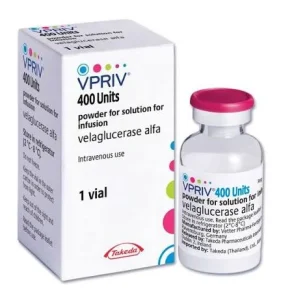
TM Owner Takeda
Vpriv 400 units Injection
Global Shipping : Reliable Global Distribution Network
Express Delivery : Priority Shipping for Every Order
Secure Payments : Trusted Payment Protection System
 Disclaimer

Secure Handling
24/7 Worldwide Support

Global Access
Worldwide Access to Health

Cold-Chain Expert
Excellence in Cold-Chain

Trusted Supply
Certified Medical Supply
Indications & Clinical Uses
- Vpriv 400 units is a single-dose vial of velaglucerase alfa, an enzyme replacement therapy (a laboratory-made form of the enzyme glucocerebrosidase) used for long-term treatment of type 1 Gaucher disease.
- In the US the label describes use in adults and in children, with safety and effectiveness established in patients aged 4 to 17 years; in the EU it is authorised (Takeda) for long-term enzyme replacement therapy in patients with type 1 Gaucher disease.
- It is given only as an intravenous infusion over 60 minutes, usually 60 units/kg every other week, under the supervision of a healthcare provider in a setting with resuscitation equipment; in the EU, later infusions may be given at home after the first hospital infusions if well tolerated.
- It is one of several Gaucher enzyme products, so it must not be swapped for another without the prescriber.
- Patients switching from imiglucerase start at their previous dose two weeks after the last imiglucerase dose.
Side Effects
- The US label carries a boxed warning: life-threatening hypersensitivity reactions, including anaphylaxis, have occurred with enzyme replacement therapies including Vpriv, during early treatment and after long use.
- Hypersensitivity reactions were the most common effect (about 52% of previously untreated patients and 23% of patients switched from imiglucerase).
- Other very common reactions were headache (about 35% and 30%), dizziness (22% and 8%), fever (22% and 13%) and abdominal pain (19% and 15%).
- Back or joint pain, tiredness or weakness (about 15%), nausea, and a raised activated partial thromboplastin time (11%) were also reported.
- About 2% of previously untreated patients developed antibodies to the medicine.
- Serious vomiting needing hospital care has been reported after approval.
- Tell the infusion team straight away about difficulty breathing, throat tightness, facial swelling, rash, itching, chest discomfort or feeling faint during or after an infusion.
Precautions & Warnings
- Boxed warning: life-threatening hypersensitivity reactions, including anaphylaxis, can occur, so Vpriv must be given where trained staff and resuscitation equipment are available, and patients should know the symptoms of anaphylaxis.
- Infusion reactions are managed by slowing the infusion, giving antihistamines, fever reducers or corticosteroids, or stopping; adrenaline is used for severe reactions, and premedication may be considered for patients who have had earlier reactions.
- The US label lists no contraindications; the EU information says not to use it after a severe allergic reaction to velaglucerase alfa or its ingredients.
- Pregnancy: over 300 reported pregnancies showed no link with birth defects, and animal studies showed no fetal harm.
- Breastfeeding: no data on presence in milk.
- Use in children under 4 has not been studied.
- The powder is reconstituted with sterile water, diluted in 100 mL sodium chloride 0.9% and infused through a 0.2 to 0.22 micron low-protein-binding filter within 24 hours.
Avoid Interactions
- No specific drug interactions are described in the US label, and compatibility with other infusion products has not been evaluated, so Vpriv must not be mixed or run through the same infusion line as other medicines.
- Nothing has been identified that increases or reduces its effect.
- Antihistamines, fever reducers and corticosteroids may be given before or during an infusion by the care team to control reactions.
- Tell your healthcare provider about all prescription medicines, non-prescription products and supplements, and about any earlier allergic reaction to an enzyme replacement therapy such as imiglucerase or taliglucerase before treatment starts.
References
Frequently Asked Questions
Vpriv (velaglucerase alfa) is an enzyme replacement therapy for long-term treatment of type 1 Gaucher disease. It replaces the enzyme that people with Gaucher disease lack. In the US the label supports use in adults and in children aged 4 to 17 years.
Vpriv (velaglucerase alfa) is given as a 60-minute intravenous infusion, usually 60 units/kg every other week. A healthcare provider supervises each infusion. In the EU, later infusions may be given at home after the first hospital infusions, if you tolerate treatment and trained staff supervise.
Vpriv very commonly causes hypersensitivity reactions, headache, dizziness, fever, abdominal pain, back or joint pain and tiredness. Anaphylaxis can occur. Tell the infusion team at once about trouble breathing, throat tightness, facial swelling, rash or feeling faint during or after an infusion.
No drug interactions are described for Vpriv (velaglucerase alfa), but it must not be mixed or run through the same infusion line as other medicines. Do not switch to another Gaucher enzyme product without your prescriber. Tell your care team about all medicines and any past reaction to enzyme therapy.
During a Vpriv (velaglucerase alfa) infusion, staff give the dose through a vein over 60 minutes with a filter, and watch you for allergic reactions. Resuscitation equipment must be available. If a reaction occurs, staff can slow or stop the infusion and give antihistamines, fever reducers or corticosteroids.
Vpriv carries a boxed warning for life-threatening hypersensitivity reactions, including anaphylaxis, which can occur early in treatment or after long use. Vpriv (velaglucerase alfa) must be given where staff and resuscitation equipment are ready. Learn the symptoms of anaphylaxis and report them immediately.

Trusted & Reliable – Your Partner in Global Distribution.
We provide comprehensive lines of pharmaceutical products to support all your healthcare distribution needs.


