

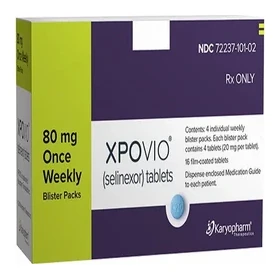
TM Owner Karyopharm Therapeutics
Xpovio 20mg FC Tablet
Global Shipping : Reliable Global Distribution Network
Express Delivery : Priority Shipping for Every Order
Secure Payments : Trusted Payment Protection System
 Disclaimer

Secure Handling
24/7 Worldwide Support

Global Access
Worldwide Access to Health

Cold-Chain Expert
Excellence in Cold-Chain

Trusted Supply
Certified Medical Supply
Indications & Clinical Uses
- Xpovio 20 mg film-coated tablets contain selinexor, an oral cancer medicine (a selective inhibitor of nuclear export).
- It is approved in the US for adults with multiple myeloma in two settings: in combination with bortezomib and dexamethasone for patients who have received at least one prior therapy (100 mg once weekly), and in combination with dexamethasone for relapsed or refractory multiple myeloma after at least four prior therapies, where the disease is refractory to specific proteasome inhibitor, immunomodulatory and anti-CD38 antibody drugs (80 mg on days 1 and 3 of each week).
- Xpovio is available in several strengths (10, 20, 40, 50, 60 and 80 mg), so the number of 20 mg tablets depends on the regimen; for example 80 mg is four 20 mg tablets.
- It is specialist-prescribed and taken by you at home, and the label states no boxed warning.
Side Effects
- For the combination with bortezomib and dexamethasone, reactions in 20% or more of patients include fatigue, nausea, decreased appetite, diarrhoea, peripheral neuropathy, upper respiratory tract infection, weight loss, cataract and vomiting.
- With dexamethasone alone, the most common reactions include low platelets (thrombocytopenia), fatigue, nausea, anaemia, decreased appetite, weight loss, diarrhoea, vomiting, low sodium (hyponatraemia) and neutropenia.
- Grade 3 to 4 laboratory abnormalities include low platelets (43% to 61%), low lymphocytes, anaemia, low sodium and neutropenia.
- Serious reactions include life-threatening thrombocytopenia with bleeding, neutropenia with serious infections, gastrointestinal toxicity, neurological toxicity (dizziness, mental status changes) and new or worsening cataract.
- There is no boxed warning.
- Tell your healthcare team quickly about bleeding, fever or infection symptoms, confusion, or persistent vomiting or diarrhoea.
Precautions & Warnings
- The Xpovio label has no boxed warning and no contraindications, but it lists important warnings: thrombocytopenia (platelet counts are monitored), neutropenia (growth-factor support may be considered), gastrointestinal toxicity, hyponatraemia (sodium is monitored and fluids managed), serious infection, neurological toxicity, embryo-fetal toxicity and cataract.
- Take a 5-HT3 receptor antagonist and other anti-nausea medicine before and during treatment to control nausea and vomiting.
- Use effective contraception during treatment and for 1 week after the last dose, as selinexor can harm an unborn baby, and do not breastfeed.
- Do not drive or do dangerous tasks if you feel dizzy or confused.
- If a dose is missed or delayed, take the next dose at the next regularly scheduled time; if you vomit a dose, do not repeat it.
- Store at or below 30°C.
Avoid Interactions
- The label reports no clinically significant interaction with clarithromycin (a CYP3A4 inhibitor) or carbamazepine (an enzyme inducer) in clinical studies, so no dose change is specified for these.
- Selinexor inhibits the OATP1B3 transporter but does not significantly inhibit other major transporters.
- When taken with bortezomib and dexamethasone, or dexamethasone alone, the side effects of those medicines are added to those of Xpovio, and required anti-nausea medicines must be taken as directed.
- Tell your healthcare provider about every prescription medicine, over-the-counter product and supplement you use before starting Xpovio, and do not start new medicines without checking.
- Avoid becoming pregnant or breastfeeding while taking it.
References
Frequently Asked Questions
Xpovio (selinexor) is a tablet for adults with multiple myeloma. It is used with bortezomib and dexamethasone after at least one prior therapy, or with dexamethasone alone in relapsed or refractory disease after at least four prior therapies. It is prescribed by a cancer specialist.
Xpovio (selinexor) is taken by mouth: 100 mg once weekly with bortezomib and dexamethasone, or 80 mg on days 1 and 3 of each week with dexamethasone. With 20 mg tablets, 80 mg is four tablets. You need an anti-nausea medicine, such as a 5-HT3 blocker, before and during treatment.
Common Xpovio side effects include fatigue, nausea, vomiting, diarrhoea, poor appetite, weight loss, low platelets, anaemia and low sodium. Xpovio can also cause serious infections, low white cells, nerve problems and cataracts. Tell your healthcare provider straight away about bleeding, fever, confusion or dizziness.
Studies found no clinically significant interaction between Xpovio (selinexor) and clarithromycin, but always tell your healthcare provider about every medicine you take. Avoid driving or dangerous tasks if Xpovio makes you dizzy or confused. Do not breastfeed during treatment, and take the anti-nausea medicines your team prescribes.
If you miss or delay a dose of Xpovio (selinexor), take your next dose at the next regularly scheduled time. If you vomit a dose, do not repeat it; take the next dose on your next scheduled day. Store the tablets at or below 30°C.
No. Xpovio (selinexor) can harm an unborn baby. Use effective contraception during treatment and for 1 week after your last dose, and do not breastfeed. Your healthcare team will also monitor your blood counts and sodium levels during treatment. Selinexor caused fetal harm in animal data.

Trusted & Reliable – Your Partner in Global Distribution.
We provide comprehensive lines of pharmaceutical products to support all your healthcare distribution needs.


