

TM Owner Roche
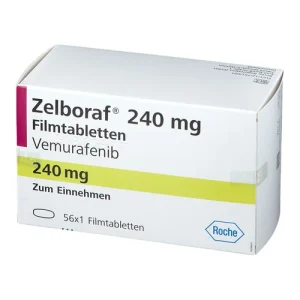
Zelboraf 240mg Tablet
Global Shipping : Reliable Global Distribution Network
Express Delivery : Priority Shipping for Every Order
Secure Payments : Trusted Payment Protection System
 Disclaimer

Secure Handling
24/7 Worldwide Support

Global Access
Worldwide Access to Health

Cold-Chain Expert
Excellence in Cold-Chain

Trusted Supply
Certified Medical Supply
Indications & Clinical Uses
- Zelboraf 240 mg (vemurafenib) is a BRAF kinase inhibitor taken as film-coated tablets.
- In the US it is indicated for adults with unresectable or metastatic melanoma whose tumour carries a BRAF V600E mutation, confirmed by an approved test, and for Erdheim-Chester disease with a BRAF V600 mutation.
- In the EU it is approved as a single agent for adults with BRAF V600 mutation-positive unresectable or metastatic melanoma.
- It is not indicated for melanoma with normal (wild-type) BRAF.
- The usual dose is 960 mg (four 240 mg tablets) every 12 hours with or without food, swallowed whole and not crushed or chewed.
- It is prescribed by a cancer specialist.
- Roche markets it in the EU and Genentech in the US.
- The EU pack is 56 tablets; US bottles hold 112 or 120 tablets.
Side Effects
- Very common side effects (30% or more in the US label) include joint pain (53%), hair loss (45%), fatigue (38%), rash (37%), nausea (35%) and sensitivity to sunlight (33%); itching and skin papillomas are also common.
- Serious effects include new skin cancers such as cutaneous squamous cell carcinoma (24% in the US trial), heart rhythm changes (QT prolongation), liver problems, severe skin reactions including Stevens-Johnson syndrome, uveitis (eye inflammation), severe reactions when combined with radiation, and Dupuytren's contracture of the hand.
- There is no boxed warning.
- Use sunscreen of SPF 30 or higher, avoid sun exposure, and report new skin lesions, palpitations, fainting or eye pain promptly.
Precautions & Warnings
- Skin checks are needed before treatment and every 2 months during treatment.
- ECG and electrolyte checks are needed because of QT prolongation, and treatment is withheld if QTc reaches 500 ms or more.
- Liver enzymes are checked monthly.
- Zelboraf can cause fetal harm: use effective contraception during treatment and for 2 weeks after the last dose (US label; the EU label says at least 6 months).
- Do not breastfeed during treatment and for 2 weeks after the last dose.
- The EU label states a minor effect on driving or using machines.
- Radiation treatment given before, during or after Zelboraf can cause severe reactions.
- If a dose is missed it can be taken up to 4 hours before the next dose.
- Do not take an extra dose after vomiting.
Avoid Interactions
- Drugs that may increase Zelboraf levels or toxicity: strong CYP3A4 inhibitors should be avoided, or the dose reduced if unavoidable.
- Do not combine with other QT-prolonging drugs.
- Zelboraf can also raise levels of other drugs: CYP1A2 substrates with a narrow safety margin (tizanidine exposure rose 4.7-fold) and P-glycoprotein substrates such as digoxin (1.8-fold) should be avoided or monitored, and warfarin exposure rose modestly.
- Drugs that may reduce Zelboraf's efficacy: strong CYP3A4 inducers should be avoided, or the dose increased under specialist advice if unavoidable.
- Tell your healthcare provider about all prescription medicines, over-the-counter products and herbal supplements.
References
Frequently Asked Questions
Zelboraf (vemurafenib) treats adults with melanoma that cannot be removed by surgery or has spread and has a BRAF V600 mutation. In the US it is also used for Erdheim-Chester disease with a BRAF V600 mutation. It does not work for melanoma with normal BRAF.
Take Zelboraf (vemurafenib) 960 mg, which is four 240 mg tablets, by mouth every 12 hours, with or without food. Swallow the tablets whole; do not crush or chew them. If you vomit after a dose, do not take another one; take the next scheduled dose.
Common Zelboraf side effects include joint pain, hair loss, fatigue, rash, nausea and sun sensitivity. Serious risks are new skin cancers, QT prolongation, liver problems, severe skin reactions and eye inflammation. Report new skin lesions, fainting, palpitations or eye pain promptly.
Avoid sun exposure with Zelboraf (vemurafenib); use sunscreen of SPF 30 or higher. Avoid strong CYP3A4 inhibitors and inducers, QT-prolonging drugs and narrow-margin CYP1A2 or P-glycoprotein drugs such as tizanidine and digoxin. Do not breastfeed during treatment or for 2 weeks after.
If you miss a dose of Zelboraf (vemurafenib), you can take it up to 4 hours before your next scheduled dose. After that point, wait for the next scheduled dose and carry on with your usual schedule. Do not take an extra dose after vomiting.
Zelboraf (vemurafenib) needs a skin check before treatment and every 2 months, ECG and electrolyte tests for QT changes, and monthly liver enzyme tests. Eye symptoms should be checked promptly. Use effective contraception during treatment and for 2 weeks after (US label).

Trusted & Reliable – Your Partner in Global Distribution.
We provide comprehensive lines of pharmaceutical products to support all your healthcare distribution needs.


