

TM Owner Guilin Pharmaceutical
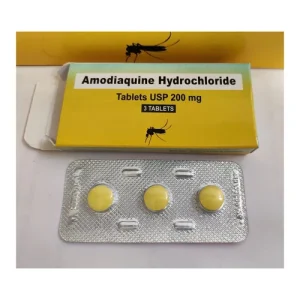
Amodiaquine (Guilin) 153 mg base / 200 mg HCl Tablet
Global Shipping : Reliable Global Distribution Network
Express Delivery : Priority Shipping for Every Order
Secure Payments : Trusted Payment Protection System
 Disclaimer

Secure Handling
24/7 Worldwide Support

Global Access
Worldwide Access to Health

Cold-Chain Expert
Excellence in Cold-Chain

Trusted Supply
Certified Medical Supply
Indications & Clinical Uses
- This product is the Guilin Pharmaceutical amodiaquine 153 mg dispersible tablet, each tablet containing amodiaquine hydrochloride equivalent to 153 mg of amodiaquine base, roughly 200 mg of the hydrochloride salt.
- Amodiaquine is a 4-aminoquinoline antimalarial.
- There is no United States or European Medicines Agency licence for this presentation; the information here comes from the WHO-prequalified label for the Guilin co-blistered product whose approved name is SPAQ-CO Disp, in which these three amodiaquine tablets are packed with one sulfadoxine 500 mg plus pyrimethamine 25 mg dispersible tablet.
- It is approved for seasonal malaria chemoprevention, that is monthly preventive treatment given to children aged 12 to 59 months during the malaria transmission season in the Sahel sub-region of Africa.
- It is given by trained community distributors under national programmes.
- Amodiaquine alone is not a treatment for an established attack of malaria and must not be used for traveller prophylaxis.
Side Effects
- The commonest effects reported in children given amodiaquine for seasonal chemoprevention are vomiting, abdominal pain, fever, diarrhoea, headache and itching, most of them mild and short-lived.
- Vomiting soon after a dose is frequent and the dose may need to be repeated.
- There is NO boxed warning on this WHO-prequalified label, but three rare and serious reactions must be recognised.
- Amodiaquine can cause idiosyncratic acute hepatitis, which may be severe or fatal and is estimated at roughly one serious liver injury per 15,000 exposures, with aminotransferase rises in about 1 per cent of users.
- It can also cause agranulocytosis, a dangerous fall in neutrophils that may last weeks and lead to fatal infection.
- Severe skin reactions including Stevens-Johnson syndrome occur rarely, and reversible extrapyramidal movement reactions have been reported.
- Stop the tablets and seek urgent care for any rash or hives, yellowing of the eyes or skin, dark urine, unusual tiredness, or fever with sore throat or mouth ulcers.
Precautions & Warnings
- Amodiaquine 153 mg dispersible tablets must not be given to a child who is allergic to amodiaquine or any excipient, who has previously had liver injury or a blood disorder while taking amodiaquine, or who has retinopathy.
- In the SPAQ-CO Disp course the sulfadoxine and pyrimethamine component adds contraindications for sulfonamide allergy.
- Do not start a course if the child has had amodiaquine or sulfadoxine/pyrimethamine within the previous 30 days, or is acutely unwell with a suspected malaria attack, which needs treatment rather than prevention.
- Extra caution is needed in HIV-positive children taking co-trimoxazole.
- Treatment must be stopped at once if a rash or itching appears.
- Repeated or prolonged amodiaquine exposure is what drives the risk of agranulocytosis and hepatitis, which is why courses are limited to three days, given monthly, for a maximum of four courses in a season.
- The tablet is dispersed in a small amount of clean water or breast milk and swallowed under supervision.
- Store below 30 degrees Celsius.
Avoid Interactions
- Tell the health worker about every medicine the child is taking.
- The risk of blood and liver toxicity is INCREASED by co-trimoxazole and by trimethoprim or sulfamethoxazole given alone, which add to the haematological effects of the sulfadoxine/pyrimethamine partner; by efavirenz, which with amodiaquine has caused marked hepatotoxicity and should be avoided; and by zidovudine, which adds to the risk of neutropenia.
- Other medicines that suppress the bone marrow or damage the liver should be avoided during a course.
- Amodiaquine is metabolised by CYP2C8 to its active metabolite desethylamodiaquine, so drugs that inhibit or induce CYP2C8 can raise toxicity or REDUCE efficacy; amodiaquine also inhibits CYP2D6, so caution is needed with beta-blockers, tricyclic antidepressants and antipsychotics.
- Do not give other antimalarial medicines at the same time as a chemoprevention course unless a health worker directs it, because that both duplicates exposure and complicates the treatment of a breakthrough attack.
- Grapefruit juice and alcohol are not relevant to this paediatric product.
References
- Amodiaquine (as hydrochloride) 153 mg Dispersible Tablets + Sulfadoxine/Pyrimethamine (SPAQ-CO Disp, Guilin Pharmaceutical) - WHOPAR Part 4 Summary of Product Characteristics, WHO Prequalification
- SPAQ-CO Disp - WHO-PQ Recommended Patient Information Leaflet (WHOPAR Part 3)
- SPAQ-CO Disp (Guilin Pharmaceutical Co. Ltd) - WHOPAR Part 6 Public Assessment Report, WHO Prequalification
- Amodiaquine - LiverTox: Clinical and Research Information on Drug-Induced Liver Injury, NIH/NIDDK
Frequently Asked Questions
Guilin amodiaquine 153 mg dispersible tablets are used for seasonal malaria chemoprevention in children aged 12 to 59 months in Africa's Sahel region. Each tablet holds amodiaquine hydrochloride equal to 153 mg of amodiaquine base. It is given with sulfadoxine/pyrimethamine as the WHO-prequalified SPAQ-CO Disp course.
One 153 mg tablet is dispersed in a little clean water or breast milk and given once daily for three days. A sulfadoxine/pyrimethamine tablet is added on day 1 only. The three-day course repeats once a month, up to four courses in one malaria season.
Common amodiaquine side effects in children are vomiting, stomach pain, fever, diarrhoea, headache and itching. Rare but serious reactions include severe liver injury, agranulocytosis (a dangerous fall in white cells) and Stevens-Johnson syndrome. Stop the tablets for any rash, yellow eyes, or fever with mouth ulcers.
Do not give Guilin amodiaquine to a child who has had liver injury or a blood disorder with amodiaquine, or who took amodiaquine or sulfadoxine/pyrimethamine in the past 30 days. Avoid co-trimoxazole, efavirenz and zidovudine, which raise the risk of liver and blood damage.
No. Guilin amodiaquine is not licensed for traveller prophylaxis. Routine preventive use was abandoned because of agranulocytosis and severe liver injury, estimated at about one serious case per 15,000 exposures. It is used only in short, supervised seasonal chemoprevention courses for young children in high-transmission areas.
Store Guilin amodiaquine 153 mg dispersible tablets below 30°C in the original blister inside its carton, protected from light. Keep them out of reach of children, because amodiaquine is dangerous in overdose. Do not use tablets from a damaged blister, and follow the 36-month shelf life.

Trusted & Reliable – Your Partner in Global Distribution.
We provide comprehensive lines of pharmaceutical products to support all your healthcare distribution needs.


