
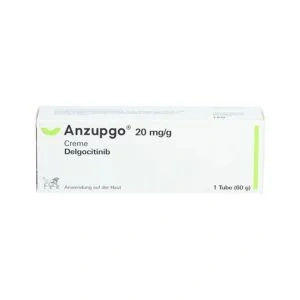
TM Owner LEO Pharma
Anzupgo 20 mg/g (2%) Cream
Global Shipping : Reliable Global Distribution Network
Express Delivery : Priority Shipping for Every Order
Secure Payments : Trusted Payment Protection System
 Disclaimer

Secure Handling
24/7 Worldwide Support

Global Access
Worldwide Access to Health

Cold-Chain Expert
Excellence in Cold-Chain

Trusted Supply
Certified Medical Supply
Indications & Clinical Uses
- Anzupgo 20 mg/g cream, also written as 2%, contains delgocitinib, a topical pan-Janus kinase inhibitor that blocks all four JAK enzymes in the skin.
- It is approved for the topical treatment of moderate to severe chronic hand eczema in adults who have not responded adequately to topical corticosteroids, or for whom corticosteroids are not advisable.
- The US Food and Drug Administration approved Anzupgo on 23 July 2025; the European Commission authorised it earlier, on 19 September 2024, to LEO Pharma A/S of Denmark, and the EU product carries the black triangle for additional monitoring.
- In the European Union, treatment should be started and supervised by a clinician experienced in chronic hand eczema.
- It is for use on the hands and wrists only, and safety in people under 18 has not been established, although a US supplemental application covering ages 12 to 17 was accepted in April 2026.
Side Effects
- The side effects reported with Anzupgo are mostly at the site of application and occur in around 1 in 100 people: pain, tingling or a burning sensation, itching and redness where the cream is applied.
- Bacterial skin infections, low white cell counts and low neutrophil counts have also been recorded.
- Anzupgo has NO boxed warning, which distinguishes it from oral JAK inhibitors, but its label still carries class warnings.
- These cover serious infections, including eczema herpeticum, non-melanoma skin cancers, and the findings from a large study of an oral JAK inhibitor in rheumatoid arthritis showing higher rates of death, major cardiovascular events, blood clots and cancers.
- Tell your healthcare provider promptly about fever, spreading painful blisters or cold sores on the hands, a new or changing skin lesion, unusual bruising, or swelling and pain in a leg.
Precautions & Warnings
- Anzupgo is for topical use only and must never be swallowed or used in the eyes or the vagina.
- Apply it only to affected skin on the hands and wrists, and do not exceed 30 grams in any two weeks or 60 grams in a month.
- Using it together with other JAK inhibitors, whether topical or oral, or with potent immunosuppressants, is not recommended.
- Live vaccines should be avoided during treatment.
- Your healthcare provider should check for active infection, including tuberculosis, before starting, and should reassess if a serious infection develops.
- In the European Union, treatment is stopped if there has been no improvement after 12 weeks.
- Regular skin checks and sun protection are sensible because of the risk of non-melanoma skin cancer.
- Data in pregnancy are insufficient; if you are breastfeeding, avoid contact between treated hands and the nipple.
- Store the tube at 20 to 25 degrees C and do not freeze it.
Avoid Interactions
- Increased risk: Anzupgo should not be combined with other Janus kinase inhibitors, whether creams or tablets, or with potent immunosuppressants such as ciclosporin, azathioprine, methotrexate or systemic corticosteroids, because the combined effect on the immune system has not been studied and may raise the risk of serious infection.
- Live attenuated vaccines, including measles, mumps, rubella, varicella, yellow fever and live nasal influenza vaccine, should be avoided during treatment.
- Reduced efficacy: no clinical drug-interaction studies have been performed, and laboratory studies found no meaningful effect on the main drug-metabolising enzymes or transporters, so ordinary tablets are not expected to change how Anzupgo works.
- Applying other creams, ointments, emollients or hand sanitiser immediately over the same skin may wash the product off or dilute it.
- Tell your healthcare provider about every medicine, cream, herbal product and supplement you use.
References
Frequently Asked Questions
Anzupgo (delgocitinib) 20 mg/g cream treats moderate to severe chronic hand eczema in adults who have not responded well to topical corticosteroids, or who cannot use them. It is a topical JAK inhibitor applied to the hands and wrists. It is not approved for anyone under 18.
Apply Anzupgo (delgocitinib) cream twice daily to the affected skin on your hands and wrists only. Do not use more than 30 grams in two weeks or 60 grams in a month. It is for skin use only, never for the eyes, mouth or vagina.
Anzupgo (delgocitinib) side effects are mostly where the cream is applied and affect about 1 in 100 people: pain, tingling, burning, itching and redness. Bacterial skin infections and low white cell or neutrophil counts have also been reported. Report fever or spreading blisters on the hands promptly.
Avoid using Anzupgo (delgocitinib) with other JAK inhibitors, topical or oral, or with strong immunosuppressants such as ciclosporin or methotrexate. Live vaccines, including measles, varicella and yellow fever, should be avoided during treatment. Do not swallow the cream or use it in the eyes or vagina.
Anzupgo (delgocitinib) cream was approved by the US FDA on 23 July 2025 for moderate to severe chronic hand eczema in adults. The European Commission authorised it earlier, on 19 September 2024, for LEO Pharma. The EU product is under additional monitoring and carries a black triangle.
No. Anzupgo (delgocitinib) cream has no boxed warning, unlike oral JAK inhibitors. Its label still warns about serious infections including eczema herpeticum, non-melanoma skin cancers, and the class findings of higher death, heart attack, blood clot and cancer rates seen with an oral JAK inhibitor.

Trusted & Reliable – Your Partner in Global Distribution.
We provide comprehensive lines of pharmaceutical products to support all your healthcare distribution needs.