

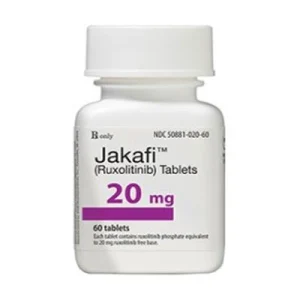
TM Owner Incyte
Jakafi 20mg Tablet
Global Shipping : Reliable Global Distribution Network
Express Delivery : Priority Shipping for Every Order
Secure Payments : Trusted Payment Protection System
 Disclaimer

Secure Handling
24/7 Worldwide Support

Global Access
Worldwide Access to Health

Cold-Chain Expert
Excellence in Cold-Chain

Trusted Supply
Certified Medical Supply
Indications & Clinical Uses
- Jakafi 20 mg tablets contain ruxolitinib, a Janus kinase (JAK1/JAK2) inhibitor taken by mouth.
- In the United States Jakafi is approved for adults with intermediate or high-risk myelofibrosis, including primary myelofibrosis, post-polycythaemia vera myelofibrosis and post-essential thrombocythaemia myelofibrosis; for adults with polycythaemia vera who have responded inadequately to or cannot tolerate hydroxyurea; and for steroid-refractory acute graft-versus-host disease and for chronic graft-versus-host disease after failure of previous systemic therapy, in adults and children aged 12 years and older.
- The same ruxolitinib medicine is sold in Europe by Novartis as Jakavi; Jakafi is the Incyte brand used in the United States.
- Jakafi immediate-release tablets are taken twice daily and must not be confused with Jakafi XR extended-release tablets, which are taken once daily in different strengths.
Side Effects
- Jakafi does NOT carry a boxed warning.
- The commonest effects in myelofibrosis are falls in blood counts: anaemia in about 96% of patients, low platelets in about 70% and low neutrophils in about 19%.
- Bruising affects roughly 23%, dizziness 18% and headache 15%, and cholesterol and other blood fats often rise.
- Serious risks include bacterial, fungal, viral and opportunistic infections such as tuberculosis, shingles, hepatitis B reactivation and the rare brain infection progressive multifocal leukoencephalopathy.
- Non-melanoma skin cancers, other second cancers, major cardiovascular events and blood clots have been reported with JAK inhibitors.
- Seek urgent help for fever, chills, cough, a painful blistering rash, confusion, weakness on one side of the body, breathlessness, leg swelling or unusual bleeding.
Precautions & Warnings
- Blood counts are checked before Jakafi is started and every 2 to 4 weeks until the dose is stable, then as needed, because the dose depends on your platelet count: 20 mg twice daily above 200 x 10^9/L, 15 mg twice daily at 100 to 200, and 5 mg twice daily at 50 to under 100.
- You are assessed for tuberculosis and hepatitis B before treatment and watched for infection throughout.
- Do NOT stop Jakafi suddenly: symptoms can return within about a week, and your provider will normally taper the dose, for example by 5 mg twice daily each week.
- Doses are lowered in kidney and liver impairment.
- Have regular skin examinations and lipid tests.
- Jakafi is not recommended in pregnancy, and you should not breastfeed during treatment.
- Tablets can be taken with or without food.
Avoid Interactions
- Increase ruxolitinib levels and toxicity: strong CYP3A4 inhibitors such as ketoconazole, itraconazole, clarithromycin and ritonavir or other boosted HIV medicines, and the dual CYP2C9/CYP3A4 inhibitor fluconazole.
- Fluconazole doses above 200 mg a day should be avoided, and with these medicines the ruxolitinib dose is usually reduced by about half with more frequent blood counts.
- Grapefruit and grapefruit juice also block CYP3A4 and are best avoided.
- Reduce the effect: strong CYP3A4 inducers such as rifampicin, carbamazepine, phenytoin, phenobarbital and St John's wort can lower ruxolitinib levels so treatment works less well, and closer monitoring or a dose increase may be needed.
- Live vaccines are generally avoided during JAK inhibitor treatment.
- Tell every prescriber and pharmacist that you take this medicine, especially before antifungal, antibiotic or antiviral treatment, and mention all herbal products and supplements.
References
Frequently Asked Questions
Jakafi (ruxolitinib) treats intermediate or high-risk myelofibrosis in adults, polycythaemia vera in adults who cannot take or did not respond to hydroxyurea, and acute or chronic graft-versus-host disease from age 12 when steroids have not worked. It shrinks an enlarged spleen and eases symptoms.
Jakafi (ruxolitinib) immediate-release tablets are taken by mouth twice a day, with or without food. In myelofibrosis the 20 mg twice-daily dose is for platelet counts above 200,000; lower counts start lower. Jakafi XR is a different, once-daily tablet and is not swapped milligram for milligram.
Jakafi (ruxolitinib) lowers blood counts: anaemia affects about 96% of people with myelofibrosis, low platelets 70% and low neutrophils 19%. Bruising, dizziness, headache and raised cholesterol are common. Report fever, chills, cough, a painful rash or confusion urgently, as serious infections can occur.
Avoid grapefruit and strong CYP3A4 inhibitors such as ketoconazole and clarithromycin with Jakafi (ruxolitinib), and fluconazole above 200 mg daily, as these raise drug levels. St John's wort and rifampicin weaken it. Live vaccines are generally avoided, and Jakafi is not used in pregnancy or breastfeeding.
No. Stopping Jakafi (ruxolitinib) abruptly can bring myelofibrosis symptoms back within about a week, sometimes severely. Your specialist tapers the dose, for example by 5 mg twice daily each week. If you miss a dose, skip it and take the next scheduled dose; never take a double dose.
Before starting Jakafi (ruxolitinib) you are screened for tuberculosis and hepatitis B. Blood counts are checked every 2 to 4 weeks until the dose is stable, then as needed. Cholesterol and regular skin checks for non-melanoma skin cancer are also part of routine monitoring.

Trusted & Reliable – Your Partner in Global Distribution.
We provide comprehensive lines of pharmaceutical products to support all your healthcare distribution needs.


