

TM Owner Sanofi
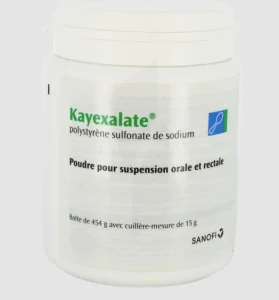
Kayexalate 15g Powder
Global Shipping : Reliable Global Distribution Network
Express Delivery : Priority Shipping for Every Order
Secure Payments : Trusted Payment Protection System
 Disclaimer

Secure Handling
24/7 Worldwide Support

Global Access
Worldwide Access to Health

Cold-Chain Expert
Excellence in Cold-Chain

Trusted Supply
Certified Medical Supply
Indications & Clinical Uses
- Kayexalate, the original brand of sodium polystyrene sulfonate powder, is DISCONTINUED in the United States: Drugs@FDA records application NDA 011287 (sponsor Concordia) with a marketing status of 'Discontinued', and no Kayexalate-branded label appears on DailyMed, so the information below comes from current US prescribing information for generic sodium polystyrene sulfonate powder for oral or rectal suspension.
- This is a manufacturer discontinuation, not a safety withdrawal or a revoked approval.
- Sodium polystyrene sulfonate is a cation-exchange resin that swaps sodium for potassium in the bowel, removing potassium in the stool at a rate of roughly 1 mEq of potassium per gram of resin.
- It is indicated for the treatment of high blood potassium (hyperkalaemia) in adults.
- It must NOT be used as emergency treatment for life-threatening hyperkalaemia, because it acts too slowly.
- The usual oral dose is 15 g, one to four times daily.
Side Effects
- The commonest effects are gut-related: loss of appetite, constipation, diarrhoea, nausea and vomiting.
- More serious reported reactions include faecal impaction, gastrointestinal concretions (bezoars), ischaemic colitis and intestinal necrosis, which has sometimes been fatal.
- Current US labels for sodium polystyrene sulfonate carry NO boxed warning, but they do carry a prominent warning about intestinal necrosis and state that concomitant administration of SORBITOL IS NOT RECOMMENDED, because the combination has been linked to these severe bowel injuries.
- Severe hypokalaemia (potassium falling too low) can occur, and the resin also binds magnesium and calcium, so low magnesium and low calcium are possible.
- Seek urgent medical help for severe abdominal pain, a swollen abdomen, vomiting, bloody stools, no bowel movement, or marked muscle weakness, cramps or an irregular heartbeat.
Precautions & Warnings
- Do not give sodium polystyrene sulfonate with sorbitol.
- Separate it from ALL other medicines taken by mouth: take other oral medicines at least 3 hours before or 3 hours after the resin, and allow 6 hours if you have gastroparesis or another condition that slows stomach emptying, because the resin binds other drugs and can stop them working.
- Serum potassium must be monitored during treatment, and magnesium and calcium should also be checked; treatment stops when potassium falls to the target range.
- The resin is avoided in people with obstructive bowel disease, reduced gut motility, after surgery, and in newborns, and is used with caution in those at risk of constipation or impaction.
- Each gram delivers sodium, so caution is needed in heart failure, severe hypertension or marked oedema.
- Store the powder at 20°C to 25°C, and prepare each dose fresh.
Avoid Interactions
- Because it is a binding resin, sodium polystyrene sulfonate reduces the absorption and therefore the efficacy of many oral medicines taken at the same time - this includes levothyroxine and lithium among others - which is why every other oral medicine must be separated by at least 3 hours, or 6 hours in gastroparesis.
- Antacids and laxatives containing magnesium or calcium, such as magnesium hydroxide or calcium carbonate, can bind to the resin, reduce its potassium-lowering effect and cause metabolic alkalosis, so they should be avoided.
- Sorbitol, whether given with the resin or in a sorbitol-containing preparation, increases the risk of intestinal necrosis and is not recommended.
- Digoxin toxicity may be worsened if potassium falls too far.
- Tell your healthcare provider about every medicine, antacid, laxative and supplement you take.
References
Frequently Asked Questions
Kayexalate (sodium polystyrene sulfonate) treats high blood potassium in adults by exchanging sodium for potassium in the bowel, removing about 1 mEq of potassium per gram of resin. It works slowly and must never be used as emergency treatment for life-threatening hyperkalaemia.
The usual oral dose of sodium polystyrene sulfonate is 15 g, which is four level teaspoons, taken one to four times daily as a freshly mixed suspension in water. A rectal dose of 30 g to 50 g every six hours is an alternative. Never mix it with sorbitol.
Common side effects of Kayexalate (sodium polystyrene sulfonate) are constipation, diarrhoea, nausea, vomiting and loss of appetite. Serious reported harms include faecal impaction, bowel concretions, ischaemic colitis and intestinal necrosis. Get urgent care for severe stomach pain, a swollen abdomen or bloody stools.
Avoid sorbitol completely with Kayexalate, because together they raise the risk of intestinal necrosis. Avoid magnesium- or calcium-containing antacids and laxatives, which reduce its effect and can cause alkalosis. Separate every other oral medicine by at least 3 hours, or 6 hours with gastroparesis.
The Kayexalate brand itself is discontinued in the United States: Drugs@FDA lists NDA 011287 as discontinued and no Kayexalate label appears on DailyMed. This was a commercial discontinuation, not a safety withdrawal. Generic sodium polystyrene sulfonate powder remains available.
Yes. Potassium must be checked during Kayexalate treatment, because severe low potassium can develop. Sodium polystyrene sulfonate also binds magnesium and calcium, so those levels are monitored too. Treatment stops once potassium reaches the target range.

Trusted & Reliable – Your Partner in Global Distribution.
We provide comprehensive lines of pharmaceutical products to support all your healthcare distribution needs.


