

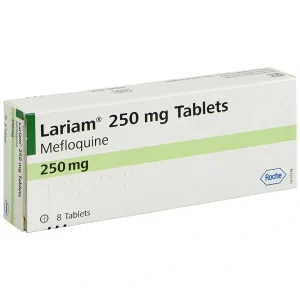
TM Owner Roche
Lariam 250mg Tablet
Global Shipping : Reliable Global Distribution Network
Express Delivery : Priority Shipping for Every Order
Secure Payments : Trusted Payment Protection System
 Disclaimer

Secure Handling
24/7 Worldwide Support

Global Access
Worldwide Access to Health

Cold-Chain Expert
Excellence in Cold-Chain

Trusted Supply
Certified Medical Supply
Indications & Clinical Uses
- Lariam 250 mg tablets contain mefloquine hydrochloride 250 mg, equivalent to 228 mg of mefloquine base.
- Mefloquine is a quinoline-methanol antimalarial.
- It is used to treat mild to moderate acute malaria caused by mefloquine-susceptible Plasmodium falciparum, including chloroquine-resistant strains, or by P. vivax, and to prevent malaria caused by P. falciparum and P. vivax in travellers, including in chloroquine-resistant areas.
- It does not prevent later relapses of P. vivax or P. ovale malaria, so an 8-aminoquinoline such as primaquine is needed as well.
- No Lariam-branded product is listed among the US labels on DailyMed, where 250 mg mefloquine tablets are supplied as generics by Teva and Chartwell RX; brand availability varies by country.
- International guidance now places mefloquine as a later-line option because of its neuropsychiatric risks.
Side Effects
- Mefloquine carries a BOXED WARNING: it may cause neuropsychiatric adverse reactions that can persist after the medicine has been stopped.
- These include anxiety, paranoia, depression, hallucinations, psychotic behaviour, confusion, restlessness, unusual or vivid dreams and, rarely, suicidal thoughts, and they can last for months or years and in some people become permanent.
- Dizziness, vertigo, ringing in the ears and loss of balance may also occur and have likewise been permanent in some people.
- The most common side effects are nausea, vomiting, diarrhoea, abdominal pain, dizziness and headache.
- Heart conduction changes have been reported.
- If you develop anxiety, depression, restlessness or confusion while taking Lariam for prevention, stop it and contact a healthcare provider at once, because these may be early signs of a more serious reaction and an alternative antimalarial should be used.
Precautions & Warnings
- Lariam must not be used by anyone allergic to mefloquine, quinine or quinidine, or by anyone with active depression, a recent history of depression, generalised anxiety disorder, psychosis, schizophrenia, another major psychiatric disorder, or a history of convulsions.
- For prevention, one 250 mg tablet is taken weekly on the same day each week, starting at least one week before travel and continuing for four weeks after leaving the malarial area.
- Treatment doses are taken with food and a full glass of water (about 240 mL).
- Because dizziness, loss of balance and other nervous system effects can occur and may last a long time, do not drive, operate machinery or scuba dive until you know how Lariam affects you.
- Use with caution in cardiac conduction disorders and in liver impairment.
- Store at 20°C to 25°C, out of reach of children.
Avoid Interactions
- Tell your healthcare provider about every medicine and supplement you take.
- The risk of serious heart rhythm problems is increased by halofantrine, which must never be taken with mefloquine or within 15 weeks of stopping it, and by ketoconazole, which should be avoided during treatment and for 15 weeks afterwards.
- Quinine, quinidine and chloroquine raise the risk of abnormal heart rhythms and convulsions; if quinine is given for treatment, mefloquine should be separated from it by at least 12 hours.
- Other QT-prolonging medicines, beta-blockers, calcium channel blockers and antiarrhythmics need caution.
- Mefloquine's effect may be reduced by anticonvulsants such as valproate, carbamazepine, phenobarbital and phenytoin, and their own blood levels may fall as well.
- Finish a live oral typhoid vaccine course at least three days before the first mefloquine dose, and avoid alcohol.
References
Frequently Asked Questions
Lariam 250 mg contains mefloquine and is used to prevent malaria in travellers and to treat mild to moderate malaria caused by mefloquine-susceptible P. falciparum or P. vivax, including chloroquine-resistant strains. It does not stop later relapses of P. vivax or P. ovale, which need a second medicine.
For prevention, Lariam (mefloquine) is one 250 mg tablet once a week on the same day, starting a week before travel and continuing four weeks after you leave the malaria area. Take it with food and a full glass of water. Treatment courses use a much larger single dose.
Common side effects of Lariam (mefloquine) are nausea, vomiting, diarrhoea, abdominal pain, dizziness and headache. Lariam carries a boxed warning for neuropsychiatric reactions, including anxiety, paranoia, depression, hallucinations, vivid dreams and rarely suicidal thoughts, which can persist after the medicine is stopped.
Never take halofantrine with Lariam or within 15 weeks of stopping it, and avoid ketoconazole over the same period, because of dangerous heart rhythms. Avoid quinine, quinidine and chloroquine, which raise the seizure and arrhythmia risk. Avoid alcohol, driving and scuba diving until you know how mefloquine affects you.
Lariam (mefloquine) must not be taken by anyone with active or recent depression, generalised anxiety disorder, psychosis, schizophrenia, another major psychiatric illness, or a history of seizures. It is also contraindicated in people allergic to mefloquine, quinine or quinidine. Tell your provider about any past mental health problem.
Yes. Lariam's boxed warning states that mefloquine can cause neuropsychiatric reactions that persist after the drug is stopped, sometimes for months or years. Dizziness, vertigo, tinnitus and loss of balance have also become permanent in some people. Stop Lariam and seek advice at the first psychiatric symptom.

Trusted & Reliable – Your Partner in Global Distribution.
We provide comprehensive lines of pharmaceutical products to support all your healthcare distribution needs.


