

TM Owner Roche / Genentech
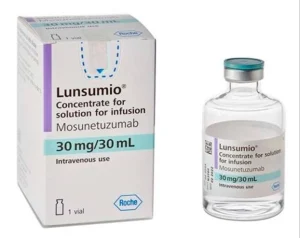
Lunsumio 30mg/30mL Injection
Global Shipping : Reliable Global Distribution Network
Express Delivery : Priority Shipping for Every Order
Secure Payments : Trusted Payment Protection System
 Disclaimer

Secure Handling
24/7 Worldwide Support

Global Access
Worldwide Access to Health

Cold-Chain Expert
Excellence in Cold-Chain

Trusted Supply
Certified Medical Supply
Indications & Clinical Uses
- Lunsumio 30 mg/30 mL vials contain mosunetuzumab, a bispecific antibody that binds CD20 on lymphoma cells and CD3 on the patient's own T cells, bringing them together so the immune system attacks the cancer.
- Lunsumio is indicated as a single agent for adults with relapsed or refractory follicular lymphoma who have already received at least two lines of systemic therapy.
- It holds accelerated approval in the United States from Genentech and a conditional marketing authorisation in the European Union, granted on 3 June 2022 to Roche Registration GmbH, with continued approval dependent on confirmatory trials.
- Lunsumio is given only in a hospital or specialist centre able to manage severe reactions.
- Important safety point: Lunsumio given as an intravenous infusion and LUNSUMIO VELO given as a subcutaneous injection are different presentations with different doses and routes, and the label warns specifically about medication errors between them; they must never be swapped.
Side Effects
- Lunsumio carries a BOXED WARNING for cytokine release syndrome, which can be serious or life-threatening.
- Cytokine release syndrome occurred in 44 percent of patients and can cause fever, chills, a fast heartbeat, low blood pressure, breathlessness and confusion, most often around the step-up doses in cycle 1.
- Other common reactions affecting at least 20 percent of patients are tiredness in 42 percent, rash in 39 percent, headache in 32 percent and fever in 29 percent; low white cell counts and upper respiratory infections are also frequent.
- Serious risks include neurological toxicity such as confusion, tremor or difficulty speaking and writing, severe infections, haemophagocytic lymphohistiocytosis, low blood counts and tumour flare.
- Seek urgent medical help for fever, shivering, dizziness, breathlessness, severe headache, confusion or seizures at any time during treatment and for several weeks afterwards.
Precautions & Warnings
- Lunsumio is for intravenous infusion only, through a dedicated line and without an in-line filter.
- Cycle 1 uses step-up dosing to reduce cytokine release syndrome: 1 mg on day 1, 2 mg on day 8 and 60 mg on day 15, each infused over at least 4 hours; 60 mg is then given on day 1 of cycle 2 and 30 mg every 3 weeks after that.
- Before every dose in cycles 1 and 2 all patients receive premedication with intravenous dexamethasone at least an hour beforehand plus an antihistamine and paracetamol at least 30 minutes beforehand.
- Patients are monitored closely after each infusion, and admission may be needed.
- Tell your team about any active infection before a dose.
- Lunsumio may harm an unborn baby, so women who can become pregnant should use effective contraception during treatment and for 3 months after the last dose.
- Vials are stored at 2°C to 8°C in the original carton, protected from light.
Avoid Interactions
- No formal drug interaction studies are listed for Lunsumio, so there is no set list of medicines that raise or lower its blood levels.
- The practical cautions are immunological.
- Corticosteroids and other immunosuppressants given for other conditions may add to the infection risk, although dexamethasone is deliberately used as premedication to REDUCE cytokine release syndrome.
- Live and live-attenuated vaccines should be avoided before, during and for a period after treatment because the immune response to them may be inadequate and they can cause infection; discuss any vaccination with your haematology team first.
- Lunsumio must not be mixed with other medicines in the same infusion line, must be diluted only with 0.9% sodium chloride as directed, and must never be given as an intravenous push or bolus.
- Tell your team about every prescription medicine, over-the-counter product, herbal remedy and supplement you take.
References
Frequently Asked Questions
Lunsumio (mosunetuzumab) treats adults with follicular lymphoma that has come back or stopped responding after at least two earlier systemic treatments. It is a bispecific antibody that links CD20 on lymphoma cells to CD3 on your own T cells so the immune system attacks the cancer.
Lunsumio (mosunetuzumab) is given by drip into a vein over at least 4 hours. Cycle 1 uses step-up dosing: 1 mg on day 1, 2 mg on day 8 and 60 mg on day 15. Then 60 mg on cycle 2 day 1, and 30 mg every 3 weeks.
Cytokine release syndrome affects 44 percent of people given Lunsumio (mosunetuzumab), causing fever, chills, fast heartbeat and low blood pressure. Tiredness affects 42 percent, rash 39 percent, headache 32 percent and fever 29 percent. Low white cells and infections are also common.
Lunsumio (mosunetuzumab) carries a boxed warning for cytokine release syndrome, which can be serious or life-threatening. It happens most often around the step-up doses in cycle 1. Seek urgent help for fever, chills, dizziness, breathlessness or confusion during treatment or in the weeks afterwards.
Before each Lunsumio (mosunetuzumab) dose in cycles 1 and 2 you get intravenous dexamethasone at least an hour ahead, plus an antihistamine and paracetamol 30 minutes ahead. The infusion runs over at least 4 hours through a dedicated line, and staff monitor you closely afterwards.
No. Lunsumio (mosunetuzumab) may harm an unborn baby. Women who can become pregnant should use effective contraception during treatment and for 3 months after the last dose. Tell your haematology team straight away if you become pregnant or are breastfeeding while receiving Lunsumio.

Trusted & Reliable – Your Partner in Global Distribution.
We provide comprehensive lines of pharmaceutical products to support all your healthcare distribution needs.


