

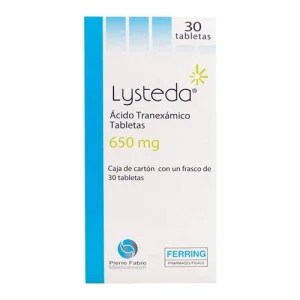
TM Owner Ferring Pharmaceuticals
Lysteda 650mg Tablet
Global Shipping : Reliable Global Distribution Network
Express Delivery : Priority Shipping for Every Order
Secure Payments : Trusted Payment Protection System
 Disclaimer

Secure Handling
24/7 Worldwide Support

Global Access
Worldwide Access to Health

Cold-Chain Expert
Excellence in Cold-Chain

Trusted Supply
Certified Medical Supply
Indications & Clinical Uses
- Lysteda 650 mg tablets contain tranexamic acid, an antifibrinolytic medicine made by Ferring Pharmaceuticals (headquartered in Switzerland), that helps blood clots already forming during a period stay stable rather than breaking down too quickly.
- It is approved for the treatment of cyclic heavy menstrual bleeding in females of reproductive age, taken only on the days of bleeding rather than continuously.
- Lysteda is not a contraceptive, does not treat cramping or other period symptoms such as PMS, and works differently from hormonal treatments for heavy periods.
- The same active ingredient, tranexamic acid, is also used in injectable form and in other tablet strengths for different situations, such as controlling bleeding during surgery; Lysteda tablets are specifically formulated and dosed for menstrual bleeding and are not interchangeable with those other forms without medical advice.
- Lysteda is a prescription tablet taken by the patient at home.
Side Effects
- The most commonly reported side effects of Lysteda in trials were headache, sinus and nasal symptoms, back pain, abdominal pain, muscle or joint pain, migraine, and tiredness; Lysteda has no boxed warning on its current US label.
- More serious but less common risks include blood clots in the legs, lungs, or elsewhere in the body, and, rarely, changes in vision, including retinal artery or vein blockage.
- Because tranexamic acid reduces the breakdown of clots throughout the body, not just in the uterus, it must not be combined with combined hormonal contraceptives, which independently raise clotting risk.
- Seek urgent medical attention for sudden leg pain or swelling, chest pain, breathlessness, sudden vision changes or loss, sudden severe headache, or sudden weakness or numbness on one side of the body, since these can be signs of a blood clot or stroke.
Precautions & Warnings
- Lysteda is contraindicated in people with active blood clots or a history of thrombosis, in those at higher risk of clots due to conditions such as certain thrombogenic heart problems, and in people taking combined hormonal contraceptives, because the clotting risk from both together is too high.
- Kidney function should be checked before starting, since the dose is reduced in kidney impairment based on serum creatinine level; people with significant kidney disease need a lower dose to avoid drug buildup.
- Lysteda is taken only during the days of menstrual bleeding, for a maximum of 5 days each cycle, and is not intended for continuous daily use.
- Tell your healthcare provider if you have a history of eye problems, since rare cases of retinal vein or artery blockage have been reported, and report any sudden vision changes immediately.
- Safety in pregnancy and breastfeeding has not been well established; discuss alternatives with your healthcare provider if either applies to you.
Avoid Interactions
- Tell your healthcare provider and pharmacist about all your medicines and supplements.
- Combined hormonal contraceptives, containing both estrogen and a progestin, must not be used with Lysteda, because both increase the risk of blood clots and the combination raises this risk further.
- Tissue plasminogen activators and other clot-dissolving medicines may work less well when combined with Lysteda, since it works against the same clot-breakdown process these drugs rely on.
- Lysteda is not recommended with factor IX complex concentrates or anti-inhibitor coagulant concentrates, because of an increased clotting risk when these are combined.
- In people being treated for a certain type of leukemia with all-trans retinoic acid, tranexamic acid is also not recommended, due to a similar increased clotting concern.
- Always confirm any new prescription or over-the-counter medicine with your healthcare provider before starting it alongside Lysteda.
References
Frequently Asked Questions
Lysteda (tranexamic acid) treats heavy menstrual bleeding in women who have periods. It helps stabilize blood clots that form naturally during your period so bleeding slows down. Lysteda does not treat period pain or PMS and is not a form of contraception.
Lysteda 650 mg tablets are usually taken as two tablets by mouth three times a day (3,900 mg total) for up to 5 days, only during the days you are bleeding. Swallow tablets whole; do not chew or crush them. Your dose may be lower with kidney problems.
Common side effects include headache, sinus symptoms, back pain, stomach pain, and tiredness. More seriously, Lysteda can raise the risk of blood clots and, rarely, sudden vision changes. Get urgent help for leg swelling, chest pain, breathlessness, or sudden vision loss.
Do not take Lysteda with combined hormonal contraceptives, such as the combined pill, since both raise clotting risk and together this risk is higher. Avoid Lysteda if you have a history of blood clots. Tell your healthcare provider about any clot-dissolving medicines you take.
Yes, but at a lower dose. If your serum creatinine is raised, your healthcare provider reduces your Lysteda dose, from three times daily down to as little as one 650 mg tablet once daily in more significant kidney impairment, to avoid the drug building up in your body.
Lysteda is taken only during your period, for up to 5 days each cycle, not continuously. Safety in pregnancy and breastfeeding has not been well established, so tell your healthcare provider if either applies to you, so they can discuss suitable alternatives.

Trusted & Reliable – Your Partner in Global Distribution.
We provide comprehensive lines of pharmaceutical products to support all your healthcare distribution needs.


