

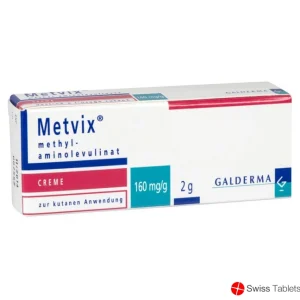
TM Owner Galderma
Metvix 160mg/g Cream
Global Shipping : Reliable Global Distribution Network
Express Delivery : Priority Shipping for Every Order
Secure Payments : Trusted Payment Protection System
 Disclaimer

Secure Handling
24/7 Worldwide Support

Global Access
Worldwide Access to Health

Cold-Chain Expert
Excellence in Cold-Chain

Trusted Supply
Certified Medical Supply
Indications & Clinical Uses
- Metvix 160 mg/g cream contains methyl aminolevulinate, a substance that makes abnormal skin cells sensitive to light as part of photodynamic therapy (PDT).
- It is approved in the European Union for thin, non-hyperkeratotic actinic keratoses on the face and scalp, for superficial basal cell carcinoma when other treatments such as surgery are unsuitable, and for Bowen's disease when surgical excision is not appropriate.
- Treatment is only for adults aged 18 and over and must be carried out by a trained healthcare professional using red light or, for actinic keratosis, daylight exposure; it is not a cream for the patient to use alone at home.
- In the United States, the equivalent product is marketed as Metvixia (16.8%) for actinic keratosis with red light therapy only.
Side Effects
- After Metvix is applied and the treatment area is exposed to light, most people feel a burning or stinging sensation at the treated site; this is the most frequently reported reaction and usually settles the same day, especially with daylight-based treatment, which causes noticeably less pain than red-light therapy.
- Redness, swelling, crusting, peeling, and small blisters are also common as the skin reacts and heals over one to two weeks.
- Less common reactions include skin infection at the site, eye irritation if the cream or light strays near the eyes, dizziness, and nausea.
- There is no boxed warning on the label.
- Seek prompt medical attention for signs of a severe allergic reaction, such as widespread rash, facial swelling, or breathing difficulty.
Precautions & Warnings
- Metvix must not be used by anyone with porphyria, a known allergy to methyl aminolevulinate or to peanut or soya-derived ingredients in the cream, or a morpheaform (sclerosing) type of basal cell carcinoma, which does not respond reliably to this treatment.
- It is not recommended during pregnancy, and breastfeeding should be paused during treatment and for a short period afterward on the healthcare provider's advice.
- The treated skin must be protected from sunlight and strong indoor light for at least 48 hours after treatment to prevent an exaggerated reaction, and patients on immunosuppressant medicines, such as transplant recipients, need closer monitoring because they carry a higher skin cancer risk.
- Metvix must be given only in a clinical setting by a trained professional - it is never a self-administered home treatment.
Avoid Interactions
- No formal drug interaction studies have been carried out with Metvix, so tell the healthcare provider about all medicines being used, particularly other treatments applied to the skin or any photosensitising medicines (drugs that increase sensitivity to light, such as certain antibiotics or retinoids), since combining these with photodynamic therapy could increase the risk of skin irritation or burning.
- Avoid applying other topical creams, sunscreens, or cosmetics to the treatment area until instructed by the healthcare provider, and avoid deliberate sun exposure or tanning beds on the treated skin in the days around treatment.
- Immunosuppressant medicines do not prevent Metvix from being used but mean the skin should be monitored more closely for new lesions.
References
Frequently Asked Questions
Metvix (methyl aminolevulinate) cream treats thin actinic keratosis patches on the face and scalp, superficial basal cell skin cancer when surgery isn't suitable, and Bowen's disease. It works with photodynamic therapy, using red light or daylight to activate the cream and destroy abnormal cells. It's for adults only.
A healthcare professional applies Metvix cream directly to the lesion in clinic, covers it, then exposes the area to red light or natural daylight for a set time. You don't apply it yourself at home. The treated skin is then protected from light for at least 48 hours.
Metvix commonly causes burning, stinging, redness, and crusting at the treated site during and after light exposure; daylight therapy causes less pain than red-light. These effects usually settle within one to two weeks. Tell your healthcare provider about swelling, infection, or a rash that doesn't improve.
Avoid sun and strong indoor light on the treated skin for at least 48 hours after Metvix therapy, since it stays light-sensitive. Don't use Metvix if you have porphyria or are allergic to peanut or soya products. Tell your healthcare provider about any other skin treatments you're using.
Metvix is not recommended during pregnancy, as safety hasn't been established. Breastfeeding should be paused during treatment and briefly afterward on your healthcare provider's advice. Tell your healthcare team if you're pregnant, breastfeeding, or planning pregnancy before starting Metvix photodynamic therapy.
Most people need one or two Metvix photodynamic therapy sessions, roughly a week apart, with the area reassessed around three months later. Your healthcare provider will confirm the exact schedule based on the lesion type and how your skin responds.

Trusted & Reliable – Your Partner in Global Distribution.
We provide comprehensive lines of pharmaceutical products to support all your healthcare distribution needs.


