

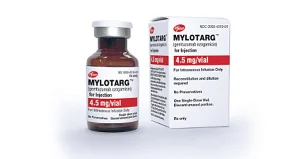
TM Owner Pfizer
Mylotarg 4.5mg Injection
Global Shipping : Reliable Global Distribution Network
Express Delivery : Priority Shipping for Every Order
Secure Payments : Trusted Payment Protection System
 Disclaimer

Secure Handling
24/7 Worldwide Support

Global Access
Worldwide Access to Health

Cold-Chain Expert
Excellence in Cold-Chain

Trusted Supply
Certified Medical Supply
Indications & Clinical Uses
- Mylotarg (gemtuzumab ozogamicin) is an antibody-drug conjugate that targets the CD33 protein found on most acute myeloid leukaemia (AML) cells, delivering a cytotoxic agent directly to the cancer cell.
- It is approved for newly diagnosed CD33-positive AML in adults and children aged 1 month and older, given either alone or combined with standard chemotherapy, and for relapsed or refractory CD33-positive AML in adults and children aged 2 years and older.
- Mylotarg is given only by intravenous infusion in a hospital or specialist oncology setting under the supervision of a physician experienced in leukaemia treatment; it is never for self-administration.
- Each single-dose vial is reconstituted and diluted by trained staff immediately before the scheduled infusion.
Side Effects
- Mylotarg carries a boxed warning for hepatotoxicity, including severe or fatal veno-occlusive disease (VOD) of the liver, which can occur during treatment or after a subsequent stem cell transplant; liver function and signs of VOD, such as rapid weight gain, right upper abdominal pain, and jaundice, are monitored closely.
- Very common side effects, affecting more than 1 in 10 patients, include bleeding, fever, infection, nausea, vomiting, constipation, mouth sores, headache, raised liver enzymes, rash, and low blood counts leading to infection or bleeding risk.
- Infusion-related reactions, including fever, chills, low blood pressure and breathing difficulty, can occur during or shortly after the infusion, so premedication is given and patients are monitored for at least an hour afterward.
- Seek urgent medical attention for yellowing of the skin or eyes, severe abdominal pain, unusual bruising, or signs of infection such as fever.
Precautions & Warnings
- Mylotarg must be given only by intravenous infusion; it must never be given as a rapid push or bolus and must never be given intrathecally.
- Liver function tests are checked before each dose, and treatment is withheld or discontinued if signs of hepatotoxicity or veno-occlusive disease appear, particularly in patients who later undergo haematopoietic stem cell transplantation, where the risk of VOD is higher.
- Severe or fatal infusion reactions and hypersensitivity, including anaphylaxis, can occur, so premedication with a corticosteroid, antihistamine and antipyretic is given before each dose.
- Mylotarg can cause severe and prolonged low blood counts, so blood counts are monitored regularly and dose interruptions are common.
- It may cause QT interval prolongation, so electrolytes and cardiac history should be reviewed.
- Mylotarg can harm a developing fetus; effective contraception is required during treatment and for a defined period afterward for both women and men, and it should not be used while breastfeeding.
Avoid Interactions
- No formal drug interaction studies have been conducted with Mylotarg, and laboratory studies suggest a low risk of interaction through the major CYP450 liver enzymes or common drug transporters at the doses used clinically.
- Even so, patients should tell the treatment team about every other medicine, including over-the-counter drugs, herbal products and supplements, since combination chemotherapy regimens carry their own interaction risks that the oncology team manages directly.
- Because Mylotarg can prolong the QT interval, other medicines that also affect heart rhythm should be reviewed by the treating physician before use.
- Mylotarg must not be mixed or co-administered with other medicines in the same infusion line; it is prepared and given as a dedicated intravenous infusion only, through a low-protein-binding 0.2-micron in-line filter.
References
Frequently Asked Questions
Mylotarg (gemtuzumab ozogamicin) treats CD33-positive acute myeloid leukaemia (AML). It is used for newly diagnosed AML in adults and children from 1 month old, and for relapsed or refractory AML in adults and children from 2 years old, given by a cancer specialist.
Mylotarg is given only as an intravenous infusion in a hospital or specialist cancer unit, never at home. Each infusion runs over about 2 hours, and you are monitored for at least an hour afterward for reactions such as fever, chills or low blood pressure.
Mylotarg commonly causes bleeding, fever, infection, nausea and low blood counts. It carries a boxed warning for severe liver damage, including veno-occlusive disease. Tell your care team at once about yellowing skin or eyes, severe stomach pain, or unusual bruising.
Your care team checks liver function before every Mylotarg dose and watches closely for signs of liver damage, such as sudden weight gain or abdominal pain. Blood counts are monitored regularly too, since Mylotarg can cause prolonged low blood cell counts.
You receive medicines beforehand to reduce reaction risk, then Mylotarg is infused into a vein over about 2 hours. Staff watch for fever, chills, low blood pressure or breathing trouble during and for at least an hour after the infusion ends.
No. Mylotarg can harm an unborn baby, so effective contraception is required during treatment and for a set time afterward for both women and men. Tell your care team right away if you are pregnant, planning a pregnancy, or breastfeeding.

Trusted & Reliable – Your Partner in Global Distribution.
We provide comprehensive lines of pharmaceutical products to support all your healthcare distribution needs.


