

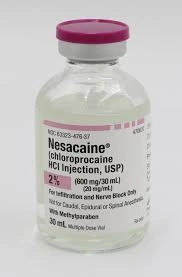
TM Owner Fresenius Kabi
Nesacaine 2% Injection
Global Shipping : Reliable Global Distribution Network
Express Delivery : Priority Shipping for Every Order
Secure Payments : Trusted Payment Protection System
 Disclaimer

Secure Handling
24/7 Worldwide Support

Global Access
Worldwide Access to Health

Cold-Chain Expert
Excellence in Cold-Chain

Trusted Supply
Certified Medical Supply
Indications & Clinical Uses
- Nesacaine 2% is chloroprocaine hydrochloride injection, USP, an ester-type local anesthetic.
- It is given only by trained healthcare professionals and is not for self-use.
- The methylparaben-preserved Nesacaine (for example the 2% 600 mg per 30 mL multi-dose vial) is indicated for producing local anesthesia by infiltration and peripheral nerve block.
- It is not approved for lumbar or caudal epidural anesthesia or for subarachnoid (spinal) injection.
- A separate preservative-free product, Nesacaine-MPF (2% and 3%), is the version that also supports epidural blocks, so the two must not be mixed up.
- Nesacaine is a Fresenius Kabi USA product; this information comes from the US labels.
Side Effects
- The main effects of chloroprocaine follow the nervous system and heart: restlessness, excitation or drowsiness, tremors and convulsions, and heart effects such as low blood pressure, slow heart rate and arrhythmias.
- Allergic reactions are rare, and methemoglobinemia (reduced oxygen-carrying capacity of the blood) can occur.
- Accidental injection into the spinal fluid can cause serious neurologic complications, and chondrolysis (cartilage loss) has been reported with continuous intra-articular infusion of local anesthetics.
- The label carries no boxed warning.
- Because the medicine is given by staff who monitor you, tell them straight away if you feel light-headed, anxious, numb around the mouth or unwell during or after the injection.
Precautions & Warnings
- Nesacaine must be used only by clinicians trained in managing local anesthetic toxicity, with resuscitation equipment and drugs immediately available.
- It is contraindicated in patients with hypersensitivity to PABA ester-type local anesthetics.
- The methylparaben-containing form must not be used for epidural or spinal anesthesia; use the preservative-free Nesacaine-MPF where the label allows epidural use.
- Chondrolysis has been reported with intra-articular infusions of local anesthetics.
- Use only when clearly needed in pregnancy (older label category C), although the label states this does not preclude obstetrical anesthesia at term.
- Store at 20°C to 25°C, protected from light and freezing.
Avoid Interactions
- Medicines that can increase the risk of harm: monoamine oxidase inhibitors (MAOIs), tricyclic antidepressants and phenothiazines may cause severe hypertension or hypotension, and certain medicines that cause methemoglobinemia add to that risk.
- Medicines whose effect is reduced: chloroprocaine's metabolite inhibits the action of sulfonamide antibiotics, so they may be less effective.
- Because the label lists these interactions, the clinician giving the injection needs to know about all prescription, over-the-counter and herbal medicines you take, and about any past allergy to local anesthetics, especially PABA-related or ester-type products, before the dose is chosen.
References
Frequently Asked Questions
Nesacaine 2% (chloroprocaine hydrochloride) is a local anesthetic that numbs an area for infiltration and peripheral nerve block. It is given by a trained healthcare professional, never for self-use. The methylparaben-preserved form is not approved for epidural or spinal use, so a different product is used for those.
Nesacaine (chloroprocaine) is injected into or around the tissue or nerve by a trained healthcare professional, as infiltration or a peripheral nerve block. You cannot use it yourself. Staff must have resuscitation equipment immediately available while it is given. The dose depends on the procedure and the area.
Nesacaine (chloroprocaine) can cause restlessness, tremors, convulsions, low blood pressure, slow heart rate and arrhythmias. Rare allergic reactions and methemoglobinemia have been reported. The label has no boxed warning. Tell staff at once if you feel dizzy, anxious or unwell during or after the injection.
Do not have Nesacaine (chloroprocaine) if you are allergic to PABA ester-type local anesthetics. Tell staff if you take MAOIs, tricyclic antidepressants or phenothiazines, which may cause severe blood pressure changes. Its metabolite can weaken sulfonamide antibiotics. The preserved form must not be used for epidural or spinal blocks.
Nesacaine (chloroprocaine) must be given by clinicians trained in managing local anesthetic toxicity, with resuscitation equipment and drugs immediately available. Staff watch for nervous system and heart effects such as tremors, convulsions, low blood pressure and slow heart rate while and after it is injected.
Nesacaine contains a methylparaben preservative and is for infiltration and peripheral nerve block only. Nesacaine-MPF (chloroprocaine) is preservative-free and is also used for epidural blocks. The preserved product must not be used for epidural or spinal anesthesia. Your clinician selects the correct product.

Trusted & Reliable – Your Partner in Global Distribution.
We provide comprehensive lines of pharmaceutical products to support all your healthcare distribution needs.


