

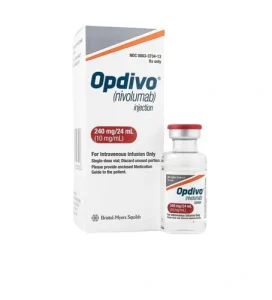
TM Owner Bristol Myers Squibb
Nivolumab IV 240mg/24ml Vial
Global Shipping : Reliable Global Distribution Network
Express Delivery : Priority Shipping for Every Order
Secure Payments : Trusted Payment Protection System
 Disclaimer

Secure Handling
24/7 Worldwide Support

Global Access
Worldwide Access to Health

Cold-Chain Expert
Excellence in Cold-Chain

Trusted Supply
Certified Medical Supply
Indications & Clinical Uses
- Nivolumab IV 240 mg/24 mL (10 mg/mL single-dose vial) is marketed as Opdivo.
- Nivolumab is a PD-1 blocking antibody that helps the immune system attack cancer cells.
- It is given into a vein in a hospital or clinic by a cancer specialist.
- The label lists melanoma (adults and children aged 12 and over), non-small cell lung cancer, malignant pleural mesothelioma, renal cell carcinoma, classical Hodgkin lymphoma, head and neck squamous cell carcinoma, urothelial carcinoma, MSI-H/dMMR colorectal cancer, hepatocellular carcinoma, and oesophageal and gastric cancers, alone or with other treatments.
- Doses range from 240 mg every 2 weeks to 360 mg every 3 weeks or 480 mg every 4 weeks, infused over 30 minutes through a low-protein-binding filter.
- Do not confuse with subcutaneous Opdivo Qvantig, which has different dosing and must not be given into a vein.
Side Effects
- In people taking nivolumab alone, the most common (20% or more) side effects are tiredness, rash, muscle and bone pain, itching, diarrhoea, nausea, weakness, cough, breathlessness, constipation and reduced appetite.
- Immune-mediated reactions may be serious and can affect any organ: pneumonitis (lung inflammation), colitis, hepatitis, endocrine problems such as thyroid disorders, skin reactions and nephritis (kidney inflammation).
- Infusion reactions can occur.
- Report new cough, chest pain, severe diarrhoea, jaundice, rash or unusual tiredness straight away.
- There is no boxed warning on the current US label.
Precautions & Warnings
- Nivolumab has no listed contraindications, but treatment may be paused or stopped for severe immune reactions, and infusions may be interrupted or slowed for infusion reactions.
- Liver, kidney and thyroid function are monitored.
- Fatal and other serious complications have occurred in people who had or later have an allogeneic stem cell transplant.
- Women who could become pregnant must use effective contraception during treatment and for at least 5 months after the last dose because of potential harm to a baby.
- Do not breastfeed.
- It may have a minor effect on driving because of tiredness.
- Unopened vials are stored at 2°C to 8°C, protected from light, and not frozen or shaken.
Avoid Interactions
- No formal drug interaction studies have been done because nivolumab is an antibody, not broken down by liver enzymes.
- Systemic corticosteroids are usually avoided at the start of treatment, although they are used to treat immune-related side effects.
- Do not give other medicines through the same intravenous line; separate bags and filters are used in combination treatment.
- Other treatments such as ipilimumab are combined only under specialist direction.
- Tell your healthcare provider about all prescription, non-prescription and herbal medicines you take.
References
Frequently Asked Questions
Nivolumab IV (Opdivo) is an immunotherapy that treats several cancers, including melanoma, lung cancer, kidney cancer, Hodgkin lymphoma, head and neck, bladder, colorectal, liver, oesophageal and gastric cancers, alone or with other treatments. Your cancer specialist decides if it suits you.
Opdivo (nivolumab) is given by intravenous infusion over 30 minutes, at 240 mg every 2 weeks, 360 mg every 3 weeks or 480 mg every 4 weeks, depending on your cancer and any combination treatment. A healthcare professional gives it.
Opdivo (nivolumab) commonly causes tiredness, rash, muscle and bone pain, itching, diarrhoea and nausea. It can also cause serious immune reactions in the lungs, bowel, liver, hormone glands, skin and kidneys. Report new cough, severe diarrhoea, jaundice or rash straight away.
Avoid pregnancy and breastfeeding on Opdivo (nivolumab). Use effective contraception during treatment and for 5 months after the last dose. Systemic steroids are usually avoided at the start. Nothing else should be given through the same intravenous line.
Opdivo (nivolumab) runs into a vein for 30 minutes through a low-protein-binding filter, in a hospital or clinic. Staff can slow or stop the infusion if you have an infusion reaction. Blood tests check your liver, kidney and thyroid during treatment.
No. Nivolumab IV (Opdivo) is an intravenous infusion, while Opdivo Qvantig is nivolumab with hyaluronidase given under the skin. Their dosing and administration instructions differ, and Opdivo Qvantig must not be given into a vein.

Trusted & Reliable – Your Partner in Global Distribution.
We provide comprehensive lines of pharmaceutical products to support all your healthcare distribution needs.


