

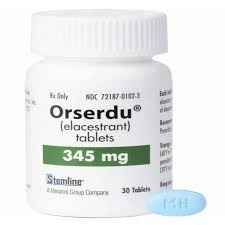
TM Owner Stemline Therapeutics (Menarini)
Orserdu 345mg Tablet
Global Shipping : Reliable Global Distribution Network
Express Delivery : Priority Shipping for Every Order
Secure Payments : Trusted Payment Protection System
 Disclaimer

Secure Handling
24/7 Worldwide Support

Global Access
Worldwide Access to Health

Cold-Chain Expert
Excellence in Cold-Chain

Trusted Supply
Certified Medical Supply
Indications & Clinical Uses
- Orserdu 345 mg tablets contain elacestrant, an oral selective oestrogen receptor degrader (SERD) and endocrine therapy for breast cancer.
- It is approved in the United States for postmenopausal women and adult men with oestrogen receptor (ER)-positive, HER2-negative, ESR1-mutated advanced or metastatic breast cancer whose disease has progressed on or after at least one prior line of endocrine-based therapy, including one that contained a CDK4/6 inhibitor.
- An FDA-approved companion diagnostic test is used to confirm the ESR1 mutation from a blood or tumour sample before treatment starts.
- Orserdu is taken as a single agent, not in combination with other anticancer therapy, and is prescribed and monitored by a cancer specialist.
- It is not authorised for use before this point in treatment or in patients without a confirmed ESR1 mutation.
Side Effects
- Very commonly reported effects include musculoskeletal pain, nausea, raised cholesterol and triglycerides, increased liver enzymes, tiredness, low haemoglobin, vomiting, low sodium, raised creatinine, reduced appetite, diarrhoea, headache, constipation, abdominal pain, hot flushes and indigestion.
- Orserdu has no boxed warning.
- Hypercholesterolaemia and hypertriglyceridaemia occur in roughly a quarter to a third of patients, so blood lipids are checked before and during treatment.
- Report any unusual bruising or bleeding, persistent nausea or vomiting, yellowing of the skin or eyes, or severe abdominal pain promptly, as these may signal liver or metabolic problems needing dose adjustment or a treatment pause.
Precautions & Warnings
- Orserdu can cause fetal harm, so women of childbearing potential must use effective non-hormonal contraception during treatment and for one week after the last dose, and men with partners of childbearing potential should use condoms; it must not be used in pregnancy.
- Cholesterol and triglyceride levels should be monitored before starting and periodically during treatment, with lipid-lowering therapy started if needed.
- Liver enzymes and kidney function are also checked periodically.
- Elacestrant exposure is higher in patients with moderate hepatic impairment, so a lower dose is used, and it has not been studied in severe hepatic or severe renal impairment.
- There is no specific driving restriction, but tiredness or dizziness should be taken into account before driving or using machinery.
- Breastfeeding is not recommended during treatment.
Avoid Interactions
- Orserdu is broken down mainly by the liver enzyme CYP3A4, so strong or moderate CYP3A4 inhibitors, such as certain antifungals (ketoconazole, itraconazole), macrolide antibiotics and grapefruit or grapefruit juice, can raise elacestrant levels and increase side effects, while strong or moderate CYP3A4 inducers, such as rifampicin, carbamazepine, phenytoin and St John's wort, can lower its levels and reduce effectiveness; both combinations should be avoided where possible.
- Elacestrant can also raise blood levels of P-glycoprotein and BCRP substrate drugs, such as digoxin and rosuvastatin, so doses of these may need adjusting.
- Patients should tell their healthcare provider and pharmacist about every prescription medicine, over-the-counter product, herbal remedy and supplement they take before and during treatment with Orserdu.
References
Frequently Asked Questions
Orserdu (elacestrant) treats ER-positive, HER2-negative, ESR1-mutated advanced or metastatic breast cancer in postmenopausal women and adult men. It is used after the cancer has progressed on at least one prior hormone-based therapy, including one with a CDK4/6 inhibitor.
Orserdu is taken as two 345 mg tablets by mouth once daily with food, swallowed whole at about the same time each day. It is used alone, not combined with other cancer treatments, and continued for as long as it is working.
Common effects include musculoskeletal pain, nausea, raised cholesterol and triglycerides, tiredness, and changes in liver blood tests. Tell your doctor about persistent vomiting, yellowing skin or eyes, or unusual bleeding, which need urgent review.
Avoid grapefruit, grapefruit juice, and strong CYP3A4 inhibitors or inducers such as certain antifungals, rifampicin, and St John's wort, as they change elacestrant levels. Effective non-hormonal contraception is required during treatment and for a week after.
Yes. An FDA-approved companion diagnostic test confirms the ESR1 gene mutation in blood or tumour tissue before Orserdu is prescribed, since it only works in this specific mutated cancer type. Your oncologist arranges this testing.
No. Orserdu can harm an unborn baby, so it must not be used in pregnancy, and effective non-hormonal contraception is required during treatment and for one week afterward. Breastfeeding is not recommended while taking Orserdu.

Trusted & Reliable – Your Partner in Global Distribution.
We provide comprehensive lines of pharmaceutical products to support all your healthcare distribution needs.


