

TM Owner GSK
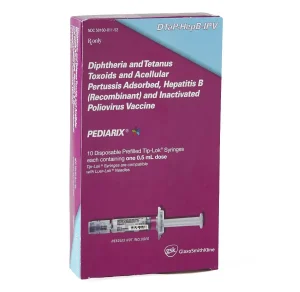
Pediarix 0.5mL Injection
Global Shipping : Reliable Global Distribution Network
Express Delivery : Priority Shipping for Every Order
Secure Payments : Trusted Payment Protection System
 Disclaimer

Secure Handling
24/7 Worldwide Support

Global Access
Worldwide Access to Health

Cold-Chain Expert
Excellence in Cold-Chain

Trusted Supply
Certified Medical Supply
Indications & Clinical Uses
- Pediarix is a combination vaccine that protects against diphtheria, tetanus, pertussis (whooping cough), hepatitis B, and poliomyelitis in a single 0.5 mL injection.
- It combines diphtheria and tetanus toxoids and acellular pertussis (DTaP) antigens, recombinant hepatitis B surface antigen, and inactivated poliovirus (IPV), manufactured by GSK.
- In the United States it is approved for infants from 6 weeks through 6 years of age (before the seventh birthday) whose mothers are hepatitis B surface antigen-negative, given as a three-dose primary series, typically at 2, 4 and 6 months.
- It is intended to replace the individual component vaccines for the doses in this schedule and is not used for booster doses later in childhood, which use separate age-appropriate vaccines.
- It is given by a healthcare provider only, by intramuscular injection, usually into the infant's thigh.
Side Effects
- Very common reactions, affecting 25% or more of infants after any dose, include fever of 100.4°F (38°C) or higher, pain, redness and swelling at the injection site, drowsiness, irritability/fussiness and loss of appetite.
- Fever tends to occur more often with Pediarix than when the same vaccines are given as separate injections.
- Less commonly, brief fainting (syncope) can occur around the time of injection, and apnoea (pauses in breathing) has been reported in infants born very prematurely, so monitoring for 48-72 hours after vaccination is advised in this group.
- There is no boxed warning on the current Pediarix label.
- Seek urgent medical attention for a high fever, unusual high-pitched crying, seizures, difficulty breathing, or any sign of a severe allergic reaction such as swelling of the face or throat, hives or breathing difficulty shortly after the injection.
Precautions & Warnings
- Pediarix must not be given to a child who has had a severe allergic reaction to a previous dose of Pediarix or any of its components (including latex from the vial stopper), or who developed encephalopathy within 7 days of a previous pertussis-containing vaccine with no other identifiable cause.
- It should not be given to children with a progressive neurologic disorder such as uncontrolled epilepsy until the condition is stabilised, and vaccination is generally postponed if the child has a moderate or severe acute illness with or without fever.
- Because vaccine components take time to induce protective immunity, infection with one of the targeted diseases can still occur in the days after vaccination.
- An antipyretic may be considered for infants at higher risk of fever-related seizures.
- As with any injectable vaccine, appropriate medical treatment for a rare anaphylactic reaction must be available.
- Store refrigerated at 2°C to 8°C; do not freeze, and discard if the vaccine has been frozen.
Avoid Interactions
- Pediarix can be given at the same visit as other routine childhood vaccines, such as pneumococcal conjugate, rotavirus and Haemophilus influenzae type b vaccines, provided each vaccine is given at a separate injection site; do not mix Pediarix with any other vaccine or medicine in the same syringe.
- Tell the healthcare provider about any recent tetanus-toxoid-containing vaccine, since Guillain-Barré syndrome has rarely been reported within 6 weeks of a prior tetanus vaccine, and about any immunosuppressive treatment, corticosteroid therapy, blood products, or immune globulin the child has received, as these can reduce the vaccine's effectiveness.
- Tell the provider about all medicines, supplements and other vaccines the child is receiving so the schedule can be planned appropriately.
References
Frequently Asked Questions
Pediarix is a combination vaccine that protects infants against diphtheria, tetanus, whooping cough (pertussis), hepatitis B and polio in one shot. It is given to infants from 6 weeks through 6 years old whose mothers do not have hepatitis B.
Pediarix is given as three intramuscular injections, usually at 2, 4 and 6 months of age, as part of the routine primary vaccination series. It replaces separate DTaP, hepatitis B and polio shots for these three doses.
Fever, and pain, redness or swelling at the injection site are very common, affecting 1 in 4 or more infants. Drowsiness, fussiness and poor appetite are also common. Seek urgent care for a high fever, seizures, or signs of a severe allergic reaction.
Avoid Pediarix if the infant had a severe allergic reaction to a previous dose, encephalopathy after a pertussis vaccine, or has an uncontrolled progressive neurological disorder. Tell the provider about latex allergy, since the vial stopper contains latex.
Yes, Pediarix can be given at the same visit as other routine infant vaccines like pneumococcal, rotavirus and Hib, using separate injection sites. It should never be mixed with another vaccine in the same syringe.
Very premature infants can have breathing pauses (apnoea) after Pediarix, so monitoring for 48 to 72 hours after injection is recommended in this group. The benefits of on-time vaccination still generally outweigh this risk.

Trusted & Reliable – Your Partner in Global Distribution.
We provide comprehensive lines of pharmaceutical products to support all your healthcare distribution needs.


