

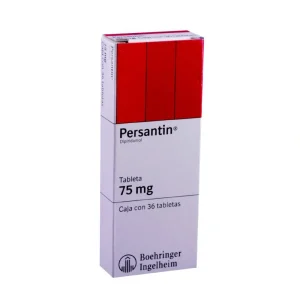
TM Owner Boehringer Ingelheim
Persantine 75mg Tablet
Global Shipping : Reliable Global Distribution Network
Express Delivery : Priority Shipping for Every Order
Secure Payments : Trusted Payment Protection System
 Disclaimer

Secure Handling
24/7 Worldwide Support

Global Access
Worldwide Access to Health

Cold-Chain Expert
Excellence in Cold-Chain

Trusted Supply
Certified Medical Supply
Indications & Clinical Uses
- Persantine 75 mg tablets contain dipyridamole, an antiplatelet medicine (not itself an anticoagulant) that works by inhibiting platelet aggregation and increasing blood flow, mainly in the small coronary vessels.
- It is approved as an adjunct to coumarin/warfarin-type anticoagulants for the prevention of thromboembolic complications after cardiac (heart) valve replacement surgery in adults; dipyridamole is added to warfarin therapy rather than used to replace it.
- Dipyridamole is also used, usually as a different modified-release combination product with aspirin, for secondary prevention of stroke, and as an intravenous agent for pharmacological cardiac stress (perfusion) imaging — these are separate uses from the oral Persantine tablet described here.
- Persantine tablets are taken by mouth and are prescribed and monitored by a healthcare provider alongside regular anticoagulation checks; they are not intended as a stand-alone treatment for blood clot prevention.
Side Effects
- The most commonly reported side effects of Persantine (dipyridamole) in clinical studies were dizziness, affecting more than 1 in 10 people, along with stomach upset or abdominal discomfort, headache and skin rash.
- Because dipyridamole widens blood vessels, flushing, low blood pressure and a fast heartbeat can also occur, especially when treatment is first started or the dose is increased.
- In people with underlying coronary artery disease, dipyridamole can occasionally worsen chest pain (angina) through a 'coronary steal' effect; report any new or worsening chest pain promptly.
- Rare but serious reactions include significant liver enzyme changes or liver failure, and severe allergic reactions with rash, swelling or breathing difficulty.
- Because Persantine is taken with a warfarin-type anticoagulant, unusual bruising, prolonged bleeding from cuts, blood in urine or stools, or severe headache could signal a bleeding problem and need urgent medical review.
- Seek immediate help for chest pain, fainting, or signs of a stroke such as sudden weakness or slurred speech.
Precautions & Warnings
- Persantine should be used cautiously in people with unstable angina, a recent heart attack, or severe coronary artery disease, since it can occasionally worsen chest pain through a coronary 'steal' effect that reduces blood flow to already narrowed vessels.
- It is contraindicated in anyone with known hypersensitivity to dipyridamole.
- Liver function should be monitored, as hepatic enzyme changes and rare liver failure have been reported.
- Blood pressure and heart rate should be checked periodically, particularly at the start of treatment, because of the risk of hypotension and flushing.
- Persantine is always used together with a coumarin anticoagulant for the valve-replacement indication, so international normalised ratio (INR) and bleeding risk must be monitored as part of that anticoagulant therapy, not because of Persantine itself.
- If you need any cardiac stress test using intravenous dipyridamole or adenosine, tell the team you take Persantine, as it can interact with the test; oral dipyridamole may need to be withheld beforehand.
- Avoid driving or operating machinery until you know how Persantine affects you, since dizziness is common.
Avoid Interactions
- Tell your healthcare provider about all medicines you take before starting Persantine (dipyridamole), especially your anticoagulant, since Persantine is prescribed together with warfarin-type medicines and the combination increases bleeding risk that needs regular monitoring.
- Avoid taking aspirin or other antiplatelet medicines alongside Persantine unless specifically directed, as combining antiplatelet drugs further raises the chance of bruising or bleeding.
- Adenosine and adenosine-receptor agonists such as regadenoson, used in cardiac stress testing, have their effects strongly increased by dipyridamole, so their dose must be reduced or oral dipyridamole withheld before the test as instructed by your care team.
- Cholinesterase inhibitors, including some medicines for myasthenia gravis and dementia, may have their effects reduced by dipyridamole, and symptoms of myasthenia gravis can worsen.
- Antacids may slightly reduce dipyridamole absorption.
- Always mention any new prescription, over-the-counter medicine or herbal supplement, particularly other blood thinners, NSAIDs, or heart medicines, before starting or stopping any of them.
References
Frequently Asked Questions
Persantine (dipyridamole) is an antiplatelet medicine added to warfarin-type anticoagulants to help prevent blood clots forming after heart valve replacement surgery. It is not itself an anticoagulant — it works alongside one by making platelets less likely to clump together and block small vessels.
Persantine tablets are taken by mouth, usually 75 to 100 mg four times a day, alongside your prescribed warfarin-type anticoagulant. Take it at evenly spaced times as directed, and do not stop it or change the dose without checking with your healthcare provider.
The most common effect is dizziness, affecting more than 1 in 10 people, along with stomach upset, headache and rash. Because Persantine can worsen chest pain in some people with coronary artery disease, report any new or increasing chest pain to your healthcare provider right away.
Avoid taking aspirin or other antiplatelet medicines unless specifically told to, since combining them increases bleeding risk. Tell any team performing a cardiac stress test that you take Persantine, as it strongly increases the effect of adenosine used in some tests. Avoid driving until you know how it affects you.
Yes, indirectly. Because Persantine is used together with a warfarin-type anticoagulant, your International Normalised Ratio (INR) and bleeding risk are monitored regularly as part of that anticoagulant therapy. Your liver function and blood pressure may also be checked periodically while you take Persantine.
No. Dipyridamole (Persantine) is an antiplatelet agent, a different drug class from anticoagulants such as warfarin. It works by reducing platelet clumping rather than by slowing the blood-clotting cascade, which is why it is added to, not used instead of, warfarin after valve surgery.

Trusted & Reliable – Your Partner in Global Distribution.
We provide comprehensive lines of pharmaceutical products to support all your healthcare distribution needs.


