

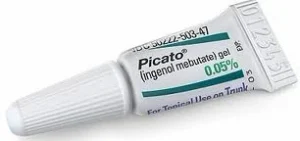
TM Owner LEO Pharma
Picato 0.02% Gel
Global Shipping : Reliable Global Distribution Network
Express Delivery : Priority Shipping for Every Order
Secure Payments : Trusted Payment Protection System
 Disclaimer

Secure Handling
24/7 Worldwide Support

Global Access
Worldwide Access to Health

Cold-Chain Expert
Excellence in Cold-Chain

Trusted Supply
Certified Medical Supply
Indications & Clinical Uses
- Picato 0.02% gel (ingenol mebutate) has been withdrawn from sale: the European Medicines Agency suspended its marketing authorisation across the EU on 17 January 2020 and the authorisation was formally withdrawn on 11 February 2020 at manufacturer LEO Pharma's request, and Health Canada announced its withdrawal from the Canadian market on 26 October 2020; it should no longer be prescribed or used.
- Picato was previously a short-course topical gel for actinic keratosis (sun-damaged, precancerous skin patches) on the face, scalp, trunk or limbs in adults, applied by the patient at home for two or three consecutive days depending on the body site and strength used.
- It was manufactured by LEO Pharma (Denmark).
- If you have unused Picato gel at home, do not apply it; return it to a pharmacy for safe disposal and ask your healthcare provider about an alternative treatment for actinic keratosis, such as cryotherapy, fluorouracil, imiquimod or photodynamic therapy.
Side Effects
- Picato (ingenol mebutate) was withdrawn because of an increased risk of skin cancer: in clinical trial follow-up, squamous cell carcinoma developed in about 3.3% of patients treated with Picato compared with 0.4% treated with the comparator imiquimod, and the European Medicines Agency concluded the risks outweighed the benefits.
- When it was in use, common reactions at the application site affected more than 1 in 10 people and included redness, flaking or scaling, crusting, swelling, and sometimes blistering or a small erosion, usually peaking within the first week and healing over two to four weeks.
- Application-site infection, eyelid swelling (with periocular use), and headache were also reported.
- Anyone who used Picato in the past and notices a new or changing skin lesion, sore that will not heal, or growth at a former treatment site should have it checked by a healthcare provider promptly, given the confirmed skin cancer signal.
Precautions & Warnings
- Picato gel is no longer authorised; this section reflects its withdrawn status for reference.
- It was for skin use only and was never to be used on broken skin, mucous membranes, or near the eyes, lips or inside the nostrils or ears, and hands had to be washed immediately after application.
- It was not recommended during pregnancy or breastfeeding, and was not studied in children.
- Treated areas had to avoid sun exposure and sunscreen use was advised, since the gel could increase sun sensitivity.
- It was not for use on more than one area at a time, and repeat courses at the same site were discouraged.
- Anyone still storing Picato gel should keep it refrigerated between 2°C and 8°C and out of reach of children until it can be returned to a pharmacy for disposal, and should not use it.
- Patients with a history of skin cancer or with actinic keratosis lesions that were only partly treated should be examined by a dermatologist for an alternative, currently authorised treatment.
Avoid Interactions
- Because Picato (ingenol mebutate) has been withdrawn from the market, no new drug or food interactions apply going forward; this section is retained for reference only.
- When it was in use, no clinically significant systemic drug interactions were established, since the gel acted locally on the skin with minimal absorption into the bloodstream.
- The main interaction concern was applying other topical products, cosmetics or sunscreens to the same area too soon before or after Picato, which could alter irritation; patients were advised to let the treated area dry before applying anything else.
- Anyone who still has Picato gel should not use it at all, regardless of other medicines, and should not mix or repackage it.
- If you are unsure whether a skin product you were previously given was Picato, or you are considering any new treatment for actinic keratosis, tell your healthcare provider about all medicines and supplements you use so a safe, currently approved option can be chosen.
References
Frequently Asked Questions
Picato (ingenol mebutate) gel was used for actinic keratosis, sun-damaged precancerous skin patches. It has been withdrawn worldwide since 2020 and must not be used. The EU suspended it in January 2020 and Canada withdrew it in October 2020, due to a skin cancer risk.
Regulators found Picato raised the risk of skin cancer: about 3.3% of patients developed squamous cell carcinoma versus 0.4% with the comparator drug imiquimod. The EMA concluded the risks outweighed the benefits and withdrew its authorisation on 11 February 2020.
Besides the confirmed skin cancer risk that led to its withdrawal, common Picato reactions included redness, flaking, crusting and swelling at the application site, affecting more than 1 in 10 users. Anyone with a new skin growth after past use should see a doctor.
Do not apply Picato gel. Return any unused tubes to a pharmacy for safe disposal and ask your healthcare provider about an alternative actinic keratosis treatment, such as cryotherapy, fluorouracil, imiquimod or photodynamic therapy.
Picato was refrigerated at 2°C to 8°C and applied once daily for two or three consecutive days depending on the body site. It was for skin use only, avoiding eyes, lips and broken skin. It is no longer authorised, so these instructions apply only to past use.
Picato was not recommended in pregnancy or breastfeeding and was not studied in children even when it was available. It is now withdrawn everywhere due to a skin cancer risk, so it should not be used by anyone, pregnant or not.

Trusted & Reliable – Your Partner in Global Distribution.
We provide comprehensive lines of pharmaceutical products to support all your healthcare distribution needs.


