

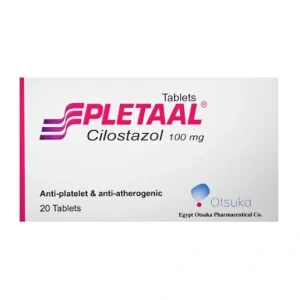
TM Owner Otsuka
Pletal 100mg Tablet
Global Shipping : Reliable Global Distribution Network
Express Delivery : Priority Shipping for Every Order
Secure Payments : Trusted Payment Protection System
 Disclaimer

Secure Handling
24/7 Worldwide Support

Global Access
Worldwide Access to Health

Cold-Chain Expert
Excellence in Cold-Chain

Trusted Supply
Certified Medical Supply
Indications & Clinical Uses
- Pletal 100 mg is a tablet containing cilostazol, a phosphodiesterase III inhibitor that inhibits platelet aggregation.
- The US label lists a single use: to reduce the symptoms of intermittent claudication (leg pain on walking caused by peripheral vascular disease), as shown by an increased walking distance.
- It comes in 50 mg and 100 mg tablets; the standard dose is 100 mg twice daily, taken at least half an hour before or two hours after breakfast and dinner, reduced to 50 mg twice daily with certain interacting medicines.
- Pletal carries a boxed warning: it is contraindicated in patients with heart failure of any severity.
- It is prescribed by a healthcare provider and taken by mouth at home.
- Information is drawn from the US Pletal prescribing information.
Side Effects
- The most common side effects at 100 mg twice daily, compared with placebo, are headache (34% versus 14%), diarrhea (19% versus 7%), abnormal stools (15% versus 4%) and palpitations (10% versus 1%).
- Dizziness is also common.
- BOXED WARNING: Pletal is contraindicated in patients with heart failure of any severity, because similar phosphodiesterase III inhibitors have reduced survival in people with heart failure.
- Cases of thrombocytopenia or leukopenia progressing to agranulocytosis (a serious drop in white cells) have been reported when the drug was not stopped promptly; this reverses on stopping.
- Heart rate can rise by 5 to 7 beats per minute and angina may worsen in susceptible people.
- Contact your healthcare provider promptly for chest pain, shortness of breath, easy bruising or bleeding, bloody stools or signs of infection.
Precautions & Warnings
- Do not take Pletal if you have heart failure of any severity (boxed warning), a bleeding disorder or hemostatic abnormality, or an allergy to cilostazol or its ingredients.
- Because it inhibits platelets, bleeding risk needs attention, and blood counts should be checked periodically.
- Left ventricular outflow tract obstruction has been reported in people with certain heart anatomy, and fast or irregular heartbeats can occur.
- Pregnancy: it is US Category C; cilostazol was teratogenic in rats at more than 5 times the human dose and there are no adequate human studies, so discuss the risks with your healthcare provider.
- Breastfeeding: transfer into milk has been reported in rats, so nursing or the medicine should be stopped.
- Data are lacking for moderate to severe liver or kidney impairment.
- Smoking lowers exposure by about 20%.
Avoid Interactions
- Medicines that block the enzymes CYP3A4 or CYP2C19 raise cilostazol levels, so the dose should be reduced to 50 mg twice daily with ketoconazole, erythromycin, diltiazem, omeprazole and ticlopidine, according to the label.
- Grapefruit juice increases exposure and should be avoided.
- Take Pletal at least half an hour before or two hours after breakfast and dinner.
- Smoking reduces cilostazol exposure by roughly 20%.
- Because Pletal inhibits platelet aggregation, other medicines that affect bleeding or clotting should be used only under medical supervision.
- Always tell your healthcare provider and pharmacist about every prescription medicine, non-prescription product and supplement you use.
References
Frequently Asked Questions
Pletal (cilostazol) reduces the leg pain of intermittent claudication, the cramping on walking caused by poor circulation in the legs. It increases the distance you can walk. It inhibits platelet aggregation. It is taken by mouth at home, usually twice a day, and prescribed by a healthcare provider.
Take Pletal (cilostazol) 100 mg twice daily, at least half an hour before or two hours after breakfast and dinner. The dose falls to 50 mg twice daily if you take certain interacting medicines such as omeprazole or ketoconazole. Your healthcare provider sets the dose.
Common Pletal side effects at 100 mg twice daily are headache (34%), diarrhea (19%), abnormal stools (15%) and palpitations (10%). Get urgent help for chest pain, shortness of breath, easy bruising or bleeding, bloody stools or signs of infection, as blood counts can fall.
Avoid grapefruit juice with Pletal (cilostazol), which raises its levels. Ketoconazole, erythromycin, diltiazem, omeprazole and ticlopidine also raise levels, so the dose drops to 50 mg twice daily. Do not take Pletal close to meals, and tell your provider about all other medicines.
Yes. Pletal (cilostazol) can cause thrombocytopenia or leukopenia that progresses to agranulocytosis if not stopped promptly, so blood counts are checked periodically. This is reversible when the drug is stopped. Report bruising, bleeding or signs of infection to your healthcare provider straight away.
Pletal (cilostazol) carries a boxed warning: it must not be used by anyone with heart failure of any severity, because similar drugs have reduced survival. It is also contraindicated with bleeding disorders. Tell your provider about any heart condition before starting.

Trusted & Reliable – Your Partner in Global Distribution.
We provide comprehensive lines of pharmaceutical products to support all your healthcare distribution needs.


