

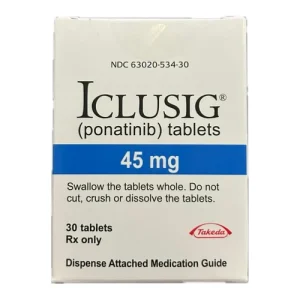
TM Owner Takeda
Ponatinib 15mg Tablet
Global Shipping : Reliable Global Distribution Network
Express Delivery : Priority Shipping for Every Order
Secure Payments : Trusted Payment Protection System
 Disclaimer

Secure Handling
24/7 Worldwide Support

Global Access
Worldwide Access to Health

Cold-Chain Expert
Excellence in Cold-Chain

Trusted Supply
Certified Medical Supply
Indications & Clinical Uses
- Ponatinib 15 mg (brand name Iclusig, made by Takeda) is a third-generation BCR-ABL tyrosine kinase inhibitor.
- No product is marketed under the plain name "Ponatinib" alone in the US or EU; this entry uses the approved brand Iclusig as its label.
- Iclusig is approved for adults with chronic myeloid leukaemia (CML) in chronic, accelerated or blast phase who are resistant or intolerant to at least two prior tyrosine kinase inhibitors, or who have the T315I mutation, which makes the disease resistant to other kinase inhibitors; it is also approved for Philadelphia chromosome-positive acute lymphoblastic leukaemia (Ph+ ALL), either combined with chemotherapy in newly diagnosed patients or as monotherapy when no other kinase inhibitor is suitable.
- It is prescribed and monitored by a haematologist or oncologist.
Side Effects
- Common side effects, each affecting 20% or more of patients, include rash and related skin reactions, abdominal pain, fatigue, headache, dry skin, constipation, joint pain, nausea, high blood pressure and elevated liver enzymes.
- Iclusig carries a boxed warning covering four serious risks: arterial occlusive events such as heart attack and stroke, which can be fatal; venous thromboembolism, including deep vein thrombosis and pulmonary embolism; heart failure, including fatal cases; and hepatotoxicity, including liver failure and death.
- Seek urgent medical help for chest pain, sudden weakness or slurred speech, leg swelling or pain, sudden breathlessness, or yellowing of the skin or eyes.
- Liver function and blood pressure are checked regularly throughout treatment.
Precautions & Warnings
- Because of the arterial and venous clotting risk, cardiovascular risk factors such as high blood pressure, diabetes and high cholesterol should be assessed and managed before and during treatment, and blood pressure is monitored regularly.
- Heart function is assessed before starting and if symptoms of heart failure develop.
- Liver enzymes are checked before treatment and at least monthly during the first three months.
- Pancreatitis has occurred, so report severe abdominal pain promptly.
- Dose interruption or reduction is common once a response is achieved, to lower cumulative risk.
- Ponatinib can cause fetal harm, so effective contraception is advised during treatment and for a period after the last dose, and breastfeeding should be avoided.
- A REMS certification programme previously restricted US access to this medicine; the FDA discontinued that specific REMS requirement in 2018 while the boxed warning and label precautions remain in force.
Avoid Interactions
- Avoid strong CYP3A inhibitors such as ketoconazole, clarithromycin, ritonavir and grapefruit or grapefruit juice, since they raise ponatinib levels; if one cannot be avoided, the ponatinib dose is reduced.
- Strong CYP3A inducers, such as rifampin, carbamazepine, phenytoin and St. John's wort, lower ponatinib levels and can reduce its effectiveness, so they should generally be avoided.
- Combining ponatinib with other medicines that increase bleeding or clotting risk, or that also affect the liver, needs extra caution and monitoring.
- Tell your healthcare provider and pharmacist about every prescription and over-the-counter medicine, herbal product and supplement you take, since dose changes are often needed.
- Do not start or stop any other medicine, including St. John's wort, without checking with your prescriber first.
References
Frequently Asked Questions
Ponatinib, sold as Iclusig, treats chronic myeloid leukaemia (CML) resistant to at least two other kinase inhibitors, CML with the T315I mutation, and Philadelphia chromosome-positive acute lymphoblastic leukaemia. No product is sold simply as "Ponatinib" — Iclusig, made by Takeda, is the only approved brand.
You swallow one tablet, once daily, with or without food, at about the same time each day. The 45 mg or 30 mg starting dose is often reduced to 15 mg once your disease responds well.
Ponatinib has a boxed warning for four risks: arterial blood clots like heart attack and stroke, venous blood clots, heart failure, and liver failure. Get urgent care for chest pain, sudden weakness, leg swelling, breathlessness or yellowing skin or eyes.
Avoid strong CYP3A inhibitors, such as clarithromycin, ketoconazole and grapefruit, which raise ponatinib levels, and strong inducers like rifampin and St. John's wort, which lower them. Tell your prescriber about all other medicines, supplements and any heart, liver or clotting risk factors.
You'll have regular blood pressure checks and liver function tests, especially monthly for the first three months. Heart function may be checked before starting and if you develop symptoms. Report severe abdominal pain, which could signal pancreatitis.
The FDA-mandated REMS certification program for Iclusig was discontinued in 2018 after review showed the risks could be managed through labeling alone. The boxed warning for blood clots, heart failure and liver failure still applies to every prescription.

Trusted & Reliable – Your Partner in Global Distribution.
We provide comprehensive lines of pharmaceutical products to support all your healthcare distribution needs.


