

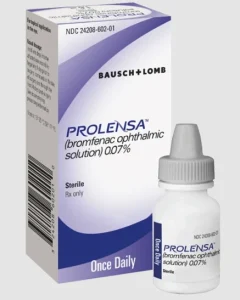
TM Owner Bausch & Lomb
Prolensa 0.07% Eye Drops
Global Shipping : Reliable Global Distribution Network
Express Delivery : Priority Shipping for Every Order
Secure Payments : Trusted Payment Protection System
 Disclaimer

Secure Handling
24/7 Worldwide Support

Global Access
Worldwide Access to Health

Cold-Chain Expert
Excellence in Cold-Chain

Trusted Supply
Certified Medical Supply
Indications & Clinical Uses
- Prolensa (bromfenac ophthalmic solution) 0.07% is a nonsteroidal anti-inflammatory drug (NSAID) eye drop used to treat inflammation and reduce eye pain after cataract surgery in adults.
- It works by blocking prostaglandin production in the eye.
- Treatment is typically started one day before surgery and continued through the first two weeks of recovery, as directed by the eye surgeon.
- Prolensa is used only in the operated eye and only for the perioperative period specified by your ophthalmologist; it is not intended for long-term or unrelated eye conditions.
- Bromfenac is also available as generic bromfenac ophthalmic solution and in other branded formulations, which may differ in strength or dosing frequency, so use only the product and schedule your surgeon has prescribed.
Side Effects
- The most commonly reported reactions, each affecting roughly 3-8% of patients in trials, are inflammation inside the front of the eye (anterior chamber inflammation), a foreign-body or gritty sensation, eye pain, sensitivity to light, and blurred vision.
- As with other topical NSAIDs, Prolensa can, in rare cases, slow or delay corneal healing, and more serious corneal problems such as keratitis, thinning, or even corneal perforation have been reported with this drug class, usually with prolonged use or in eyes already at risk.
- Seek urgent advice from your eye surgeon if you notice worsening eye pain, redness, sudden vision changes, or the sensation of something not healing after surgery.
- Prolensa also contains sodium sulfite, which can occasionally trigger allergic-type reactions in sulfite-sensitive individuals.
Precautions & Warnings
- Because topical NSAIDs like Prolensa can slow corneal healing, your surgeon will want to see you for follow-up visits during the two-week course, and treatment should be stopped and the eye assessed promptly if healing problems, corneal thinning, or vision changes appear.
- Prolensa can increase bleeding time in the treated eye, so it should be used with caution if you have a bleeding tendency or take blood-thinning medicines, and your surgeon will weigh this before and after your operation.
- Remove contact lenses before instilling the drops, since Prolensa is not intended for use while wearing lenses; wait until your surgeon confirms it is safe to reinsert them.
- Prolensa contains sodium sulfite; tell your surgeon if you have a known sulfite allergy.
- Use in pregnancy or breastfeeding should be discussed with your prescriber, as with other NSAIDs used late in pregnancy.
Avoid Interactions
- Prolensa can generally be used together with other topical eye medicines, such as alpha-agonists, beta-blockers, carbonic anhydrase inhibitors, cycloplegics, and mydriatics, as long as each drop is given at least five minutes apart to avoid washing one drop out with the next.
- Because it can increase bleeding time, tell your surgeon if you take oral anticoagulants, antiplatelet medicines such as aspirin or clopidogrel, or other NSAIDs, as combined use around the time of surgery may need extra monitoring.
- Avoid using more than one topical NSAID in the same eye unless your surgeon specifically directs it.
- Tell your eye surgeon and pharmacist about all other eye drops, oral medicines, and supplements you are using before and during your course of Prolensa.
References
Frequently Asked Questions
Prolensa (bromfenac) is an anti-inflammatory eye drop used to treat pain and inflammation after cataract surgery. It's given only in the operated eye, starting the day before surgery and continuing for about two weeks afterward.
One drop is placed in the affected eye once daily, starting one day before cataract surgery and continuing through the first 14 days of recovery, exactly as your eye surgeon directs.
Common effects include eye inflammation, a gritty or foreign-body feeling, eye pain, light sensitivity, and blurred vision. Rarely, NSAID eye drops like Prolensa can slow corneal healing or cause more serious corneal problems.
Remove contact lenses before applying the drops and don't reinsert them until your surgeon says it's safe. Space other eye drops at least five minutes apart, and tell your surgeon if you take blood thinners or aspirin.
Call promptly if you notice worsening eye pain, increasing redness, sudden vision changes, or a feeling that your eye isn't healing. These can signal a rare but serious corneal problem that needs urgent review.
Prolensa is typically used for about two weeks: starting one day before surgery and continuing daily through the postoperative healing period, unless your eye surgeon gives you a different schedule.

Trusted & Reliable – Your Partner in Global Distribution.
We provide comprehensive lines of pharmaceutical products to support all your healthcare distribution needs.


