

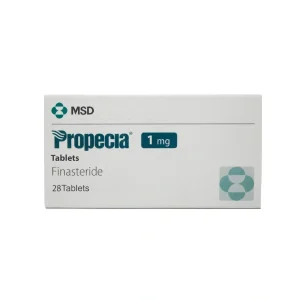
TM Owner Merck & Co.
Propecia 1mg Tablet
Global Shipping : Reliable Global Distribution Network
Express Delivery : Priority Shipping for Every Order
Secure Payments : Trusted Payment Protection System
 Disclaimer

Secure Handling
24/7 Worldwide Support

Global Access
Worldwide Access to Health

Cold-Chain Expert
Excellence in Cold-Chain

Trusted Supply
Certified Medical Supply
Indications & Clinical Uses
- Propecia 1 mg film-coated tablets contain the active substance finasteride, a type II 5-alpha-reductase inhibitor that blocks the conversion of testosterone to dihydrotestosterone (DHT), the hormone responsible for shrinking scalp hair follicles.
- Propecia is indicated for the treatment of male pattern hair loss (androgenetic alopecia) on the vertex and anterior mid-scalp area in adult men only; it is not indicated for use in women or children.
- Propecia 1 mg must not be confused with Proscar, the same molecule at the 5 mg strength, which is approved separately for benign prostatic hyperplasia (BPH) - the two are not interchangeable.
- Continuous daily use is required to maintain benefit, and hair loss resumes within about 12 months of stopping treatment.
- It is a self-administered oral tablet taken at home, not a hospital- or specialist-administered product.
Side Effects
- The most common side effects, each occurring in roughly 1 to 2 in 100 men in clinical trials, are decreased libido, erectile dysfunction and a decrease in ejaculate volume or other ejaculation disorder; these generally resolve with continued use or after stopping, though persistent sexual side effects after discontinuation have been reported after marketing.
- Male breast enlargement or tenderness can occur, and rare cases of male breast cancer have been reported - report any breast lumps, pain, nipple discharge or skin changes promptly.
- Depression and mood changes have also been reported after marketing.
- The current Propecia label carries no boxed warning.
- Seek prompt medical advice for any new or worsening mood symptoms, breast changes, or testicular pain.
Precautions & Warnings
- Propecia is contraindicated in women, especially those who are or may become pregnant, and in children.
- Pregnant women or women who could become pregnant must avoid handling crushed or broken tablets, as finasteride can be absorbed through the skin and may cause abnormal development of the external genitalia in a male fetus; intact, coated tablets are safe to handle.
- Finasteride lowers PSA (prostate-specific antigen) by about 50% after 3 to 6 months of use, which can mask prostate cancer on screening, so tell your healthcare provider you take Propecia before any PSA test; any rise in PSA while on treatment should be evaluated.
- An increased risk of high-grade (Gleason 8-10) prostate cancer has been observed with 5-alpha-reductase inhibitors at higher doses and should be discussed with your provider.
- Do not donate blood while taking Propecia and for one month after stopping, because of the risk to a pregnant blood recipient.
- Use with caution in hepatic impairment, since finasteride is metabolised by the liver.
Avoid Interactions
- No clinically significant drug interactions have been identified in studies of finasteride with other common medicine classes, including NSAIDs, ACE inhibitors, beta-blockers, warfarin, digoxin, theophylline and glyburide.
- Even so, tell your healthcare provider about all medicines and supplements you take, especially any other hair-loss or hormone-affecting treatment (such as other 5-alpha-reductase inhibitors like finasteride 5 mg or dutasteride), so duplicate or excess dosing is avoided.
- Because of the fetal-exposure risk, women who are or may be pregnant should avoid any contact with damaged tablets and should not handle finasteride without protection.
- There are no known food interactions, and Propecia can be taken with or without food.
References
Frequently Asked Questions
Propecia (finasteride 1 mg) treats male pattern hair loss in adult men only. It blocks the enzyme that converts testosterone into DHT, the hormone that shrinks scalp hair follicles, and is used for hair loss on the vertex and front of the scalp. It is not approved for women or children.
Take one Propecia 1 mg tablet by mouth once a day, with or without food. Benefits build slowly, so most men need 3 months or longer of daily use to see regrowth, and hair loss returns within about 12 months if treatment stops.
The most common side effects are decreased libido, erectile dysfunction and reduced ejaculate volume, each affecting roughly 1 to 2 in 100 men. Rarely, men report depression, mood changes, or breast lumps or pain - tell your healthcare provider promptly if these occur.
Do not share Propecia with women, and do not donate blood while taking it or for one month after stopping, since your blood could expose a pregnant recipient's male fetus to finasteride. No major drug interactions are known, but tell your provider about other hair-loss or hormone treatments.
If you miss a dose of Propecia, skip it and take your next tablet at the usual time the next day - do not double up. Occasional missed doses will not cause harm, but taking it consistently every day gives the best chance of maintaining hair regrowth.
Pregnant women, or women who could become pregnant, should not handle crushed or broken Propecia tablets. Finasteride can be absorbed through the skin and may cause abnormal genital development in a male fetus. Intact, film-coated tablets are safe to touch.

Trusted & Reliable – Your Partner in Global Distribution.
We provide comprehensive lines of pharmaceutical products to support all your healthcare distribution needs.


