

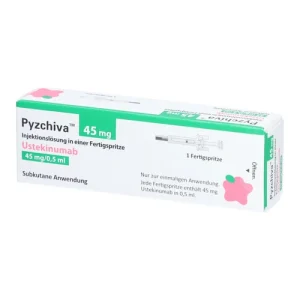
TM Owner Samsung Bioepis
Pyzchiva 45mg Vial
Global Shipping : Reliable Global Distribution Network
Express Delivery : Priority Shipping for Every Order
Secure Payments : Trusted Payment Protection System
 Disclaimer

Secure Handling
24/7 Worldwide Support

Global Access
Worldwide Access to Health

Cold-Chain Expert
Excellence in Cold-Chain

Trusted Supply
Certified Medical Supply
Indications & Clinical Uses
- Pyzchiva 45 mg (ustekinumab-ttwe in the US) is a biosimilar to the reference biologic Stelara, containing the same active substance, ustekinumab, a monoclonal antibody that blocks the interleukin-12 and interleukin-23 pathways involved in inflammation.
- It is indicated for moderate to severe plaque psoriasis in adults and in children and adolescents aged 6 years and older who have not responded adequately to, or cannot tolerate, other systemic therapies; for active psoriatic arthritis in adults, alone or with methotrexate; and for moderately to severely active Crohn's disease and, in the US label, ulcerative colitis in adults.
- The 45 mg single-dose vial is given by subcutaneous injection and is intended for patients weighing 100 kg or less; heavier patients typically need the 90 mg strength.
- Pyzchiva is administered by, or under the guidance of, a healthcare provider trained in giving injectable biologics.
Side Effects
- The most common side effects of Pyzchiva, reported in more than 5 in 100 people, are headache and nasopharyngitis (a cold-like upper airway infection).
- Other common reactions include upper respiratory tract infection, fatigue, injection-site redness, nausea, vomiting and diarrhoea, depending on the condition treated.
- There is no boxed warning on the current label, but Pyzchiva can lower the body's ability to fight infection, so serious bacterial, fungal, viral or mycobacterial (including tuberculosis) infections have occurred; report fever, persistent cough, weight loss or wounds that will not heal promptly.
- Seek urgent medical help for signs of a severe allergic reaction, such as facial swelling, difficulty breathing or widespread rash, or for new headaches, seizures, confusion or vision changes, which can rarely indicate a serious brain condition called posterior reversible encephalopathy syndrome.
Precautions & Warnings
- Pyzchiva must not be given to anyone with a clinically significant hypersensitivity to ustekinumab or any vial ingredient.
- Before starting treatment, patients should be evaluated for tuberculosis and screened for other infections, and Pyzchiva should not be started during an active, clinically important infection.
- Because ustekinumab affects the immune system, there is a potential increased risk of malignancy, and regular skin checks are recommended, particularly for non-melanoma skin cancer.
- Live vaccines (such as BCG, MMR, yellow fever or oral typhoid) should be avoided during treatment, and vaccinations should ideally be brought up to date beforehand.
- Use in pregnancy or breastfeeding should be discussed with a healthcare provider, as data are limited.
- Pyzchiva is for subcutaneous injection only; the 45 mg single-dose vial must be refrigerated at 2°C to 8°C, protected from light, and never frozen or shaken.
Avoid Interactions
- Live vaccines should not be given while receiving Pyzchiva, and BCG vaccination should be avoided for at least one year before or after treatment.
- Clinical studies found no clinically meaningful interactions between ustekinumab and cytochrome P450 enzyme substrates, so no dose adjustment is generally needed for medicines metabolised this way.
- Pyzchiva has been used together with methotrexate, corticosteroids, NSAIDs and other immunosuppressants such as azathioprine or 6-mercaptopurine without unexpected interactions, but combined immunosuppression increases infection risk and should be monitored.
- Allergen immunotherapy may be less effective, and its protective effect against severe allergic reactions may be reduced, during Pyzchiva treatment.
- Always tell your healthcare provider about all prescription, over-the-counter and herbal products you use, and never mix or dilute the injection with other substances.
References
Frequently Asked Questions
Pyzchiva (ustekinumab) is a biosimilar to Stelara, used to treat moderate to severe plaque psoriasis in adults and children aged 6 and over, active psoriatic arthritis, and moderately to severely active Crohn's disease; the US label also covers ulcerative colitis.
Pyzchiva 45 mg is given as a subcutaneous injection by, or under the guidance of, a healthcare provider, followed by maintenance doses every 8 to 12 weeks depending on the condition. Patients over 100 kg usually need the higher 90 mg strength instead.
The most common side effects are headache and nasopharyngitis, plus respiratory infections, fatigue and injection-site redness. Because it affects the immune system, watch for signs of infection like fever or persistent cough, and seek urgent help for severe allergic reactions.
Avoid live vaccines while on Pyzchiva, and BCG vaccination for a year either side of treatment. Tell your healthcare provider about any active infection before starting, since Pyzchiva lowers your ability to fight infection and treatment may need to be delayed.
Pyzchiva is a biosimilar, not the identical product, to the reference biologic Stelara. It contains the same active substance, ustekinumab, made by Samsung Bioepis, and has been shown to work and behave the same way in the body, with no boxed warning on its label.
Pyzchiva is given on a fixed schedule, so contact your healthcare provider or clinic if you miss an appointment rather than adjusting the dose yourself. Missed doses can reduce disease control, and your provider will advise when to give the next injection.

Trusted & Reliable – Your Partner in Global Distribution.
We provide comprehensive lines of pharmaceutical products to support all your healthcare distribution needs.


