

TM Owner Chiesi
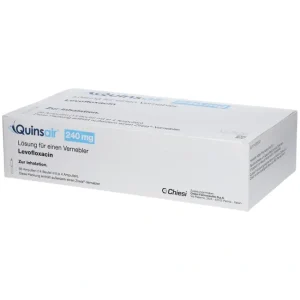
Quinsair 240mg/2.4mL Nebuliser Solution
Global Shipping : Reliable Global Distribution Network
Express Delivery : Priority Shipping for Every Order
Secure Payments : Trusted Payment Protection System
 Disclaimer

Secure Handling
24/7 Worldwide Support

Global Access
Worldwide Access to Health

Cold-Chain Expert
Excellence in Cold-Chain

Trusted Supply
Certified Medical Supply
Indications & Clinical Uses
- Quinsair 240 mg (levofloxacin 100 mg/mL) nebuliser solution, made by Chiesi, is a fluoroquinolone antibiotic inhaled as a fine mist to manage chronic lung infections caused by Pseudomonas aeruginosa in adults with cystic fibrosis.
- It is approved in the EU (EMA-authorised) for this indication; despite its name resembling the quinine-family antimalarials in this catalogue, Quinsair is an entirely different drug (levofloxacin) and route (oral inhalation via a specific electronic nebuliser handset, not injection or a tablet) and must never be confused with them.
- Treatment is cyclical: 28 days of twice-daily use followed by 28 days off, self-administered at home after training, using the manufacturer-specified Zirela or eFlow rapid nebuliser system - other nebuliser devices are not validated for this product.
Side Effects
- Very common effects (more than 1 in 10 people) include cough, altered taste (dysgeusia) and fatigue.
- Common effects include nausea, vomiting, abdominal pain, shortness of breath, wheeze/bronchospasm, and fungal infections of the mouth or vagina. ⚠️ Like all systemic fluoroquinolones, Quinsair carries an EU-mandated highlighted warning for serious, disabling and potentially irreversible adverse reactions affecting tendons (inflammation and rupture, including within 48 hours of starting), muscles, joints, nerves and the central nervous system, which can occur together.
- Other serious risks include severe allergic reactions, Stevens-Johnson syndrome, liver damage, QT prolongation, and, rarely, aortic aneurysm or dissection - seek emergency care for sudden severe chest, back or abdominal pain.
Precautions & Warnings
- Quinsair is contraindicated in epilepsy, pregnancy and breastfeeding, in people with a history of tendon disorders linked to a fluoroquinolone, and in known hypersensitivity to levofloxacin or other quinolones.
- Use with caution in myasthenia gravis, which fluoroquinolones can worsen, and in patients with cardiac conduction abnormalities, electrolyte imbalances or other QT-prolonging risk factors.
- Tendon problems are more likely in older patients, those with kidney impairment, and those also taking corticosteroids - stop treatment and rest the affected limb if pain or swelling occurs.
- Because of the risk of disabling and potentially irreversible effects, treatment should be stopped at the first sign of a serious reaction.
- Administration order matters: use bronchodilators, then dornase alfa, then airway clearance, then Quinsair, then any inhaled steroid.
Avoid Interactions
- Quinsair increases bleeding risk with vitamin K antagonists such as warfarin, so clotting tests should be monitored more closely when starting or stopping treatment.
- It can lower the seizure threshold, an effect made worse by theophylline or NSAIDs taken together.
- Avoid combining it with other QT-prolonging drugs, including class IA and III antiarrhythmics, tricyclic antidepressants, macrolide antibiotics and some antipsychotics.
- Cimetidine and probenecid reduce its renal clearance, and it raises ciclosporin blood levels, both requiring monitoring.
- Tell your healthcare provider about all other medicines, including corticosteroids (which increase tendon-rupture risk) and anticoagulants, before starting or continuing Quinsair.
References
Frequently Asked Questions
Quinsair (levofloxacin, 240 mg per ampoule) is an inhaled antibiotic for chronic lung infections caused by Pseudomonas aeruginosa in adults with cystic fibrosis. It is not an antimalarial, despite the similar name to quinine-based medicines.
You inhale one 240 mg ampoule twice daily, about 12 hours apart, using the specified Zirela or eFlow rapid nebuliser handset - no other device is validated. Treatment runs in 28-day cycles: 28 days on, then 28 days off.
Very common effects are cough, altered taste and fatigue. Like all fluoroquinolones, Quinsair can cause serious, sometimes irreversible tendon, nerve, muscle and mental-health reactions. Stop treatment and seek help immediately for tendon pain, swelling or sudden severe chest or back pain.
Avoid other QT-prolonging medicines, and tell your provider if you take warfarin, corticosteroids or theophylline, since Quinsair increases bleeding, tendon-rupture and seizure risk with these. Quinsair must not be used in pregnancy, breastfeeding or epilepsy.
Take the missed dose as soon as you remember, then continue your normal twice-daily schedule - do not double up. Store ampoules as directed, protected from light, and use each ampoule's contents immediately once opened; do not save leftover solution.
Quinsair is a systemic fluoroquinolone, a drug class with an EU-mandated warning for serious, disabling and potentially irreversible tendon, muscle, joint and nervous-system reactions, which can start within 48 hours. Risk rises with age, kidney problems and steroid use.

Trusted & Reliable – Your Partner in Global Distribution.
We provide comprehensive lines of pharmaceutical products to support all your healthcare distribution needs.


