

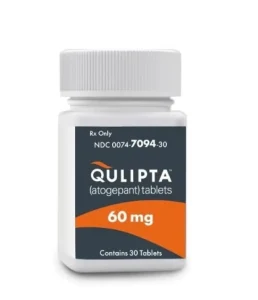
TM Owner AbbVie
Qulipta 60mg Tablet
Global Shipping : Reliable Global Distribution Network
Express Delivery : Priority Shipping for Every Order
Secure Payments : Trusted Payment Protection System
 Disclaimer

Secure Handling
24/7 Worldwide Support

Global Access
Worldwide Access to Health

Cold-Chain Expert
Excellence in Cold-Chain

Trusted Supply
Certified Medical Supply
Indications & Clinical Uses
- Qulipta 60mg tablets contain atogepant, a calcitonin gene-related peptide (CGRP) receptor antagonist ('gepant') approved by the US FDA for the preventive treatment of migraine in adults, covering both episodic and chronic migraine.
- It is taken once daily as an oral tablet to reduce how often migraine attacks occur; it is not intended to treat an attack that has already started.
- The 60mg strength is used once daily for either episodic or chronic migraine prevention, while lower 10mg and 30mg strengths are also approved depending on dosing needs and interacting medicines.
- Qulipta is self-administered at home and does not require specialist supervision to take, although it should be prescribed and monitored by a healthcare provider.
- Qulipta (atogepant) is currently approved and marketed in the United States by AbbVie, and is not to be confused with other CGRP-targeted migraine medicines given by injection, such as erenumab or fremanezumab.
Side Effects
- The most common side effects of Qulipta reported in clinical trials are nausea (up to about 9% of patients depending on dose), constipation (up to about 8%), and fatigue or sleepiness (up to about 5%), occurring more often than with placebo.
- Most reactions are mild to moderate and do not require stopping treatment.
- Less commonly, Qulipta can cause a hypersensitivity reaction; patients who have had an allergic reaction to atogepant or any tablet component should not take it, and anyone who develops swelling of the face, lips, tongue or throat, difficulty breathing, or a severe rash after taking Qulipta should stop the medicine and seek urgent medical attention.
- There is no boxed warning on the current Qulipta label.
- Patients should tell their healthcare provider about constipation that does not improve, as dose or dietary changes may be needed, and should report any new or worsening symptoms promptly.
Precautions & Warnings
- Qulipta should be avoided in patients with severe hepatic impairment, since exposure to atogepant is markedly increased and has not been studied at this level of liver disease; no dose adjustment is needed for mild to moderate impairment.
- It is contraindicated in anyone with a history of hypersensitivity to atogepant or its excipients.
- Safety in pregnancy is not established; animal data suggest a risk to the fetus at high exposures, so AbbVie maintains a pregnancy registry to collect outcome data for women exposed during pregnancy, and it is not known whether atogepant passes into breast milk.
- Qulipta has not been established as safe or effective in children.
- It must be swallowed whole as an oral tablet and is for migraine prevention only, not for treating an acute attack already underway.
- There is no specific driving restriction, but patients experiencing fatigue or dizziness should judge their own ability to drive.
Avoid Interactions
- Qulipta interacts significantly with drugs that change CYP3A4 or OATP1B1 activity.
- Strong CYP3A4 inhibitors (such as itraconazole, clarithromycin, or ritonavir-boosted medicines) raise atogepant levels, so the Qulipta dose should be reduced to 10mg once daily when co-prescribed.
- Strong or moderate CYP3A4 inducers (such as rifampin, carbamazepine, phenytoin or St John's Wort) lower atogepant levels and reduce effectiveness; chronic migraine dosing with these inducers is not recommended, and episodic migraine dosing may need adjustment.
- OATP inhibitors (such as single-dose rifampin or cyclosporine) also require a lower Qulipta dose.
- Patients should tell their healthcare provider and pharmacist about every prescription medicine, over-the-counter product, herbal supplement (especially St John's Wort) and grapefruit-containing product they use before starting Qulipta, since several common antibiotics and antifungals fall into the interacting categories above.
References
Frequently Asked Questions
Qulipta (atogepant) is an oral tablet that prevents migraine attacks in adults, both episodic and chronic migraine. It is not for treating a migraine that has already started. Qulipta blocks the CGRP receptor involved in migraine attacks. The 60mg dose is taken once daily for either type of migraine.
Take one Qulipta 60mg tablet by mouth once daily, with or without food, at about the same time each day. Swallow it whole. Qulipta is for prevention, so keep taking it regularly between attacks; do not use it to treat an attack already in progress.
The most common side effects of Qulipta are nausea, constipation and fatigue or sleepiness. These are usually mild. Seek urgent care for signs of a severe allergic reaction, such as swelling of the face or throat, trouble breathing, or a widespread rash, and stop the tablet.
Avoid strong CYP3A4 inhibitors (like itraconazole or clarithromycin) and inducers (like rifampin or St John's Wort) without medical advice, as they raise or lower atogepant levels and may need a Qulipta dose change. Tell your healthcare provider about all medicines, including grapefruit products and supplements.
If you miss a Qulipta dose, take it as soon as you remember that same day. If you don't remember until the next day, skip the missed tablet and resume your normal once-daily schedule. Never take two tablets together to make up for a missed dose.
Qulipta's safety in pregnancy has not been established, and animal studies suggest possible fetal risk at high exposures. AbbVie runs a pregnancy registry (1-833-277-0206) for women exposed to Qulipta during pregnancy. Tell your healthcare provider if you are pregnant, planning pregnancy, or breastfeeding.

Trusted & Reliable – Your Partner in Global Distribution.
We provide comprehensive lines of pharmaceutical products to support all your healthcare distribution needs.


