

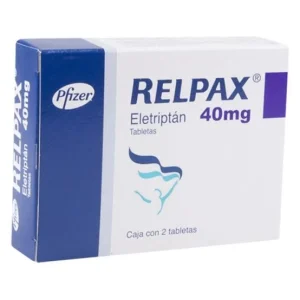
TM Owner Pfizer
Relpax 40mg Tablet
Global Shipping : Reliable Global Distribution Network
Express Delivery : Priority Shipping for Every Order
Secure Payments : Trusted Payment Protection System
 Disclaimer

Secure Handling
24/7 Worldwide Support

Global Access
Worldwide Access to Health

Cold-Chain Expert
Excellence in Cold-Chain

Trusted Supply
Certified Medical Supply
Indications & Clinical Uses
- Relpax 40 mg tablets contain eletriptan, a selective serotonin (5-HT1B/1D) receptor agonist of the triptan class, approved in the United States for the acute treatment of migraine attacks with or without aura in adults.
- Eletriptan is taken to stop a migraine that has already started; it is not approved to prevent migraine attacks and is not indicated for cluster headache.
- Tablets are supplied in strengths of 20 mg and 40 mg, and treatment is entirely self-administered by mouth at home, with or without food, as a single dose repeated only if the headache returns.
- Safety and effectiveness have not been established in children, and the maximum recommended dose in adults is 80 mg in any 24-hour period.
- Relpax is the same brand name used in most markets, including the EU, where eletriptan is authorised on comparable terms for acute migraine treatment.
Side Effects
- The most frequently reported reactions with Relpax (eletriptan) are asthenia (weakness or fatigue), nausea, dizziness and somnolence (drowsiness); these are more frequent at the higher 80 mg total daily dose than at 40 mg.
- Other common effects include dry mouth, chest or throat tightness, paraesthesia (tingling), and a warm or flushed feeling.
- Relpax carries no boxed warning on its current US label.
- Seek urgent medical attention for chest pain, tightness or pressure that is severe or does not resolve, sudden weakness or slurred speech, palpitations, or signs of an allergic reaction such as swelling of the face or throat and difficulty breathing, since triptans can rarely cause coronary vasospasm, heart attack or stroke, particularly in people with unrecognised cardiovascular risk factors.
- Using Relpax on more than 10 days a month can itself cause medication-overuse headache.
Precautions & Warnings
- Relpax must not be used by people with coronary artery disease or coronary artery vasospasm (including Prinzmetal's angina), a history of stroke, transient ischaemic attack or hemiplegic or basilar migraine, uncontrolled hypertension, peripheral vascular disease, ischaemic bowel disease, or Wolff-Parkinson-White syndrome or other arrhythmias linked to accessory conduction pathways.
- It should be avoided within 24 hours of any other triptan or an ergotamine-type medicine.
- Use caution in people with risk factors for coronary artery disease until a cardiac evaluation has been done, and in significant hepatic impairment.
- Blood pressure can rise, including in people without prior hypertension.
- Serotonin syndrome, a potentially life-threatening reaction with agitation, rapid heartbeat, muscle rigidity and fever, can occur, especially when combined with other serotonergic medicines.
- Tell your healthcare provider if you are pregnant, breastfeeding, or planning pregnancy, and avoid driving if you feel dizzy or drowsy.
Avoid Interactions
- Do not take Relpax within 24 hours of another triptan (such as sumatriptan or rizatriptan) or an ergotamine-containing medicine (such as ergotamine or dihydroergotamine), because the risk of prolonged blood-vessel narrowing increases.
- Avoid potent CYP3A4 inhibitors, including ketoconazole, itraconazole, clarithromycin, nefazodone, ritonavir and nelfinavir, for 72 hours before and after Relpax, as these substantially raise eletriptan blood levels; less potent CYP3A4 inhibitors such as fluconazole and erythromycin should be used cautiously.
- Combining Relpax with SSRIs, SNRIs, or monoamine oxidase inhibitors raises the risk of serotonin syndrome, and this risk should be discussed before starting.
- Always tell your healthcare provider and pharmacist about every prescription, over-the-counter medicine, herbal remedy and supplement you take before starting Relpax.
References
Frequently Asked Questions
Relpax (eletriptan) is a triptan tablet used to stop a migraine attack, with or without aura, once it has already started in adults. It does not prevent future migraines and is not used for cluster headache or everyday tension headache.
Swallow one 40 mg Relpax tablet whole with liquid, with or without food, as soon as migraine symptoms start. If the headache returns after initial improvement you may take a second dose at least 2 hours later, up to a maximum of 80 mg (two tablets) in 24 hours.
The most common Relpax (eletriptan) side effects are weakness, nausea, dizziness and drowsiness. Get urgent help for severe or persistent chest tightness, sudden weakness, slurred speech, fast or irregular heartbeat, or facial swelling and breathing difficulty, since triptans rarely trigger heart or vessel spasm.
Do not take Relpax within 24 hours of another triptan or an ergotamine medicine. Avoid strong CYP3A4 inhibitors such as ketoconazole, clarithromycin and ritonavir for 72 hours around a dose, and tell your provider if you use SSRIs, SNRIs or MAOIs because of serotonin syndrome risk.
Using Relpax on 10 or more days a month can itself cause medication-overuse headache, making headaches worse over time. Relpax is for occasional acute attacks, not daily prevention; if you need it very frequently, tell your healthcare provider so your migraine treatment plan can be reviewed.
Avoid Relpax if you have coronary artery disease, a past heart attack, stroke or TIA, hemiplegic or basilar migraine, uncontrolled high blood pressure, Wolff-Parkinson-White syndrome, or peripheral vascular or ischaemic bowel disease, because eletriptan can narrow blood vessels and raise blood pressure.

Trusted & Reliable – Your Partner in Global Distribution.
We provide comprehensive lines of pharmaceutical products to support all your healthcare distribution needs.


