

TM Owner Chiesi
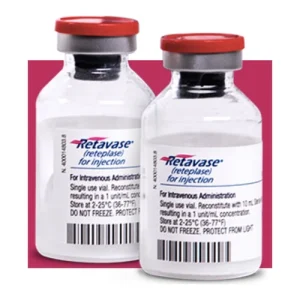
Retavase 10 units Injection
Global Shipping : Reliable Global Distribution Network
Express Delivery : Priority Shipping for Every Order
Secure Payments : Trusted Payment Protection System
 Disclaimer

Secure Handling
24/7 Worldwide Support

Global Access
Worldwide Access to Health

Cold-Chain Expert
Excellence in Cold-Chain

Trusted Supply
Certified Medical Supply
Indications & Clinical Uses
- Retavase 10 units (reteplase) is a recombinant tissue plasminogen activator (thrombolytic, "clot-busting" enzyme) approved in the United States for the treatment of acute ST-elevation myocardial infarction (STEMI) to reduce the risk of death and subsequent heart failure.
- It is given only in a hospital or emergency setting as two intravenous bolus injections of 10 units each, 30 minutes apart, as soon as possible after heart-attack symptoms begin, and is administered exclusively by trained healthcare providers monitoring the patient throughout.
- The label notes that in patients at low risk of death or heart failure from their STEMI, the risk of stroke from Retavase may outweigh its benefit, and treatment decisions are made by the clinical team on a case-by-case basis.
- Retavase is not a treatment a patient self-administers or takes home.
Side Effects
- The most common effect with Retavase is bleeding, which can range from minor bruising to serious internal haemorrhage.
- In clinical trials, injection-site bleeding occurred in up to about half of patients, with gastrointestinal bleeding in roughly 2 to 9 in 100 and genitourinary bleeding in a similar range.
- Bleeding inside the skull (intracranial haemorrhage) occurred in about 8 in 1,000 patients overall, rising to over 2 in 100 in patients older than 70 or with high blood pressure.
- Allergic-type hypersensitivity reactions and cholesterol embolism (blockage of small blood vessels by cholesterol fragments) have also been reported.
- There is no boxed warning on the current Retavase label, but the hospital team watches closely for any sign of bleeding, sudden weakness, confusion, severe headache or bruising during and after the two injections, and treats these as emergencies.
Precautions & Warnings
- Retavase must not be given to patients with active internal bleeding, a history of stroke, recent (within 3 months) brain or spinal surgery or trauma, a known bleeding disorder, severe uncontrolled high blood pressure, or a brain tumour, aneurysm or arteriovenous malformation.
- It is given for intravenous bolus injection only, into a dedicated line; intramuscular injections and unnecessary arterial or venous punctures should be avoided around the time of treatment because of bleeding risk.
- Patients are monitored closely in hospital for bleeding at puncture sites, neurological changes suggesting brain bleeding, and signs of allergic reaction or cholesterol embolisation (livedo reticularis, "purple toe" syndrome, acute kidney injury).
- Because Retavase is a one-off, clinician-administered emergency treatment, there are no missed-dose, storage-at-home or long-term monitoring instructions for the patient.
Avoid Interactions
- Retavase is chemically and physically incompatible with heparin: the label specifically warns that Retavase and heparin must not be mixed together, and Retavase should not be given through an intravenous line that is carrying heparin.
- Medicines that affect blood clotting or platelet function — including other anticoagulants (such as warfarin or heparin given separately), aspirin and other antiplatelet drugs, and NSAIDs — increase the risk of bleeding when used around the time of Retavase and are used only with careful clinical judgement in the STEMI setting.
- The hospital team reviews all of a patient's current medicines, including any blood thinners, before giving Retavase, and monitors closely afterwards for bleeding from any interacting therapy.
References
Frequently Asked Questions
Retavase (reteplase) is a clot-dissolving enzyme given in hospital for acute ST-elevation heart attack (STEMI), to reduce the risk of death and heart failure. It works by breaking down the blood clot blocking a coronary artery. It is not used for other clot conditions or given outside a monitored hospital setting.
Retavase is given as two intravenous bolus injections of 10 units each, 30 minutes apart, by a healthcare provider as soon as possible after heart-attack symptoms start. It is never a tablet or an injection you give yourself; treatment happens entirely in hospital under continuous monitoring.
Bleeding is the most common Retavase side effect, from bruising at the injection site to serious internal or brain bleeding, which affects under 1 in 100 patients overall. Watch for sudden weakness, confusion, severe headache or unusual bruising; the care team treats these as emergencies immediately.
Retavase must never be mixed with, or given through the same line as, heparin — the label states they are incompatible. Blood thinners, aspirin, and NSAIDs raise bleeding risk when used around the time of treatment. Tell the care team about every medicine you take before Retavase is given.
Retavase is avoided in anyone with active internal bleeding, a recent stroke, brain or spinal surgery within 3 months, a bleeding disorder, severe uncontrolled high blood pressure, or a brain aneurysm or tumour, because the clot-dissolving effect could trigger dangerous bleeding, including inside the skull.
No. Retavase's current US prescribing information carries no FDA boxed warning. Its main risk, emphasized throughout the label rather than in a boxed warning, is bleeding, including a small but serious risk of bleeding inside the skull, which is why treatment is given only in a monitored hospital setting.

Trusted & Reliable – Your Partner in Global Distribution.
We provide comprehensive lines of pharmaceutical products to support all your healthcare distribution needs.


