

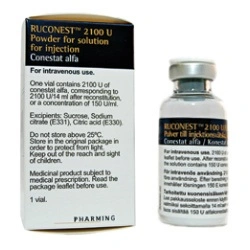
TM Owner Pharming Group
Ruconest 2100U Injection
Global Shipping : Reliable Global Distribution Network
Express Delivery : Priority Shipping for Every Order
Secure Payments : Trusted Payment Protection System
 Disclaimer

Secure Handling
24/7 Worldwide Support

Global Access
Worldwide Access to Health

Cold-Chain Expert
Excellence in Cold-Chain

Trusted Supply
Certified Medical Supply
Indications & Clinical Uses
- Ruconest 2100 U (C1 esterase inhibitor [recombinant]) replaces the natural C1-inhibitor protein that is deficient in hereditary angioedema (HAE), a genetic condition that causes sudden, painful swelling attacks - it is not an allergy medicine, even though swelling can resemble an allergic reaction.
- Ruconest is approved for the treatment of acute HAE attacks in adult and adolescent patients; its effectiveness has not been established for attacks affecting the larynx (throat), which remain a medical emergency regardless.
- Unlike plasma-derived C1-inhibitor products such as Cinryze and Berinert, Ruconest's C1-inhibitor is recombinant, produced in the milk of genetically engineered rabbits rather than from human plasma, which is why rabbit allergy is a specific concern for this product.
- Ruconest is used on demand to treat an attack that has already started, not as regular prophylaxis to prevent attacks.
Side Effects
- Common side effects may include headache, nausea and diarrhoea, generally mild and short-lived.
- Ruconest has NO boxed warning.
- The most serious risk is a severe allergic reaction, including anaphylaxis, which can occur especially in people allergic to rabbits or rabbit-derived products; symptoms include hives, rash, a racing heartbeat, wheezing, chest tightness or feeling faint, and require the infusion to be stopped and emergency treatment given immediately.
- Serious blood clots (thromboembolic events) have been reported with C1-inhibitor products in people with existing clotting risk factors, such as an indwelling catheter or a history of thrombosis; report swelling, pain, warmth or discolouration in an arm or leg promptly.
- Because Ruconest is given by injection, bruising or discomfort at the infusion site can also occur.
Precautions & Warnings
- Ruconest must not be given to anyone with a known or suspected allergy to rabbits or rabbit-derived products, or a history of severe hypersensitivity, including anaphylaxis, to a C1-inhibitor product.
- It should be used with caution in patients with a high risk of thrombosis, such as those with indwelling venous access, atherosclerosis, obesity, or a personal or family history of blood clots.
- Ruconest is given as a slow intravenous injection over about 5 minutes; it must never be given by any other route.
- It has not been formally approved for self-administration, but appropriately trained patients or caregivers may self-inject after specific instruction from a healthcare provider, once an HAE attack is recognised.
- Effectiveness for laryngeal (throat) attacks has not been established, so these remain a medical emergency requiring urgent in-person care regardless of any dose already given at home.
Avoid Interactions
- No formal drug interaction studies have identified clinically significant interactions between Ruconest and other medicines, since it is a protein replacement rather than a small-molecule drug metabolised through the usual liver pathways.
- Ruconest should not be mixed with other medicines or diluents in the same syringe or infusion line; it is reconstituted only with the sterile water for injection and administration set supplied with the kit.
- Caution is advised when Ruconest is used alongside other medicines or conditions that raise clotting risk, since C1-inhibitor products have been linked to thromboembolic events in susceptible patients.
- Tell the healthcare provider about all prescription and over-the-counter medicines, herbal products and supplements taken, and about any personal or family history of blood clots, before Ruconest is prescribed.
References
Frequently Asked Questions
Ruconest (recombinant C1 esterase inhibitor) treats acute attacks of hereditary angioedema (HAE) in adults and adolescents. HAE is a genetic swelling disorder, not a true allergy, caused by low levels of C1-inhibitor protein. Ruconest is not proven effective for throat (laryngeal) attacks, which still need emergency care.
Ruconest powder is reconstituted with sterile water and given as a slow intravenous injection over about 5 minutes, usually by a healthcare provider. Trained patients or caregivers may self-inject after instruction, once an HAE attack starts - it treats attacks, it does not prevent them.
The most common side effects of Ruconest are headache, nausea and diarrhoea. The serious risk is a severe allergic reaction, including anaphylaxis, especially in people allergic to rabbits, since Ruconest is made using rabbit milk. Stop the infusion and get emergency help for hives, wheezing or feeling faint.
Do not use Ruconest if you are allergic to rabbits or rabbit products, or have had a severe reaction to a C1-inhibitor medicine before. Use it cautiously if you have a high risk of blood clots, such as an indwelling catheter or a past clot, and tell your provider about this history.
Store unopened Ruconest vials at 2°C to 25°C, protected from light, and do not freeze. Once reconstituted, use the solution immediately, or store it in the fridge at 2°C to 8°C and use within 8 hours - do not freeze the reconstituted solution either.
No. Ruconest's C1-inhibitor is recombinant, made in rabbit milk, unlike plasma-derived products such as Cinryze or Berinert. It is used on demand for attacks, not as regular prevention. Tell your care team which HAE treatments you've used before, including any reactions.

Trusted & Reliable – Your Partner in Global Distribution.
We provide comprehensive lines of pharmaceutical products to support all your healthcare distribution needs.


