

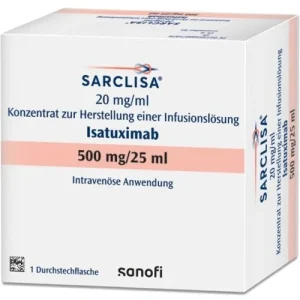
TM Owner Sanofi
Sarclisa 500mg/25ml Injection
Global Shipping : Reliable Global Distribution Network
Express Delivery : Priority Shipping for Every Order
Secure Payments : Trusted Payment Protection System
 Disclaimer

Secure Handling
24/7 Worldwide Support

Global Access
Worldwide Access to Health

Cold-Chain Expert
Excellence in Cold-Chain

Trusted Supply
Certified Medical Supply
Indications & Clinical Uses
- Sarclisa 500 mg/25 mL (isatuximab-irfc, 20 mg/mL concentrate; Sanofi) is a CD38-directed monoclonal antibody for multiple myeloma in adults, always given in combination with other anti-myeloma medicines and never alone.
- It is approved with pomalidomide and dexamethasone for relapsed or refractory disease after at least two prior therapies including lenalidomide and a proteasome inhibitor, with carfilzomib and dexamethasone for relapsed or refractory disease after one to three prior lines, and, in the US, with bortezomib, lenalidomide and dexamethasone for newly diagnosed multiple myeloma in adults not eligible for stem-cell transplant.
- Sarclisa is given only as a hospital or clinic intravenous infusion by trained staff, with pre-medication to reduce infusion reactions - patients never self-administer it.
- Because it binds CD38 on red blood cells, it can interfere with blood bank compatibility testing, so the blood bank must be told a patient is on Sarclisa before any cross-match.
Side Effects
- Infusion-related reactions are very common, affecting around a third of patients, usually during the first infusion, with symptoms such as breathlessness, cough, chills, nausea and low blood pressure - severe reactions can occur, so infusions are given under close observation with pre-medication.
- There is no boxed warning on the current Sarclisa label.
- Serious infections, including pneumonia and upper respiratory infections, occur in almost half of patients and can be fatal; low white cell counts (neutropenia) are very common and increase infection risk.
- Low red cell, platelet and lymphocyte counts, fatigue and diarrhoea are also frequent.
- A small increased risk of second primary cancers has been reported.
- Report fever, chills, new cough, unusual bruising or bleeding, or any reaction during or shortly after an infusion straight away.
Precautions & Warnings
- Before starting Sarclisa, tell the care team about any planned pregnancy, as isatuximab can cause fetal harm and effective contraception is needed during treatment and for 5 months after the last dose; it is not used in pregnancy or breastfeeding.
- Full blood counts are checked regularly because of neutropenia and infection risk, and patients are monitored closely during and after each infusion for reactions, with vital signs checked before, during and after; the infusion rate is slowed or stopped if a reaction occurs.
- Because Sarclisa interferes with the indirect antiglobulin (Coombs) test and some laboratory assessments of myeloma response, patients should carry a card noting Sarclisa treatment, and blood typing should be done before starting if possible.
- Live vaccines are generally avoided during treatment; discuss vaccination timing with the care team.
Avoid Interactions
- Sarclisa is always used together with other anti-myeloma drugs (pomalidomide, carfilzomib, or bortezomib and lenalidomide, plus dexamethasone), and it can add to the myelosuppression (low blood counts) and infection risk of those combination partners, so blood counts are watched closely throughout treatment.
- It interferes with laboratory red blood cell antibody screening (indirect Coombs test) for up to 6 months after the last dose, which can complicate blood transfusion cross-matching - always tell the blood bank about recent Sarclisa treatment.
- It can also interfere with serum protein electrophoresis and immunofixation tests used to monitor myeloma response.
- Tell the oncology team about all other medicines, supplements and any recent or planned vaccinations before each cycle.
References
Frequently Asked Questions
Sarclisa (isatuximab) treats multiple myeloma in adults, always combined with other anti-myeloma medicines like pomalidomide, carfilzomib, or bortezomib and lenalidomide plus dexamethasone. It's used for relapsed disease after prior treatment, and in some countries for newly diagnosed patients who can't have a stem-cell transplant.
Sarclisa is given as an intravenous infusion in a hospital or clinic by trained staff, combined with other myeloma medicines on a cycle schedule. The dose is 10 mg/kg of body weight. You'll receive pre-medication to lower the chance of an infusion reaction, and you don't inject it yourself.
Infusion reactions - breathlessness, chills, nausea or low blood pressure, usually during the first dose - are common with Sarclisa. Low white cell counts, infections and fatigue are also frequent. Tell your care team immediately about fever, chills, new cough, or any reaction during your infusion.
You'll be given medicines beforehand to reduce reaction risk, then Sarclisa is infused slowly while your vital signs are monitored. The first infusion is usually slowest and most closely watched. If a reaction occurs, the infusion is slowed, paused, or stopped and restarted once symptoms settle.
Yes. Sarclisa can cause false-positive results on the blood cross-match test used before transfusions, for up to 6 months after your last dose. Always tell your blood bank and care team you're on Sarclisa. It can also affect tests used to check your myeloma response.
No. Sarclisa can harm an unborn baby, so it isn't used in pregnancy or breastfeeding. Anyone who could become pregnant needs effective contraception during treatment and for 5 months after the last dose. Discuss family planning with your care team before starting.

Trusted & Reliable – Your Partner in Global Distribution.
We provide comprehensive lines of pharmaceutical products to support all your healthcare distribution needs.


