

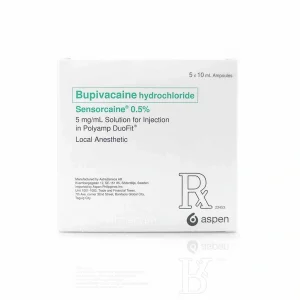
TM Owner Aspen Pharmacare
Sensorcaine 0.50% Injection
Global Shipping : Reliable Global Distribution Network
Express Delivery : Priority Shipping for Every Order
Secure Payments : Trusted Payment Protection System
 Disclaimer

Secure Handling
24/7 Worldwide Support

Global Access
Worldwide Access to Health

Cold-Chain Expert
Excellence in Cold-Chain

Trusted Supply
Certified Medical Supply
Indications & Clinical Uses
- Sensorcaine 0.5% contains bupivacaine hydrochloride, a long-acting local anaesthetic of the amide class.
- It is used by a healthcare provider to produce local or regional anaesthesia and analgesia, including local infiltration, peripheral nerve blocks, and epidural (including caudal) blocks, for surgery, dental procedures, diagnostic and therapeutic procedures, and labour or delivery pain relief in adults.
- Sensorcaine is not self-administered; it is given only by, or under the supervision of, a clinician trained in regional anaesthesia.
- The 0.5% strength is distinct from the higher 0.75% Sensorcaine concentration, which carries added restrictions and is not recommended for obstetric epidural anaesthesia.
- Sensorcaine must never be given intravenously and is not approved for intravenous regional anaesthesia (Bier block) or obstetrical paracervical block.
Side Effects
- Sensorcaine carries a boxed warning: cardiac arrest with difficult or failed resuscitation, sometimes fatal, has been reported when bupivacaine was accidentally injected into a blood vessel during epidural anaesthesia, and the 0.75% concentration (a different strength from this product) is not recommended in obstetrics because of this risk.
- Common reactions include a drop in blood pressure and central nervous system effects such as light-headedness, tingling around the mouth, ringing in the ears, tremor, or, rarely, convulsions, which usually reflect high blood levels from accidental intravascular injection.
- Cardiovascular effects can include a slow heart rate, irregular rhythm, or, in severe cases, cardiac arrest.
- Tell the clinician immediately about dizziness, metallic taste, ringing ears, confusion, chest pain or breathing difficulty during or after the injection.
Precautions & Warnings
- Sensorcaine must be given only by clinicians experienced in regional anaesthesia, with resuscitation equipment immediately available, and aspiration should be performed before and during injection to avoid intravascular administration.
- It is contraindicated for intravenous regional anaesthesia (Bier block) and for obstetrical paracervical block.
- Bupivacaine should be used cautiously in patients with liver disease, since it is metabolised by the liver, and doses should be reduced in debilitated, elderly or acutely ill patients.
- Sensorcaine is not recommended for children under 12 years of age.
- Tell the clinician if you are pregnant, since epidural anaesthesia during labour requires careful dose selection, or if you have heart block, heart failure, or any known allergy to amide-type local anaesthetics before Sensorcaine is given.
Avoid Interactions
- Tell the clinician about all medicines you take before Sensorcaine is given.
- Combining bupivacaine with monoamine oxidase inhibitors or tricyclic antidepressants can cause severe, prolonged low or high blood pressure.
- Ergot-type oxytocic drugs used with Sensorcaine may cause severe hypertension or, rarely, stroke.
- Non-selective beta-blockers taken with bupivacaine can increase the risk of high blood pressure and a slow heart rate.
- Medicines that can trigger methemoglobinemia, such as nitrates, certain antibiotics (sulfonamides, dapsone) and antimalarials, may add to this risk when combined with bupivacaine.
- Multiple-dose (preservative-containing) vials should not be used for epidural or caudal anaesthesia.
References
Frequently Asked Questions
Sensorcaine (bupivacaine) 0.5% is a long-acting local anaesthetic a clinician injects to numb an area for surgery, dental work, or labour and delivery pain relief. It's used for local infiltration, nerve blocks, and epidural anaesthesia in adults, given only by a trained healthcare provider, never by the patient.
Sensorcaine is injected by a clinician near the nerves or tissue to be numbed, using local infiltration, a nerve block, or an epidural/caudal block. You do not inject it yourself. The dose and injection site depend on the procedure, and resuscitation equipment is kept ready during administration.
Sensorcaine can cause light-headedness, tingling around the mouth, ringing in the ears, tremor or a drop in blood pressure. Its boxed warning covers cardiac arrest with difficult resuscitation from accidental injection into a blood vessel. Tell your clinician immediately about chest pain, confusion, or breathing trouble.
Before Sensorcaine is given, tell your clinician about all medicines, including MAOIs, tricyclic antidepressants, ergot-type drugs, and beta-blockers, which can interact with bupivacaine. Sensorcaine must never be given intravenously or as an obstetrical paracervical block, and the 0.75% strength is not used in obstetric epidurals.
Your clinician tests for a response before injecting the full dose and aspirates to check the needle isn't in a blood vessel. You'll be monitored for blood pressure, heart rhythm and breathing during and after the injection, since Sensorcaine acts within minutes and effects can last several hours.
Sensorcaine 0.5% is used in adults, including epidural anaesthesia during labour, but is not recommended for children under 12. Tell your clinician if you're pregnant, since dose and technique are chosen carefully for obstetric use, and the higher 0.75% strength is avoided in obstetric epidurals.

Trusted & Reliable – Your Partner in Global Distribution.
We provide comprehensive lines of pharmaceutical products to support all your healthcare distribution needs.


