

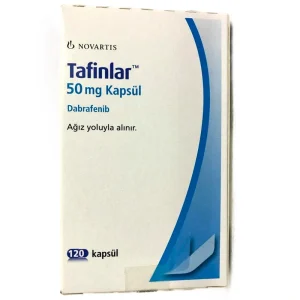
TM Owner Novartis
Tafinlar 50mg Capsule
Global Shipping : Reliable Global Distribution Network
Express Delivery : Priority Shipping for Every Order
Secure Payments : Trusted Payment Protection System
 Disclaimer

Secure Handling
24/7 Worldwide Support

Global Access
Worldwide Access to Health

Cold-Chain Expert
Excellence in Cold-Chain

Trusted Supply
Certified Medical Supply
Indications & Clinical Uses
- Tafinlar 50mg capsules contain dabrafenib, a BRAF-inhibitor targeted cancer medicine marketed by Novartis (originally developed by GlaxoSmithKline).
- As monotherapy, Tafinlar is approved for adults with unresectable or metastatic melanoma whose tumour carries a BRAF V600E mutation, confirmed by an FDA-approved test; it works by blocking the abnormal BRAF protein that drives melanoma cell growth.
- Tafinlar is also approved in combination with the MEK inhibitor trametinib (Mekinist) for BRAF V600-mutated melanoma (including adjuvant treatment after surgery), metastatic non-small cell lung cancer, anaplastic thyroid cancer, certain BRAF V600E-mutated solid tumours regardless of tumour type, and paediatric low-grade glioma.
- It is not indicated for BRAF wild-type melanoma.
- Tafinlar capsules are taken by mouth and are self-administered at home, not given in a clinic.
Side Effects
- The most common side effects of Tafinlar (dabrafenib), occurring in 20% or more of patients taking it alone, include hyperkeratosis (thickened skin patches), headache, fever, joint pain, skin papillomas, hair thinning and rash.
- When combined with trametinib, fever (54-63%), rash, chills, headache and joint pain are the most frequent.
- The current Tafinlar label carries no boxed warning, but any new or changing skin growth must be reported promptly, since dabrafenib can trigger new cutaneous squamous cell carcinoma or keratoacanthoma; skin checks are required before treatment starts, every two months during treatment, and for up to six months after stopping.
- Fever can become high, particularly with trametinib, and may require a dose interruption.
- Seek urgent medical help for a very high fever, chills, severe rash, unusual bleeding or bruising, or new vision changes.
Precautions & Warnings
- Before starting Tafinlar, your healthcare provider confirms BRAF V600E mutation status with an approved test and checks your skin at baseline.
- Dabrafenib can cause fetal harm, so effective non-hormonal contraception is needed during treatment and for two weeks after the last dose, because dabrafenib can reduce the reliability of hormonal contraceptives.
- Tafinlar must not be used in BRAF wild-type melanoma, where it may worsen the disease.
- Caution and dose adjustment are needed with hepatic or renal impairment, and in G6PD deficiency because of a haemolytic anaemia risk.
- Fever should be monitored closely, especially in combination with trametinib.
- Capsules are swallowed whole, one hour before or two hours after food, and must not be substituted for the tablet-for-oral-suspension formulation, which uses a different dosing schedule.
Avoid Interactions
- Dabrafenib is metabolised mainly by the CYP3A4 and CYP2C8 liver enzymes.
- Strong inhibitors of these enzymes, such as ketoconazole, clarithromycin or ritonavir, can raise dabrafenib levels and should be avoided; strong inducers, such as rifampin, phenytoin, carbamazepine or St John's Wort, can lower dabrafenib levels and reduce its effect and should also be avoided.
- Dabrafenib itself strongly induces several drug-metabolising enzymes, so it can make many other medicines less effective, including hormonal contraceptives, warfarin and other CYP substrates; closer monitoring is needed whenever such combinations are unavoidable.
- Tell your healthcare provider about every prescription medicine, over-the-counter product, vitamin and herbal supplement you take, both before starting Tafinlar and before adding or stopping anything else during treatment.
References
Frequently Asked Questions
Tafinlar (dabrafenib) treats adults with melanoma skin cancer that has spread or cannot be removed by surgery, when the tumour carries a BRAF V600E gene mutation confirmed by a specific test. It is also used, combined with trametinib, for certain lung cancers, thyroid cancer and other BRAF-mutated solid tumours.
Tafinlar capsules are swallowed whole with water, one hour before or two hours after a meal, usually twice daily 12 hours apart. You take it yourself at home. Do not chew or crush the capsules. If you miss a dose, skip it and resume at the next scheduled time.
Common side effects of Tafinlar (dabrafenib) include fever, headache, joint pain, thickened skin and new skin growths. Tell your healthcare provider right away about a new or changing mole, a very high fever, chills, or a severe rash, since dabrafenib can trigger new skin cancers needing prompt removal.
Avoid strong CYP3A4 inhibitors such as ketoconazole and clarithromycin, and strong inducers such as rifampin and St John's Wort, since both change dabrafenib blood levels. Dabrafenib can also make hormonal birth control less reliable, so use a non-hormonal method during treatment and for two weeks afterward.
Tafinlar capsules come in two strengths, 50mg and 75mg, which are combined in different amounts to reach your prescribed twice-daily dose. They are not interchangeable one-for-one, and the tablet-for-suspension formulation used in some children is dosed differently again, so always follow the exact prescription given.
No. Dabrafenib can harm an unborn baby, so effective non-hormonal contraception is required during treatment and for two weeks after your last dose, because dabrafenib also weakens hormonal birth control. Tell your healthcare provider immediately if you are pregnant, planning pregnancy, or become pregnant during treatment.

Trusted & Reliable – Your Partner in Global Distribution.
We provide comprehensive lines of pharmaceutical products to support all your healthcare distribution needs.


