

TM Owner Roche / Genentech
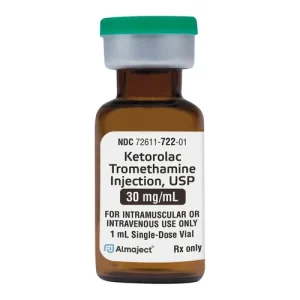
Toradol IV 30mg/mL Injection
Global Shipping : Reliable Global Distribution Network
Express Delivery : Priority Shipping for Every Order
Secure Payments : Trusted Payment Protection System
 Disclaimer

Secure Handling
24/7 Worldwide Support

Global Access
Worldwide Access to Health

Cold-Chain Expert
Excellence in Cold-Chain

Trusted Supply
Certified Medical Supply
Indications & Clinical Uses
- Toradol IV is the sheet's name for ketorolac tromethamine injection, a non-steroidal anti-inflammatory drug (NSAID); the Toradol brand itself has been discontinued in the United States, so this content is sourced from currently marketed generic ketorolac tromethamine injection labels (originally introduced as Toradol by Roche/Syntex).
- It is approved only for short-term (up to 5 days total, combining all routes) management of moderately severe acute pain that would otherwise need an opioid-level analgesic, typically after surgery.
- It is given by intramuscular (IM) or intravenous (IV) injection - the 30 mg/mL, 1 mL single-dose presentation is approved for either IV or IM use, while a higher-volume 2 mL (60 mg) presentation on some ketorolac products is approved for IM use only and is not for IV injection; check the specific vial your pharmacy has dispensed.
- Toradol IV is administered by a healthcare provider in a hospital, operating theatre or clinic, not self-injected at home.
Side Effects
- Toradol IV carries a boxed warning covering several serious NSAID risks: gastrointestinal bleeding, ulceration and perforation that can be fatal and can occur without warning; increased risk of heart attack or stroke, which can occur even early in treatment; and a bleeding risk from reduced platelet function, so it must not be used with other NSAIDs, aspirin, or in anyone at high bleeding risk.
- It must never be given by intrathecal or epidural injection, is contraindicated during labour and delivery, and is not for use while breastfeeding.
- Common effects include drowsiness, dizziness, nausea, indigestion and injection-site pain.
- Report black or bloody stools, vomiting blood, chest pain, sudden weakness, or unusual bruising to your care team immediately.
Precautions & Warnings
- Toradol IV is contraindicated in advanced kidney disease, active peptic ulcer disease or recent GI bleeding, in patients undergoing coronary artery bypass surgery, in known aspirin/NSAID hypersensitivity (including asthma triggered by NSAIDs), and in labour and delivery.
- It must never be given intrathecally or epidurally, because the injection contains alcohol that is neurotoxic by that route.
- Treatment is limited to a maximum of 5 days combined across all forms and routes because of rising GI, renal and bleeding risks with longer use.
- Dose is reduced and closely monitored in elderly patients and in mild-to-moderate kidney or liver impairment; it should be avoided in more severe impairment.
- It should be used with caution in pregnancy, particularly avoided from 20 weeks onward, and is not recommended while breastfeeding.
Avoid Interactions
- Never combine Toradol IV with aspirin or any other NSAID, since this adds no extra benefit but sharply increases bleeding and ulcer risk.
- It increases the effect of anticoagulants such as warfarin and heparin, and of other drugs that affect clotting, raising bleeding risk - blood-thinner doses and clotting tests are monitored closely.
- ACE inhibitors, ARBs and diuretics combined with Toradol IV can reduce kidney function, particularly in dehydrated or elderly patients.
- Probenecid raises ketorolac blood levels substantially and the two must not be combined.
- Lithium and methotrexate levels can rise to toxic levels with Toradol IV.
- Tell your care team about every prescription and over-the-counter medicine, especially blood thinners, other pain relievers and lithium, before you receive this injection.
References
Frequently Asked Questions
Toradol IV (ketorolac tromethamine) is an injectable NSAID given intravenously for moderately severe pain, often after surgery, for up to 5 days. The Toradol brand is discontinued in the US; this is the generic ketorolac tromethamine injection at the same 30 mg/mL strength, given by IV.
Toradol IV is given as a slow intravenous injection by a healthcare provider, usually in an operating theatre, recovery unit or hospital ward. Not every ketorolac vial is approved for IV use - a larger 60 mg/2 mL presentation on some products is for intramuscular injection only.
Toradol IV's boxed warning covers stomach bleeding or ulcers, heart attack or stroke risk, and increased bleeding from reduced platelet function. Common effects include drowsiness, dizziness and nausea. Report black stools, chest pain or sudden weakness immediately to your care team.
Never combine Toradol IV with aspirin or another NSAID, since this raises bleeding and ulcer risk without extra pain relief. Blood thinners, lithium and methotrexate levels or effects can be increased by Toradol IV - your care team reviews all your other medicines first.
Toradol IV is limited to 5 days total treatment, combining IV, IM and any oral ketorolac given, because longer use raises stomach bleeding, kidney and heart risks. It is typically given around the time of surgery, then stopped in favour of another pain reliever.
Toradol IV is contraindicated during labour and delivery and should be avoided in pregnancy from 20 weeks onward, since NSAIDs can affect the baby's circulation and reduce amniotic fluid late in pregnancy. It is also not recommended while breastfeeding.

Trusted & Reliable – Your Partner in Global Distribution.
We provide comprehensive lines of pharmaceutical products to support all your healthcare distribution needs.


