

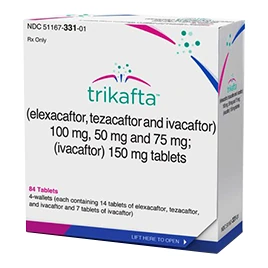
TM Owner Vertex Pharmaceuticals
Trikafta 100mg/50mg/75mg + 150mg Tablet
Global Shipping : Reliable Global Distribution Network
Express Delivery : Priority Shipping for Every Order
Secure Payments : Trusted Payment Protection System
 Disclaimer

Secure Handling
24/7 Worldwide Support

Global Access
Worldwide Access to Health

Cold-Chain Expert
Excellence in Cold-Chain

Trusted Supply
Certified Medical Supply
Indications & Clinical Uses
- Trikafta combines the CFTR modulators elexacaftor, tezacaftor and ivacaftor (taken each morning) with ivacaftor alone (taken each evening), supplied as a 28-day, 84-tablet monthly carton for the 100mg/50mg/75mg-plus-150mg strength, or as oral granules for younger children.
- It is approved for cystic fibrosis in patients aged 2 years and older who have at least one F508del mutation or another CFTR mutation responsive to the combination, confirmed by genetic testing.
- By improving the function of the faulty CFTR protein, it can improve lung function and reduce pulmonary exacerbations.
- Dosing and tablet strength depend on age and body weight, so younger or lighter children use a lower-strength combination.
- Trikafta is a self-administered oral medicine taken at home and carries a boxed warning for serious liver injury, discussed below.
Side Effects
- Trikafta carries a boxed warning for drug-induced liver injury and liver failure: cases of liver failure leading to transplantation or death have occurred, with or without pre-existing liver problems, so liver blood tests are checked before starting, monthly for the first six months, then quarterly for a year, then annually.
- Seek medical help immediately for right-upper-abdominal pain, yellowing of the skin or eyes, dark urine, loss of appetite, nausea or confusion.
- Common side effects include headache, upper respiratory infection symptoms, stomach pain, diarrhoea, and rash.
- Less common but serious effects include hypersensitivity reactions, high blood pressure, and, in children, early lens changes (cataracts), for which baseline and follow-up eye exams are recommended.
- Report any new rash, breathing difficulty, or vision changes to your care team promptly.
Precautions & Warnings
- Because of the boxed warning for liver injury, Trikafta should be used with caution and closer monitoring in people with any history of liver disease, and it is contraindicated in severe hepatic impairment (Child-Pugh Class C) and not generally recommended in moderate impairment.
- Reduce the dose in mild-to-moderate liver impairment as directed.
- Grapefruit and grapefruit juice should be avoided, as they increase drug levels.
- Baseline and periodic eye examinations are advised in children because of a cataract signal seen in trials.
- Discuss family planning with your care team, as cystic fibrosis pregnancy management needs specialist input.
- There is no specific driving restriction, but tell your doctor about dizziness or fatigue.
- Regular sinus, lung function and nutritional monitoring continues alongside Trikafta.
Avoid Interactions
- Trikafta is broken down mainly by the CYP3A enzyme, so strong CYP3A inhibitors — such as ketoconazole, itraconazole and clarithromycin — require a reduced Trikafta dose, and grapefruit or grapefruit juice should be avoided for the same reason.
- Strong CYP3A inducers, including rifampicin, phenytoin, carbamazepine and St John's Wort, significantly reduce Trikafta's effect and should generally be avoided.
- Moderate CYP3A inhibitors also require a dose adjustment.
- Because other cystic fibrosis medicines and multiple daily prescriptions are common, always give your care team a full, updated list of every medicine, herbal product and supplement, including new antibiotics or antifungals started for a chest infection, before continuing Trikafta.
References
Frequently Asked Questions
Trikafta treats cystic fibrosis in people aged 2 and over who have at least one responsive CFTR gene mutation, confirmed by genetic testing. It contains elexacaftor, tezacaftor and ivacaftor, which help a faulty CFTR protein work better, improving lung function and reducing flare-ups.
Trikafta tablets are taken by mouth twice daily with fat-containing food: one morning tablet combining elexacaftor, tezacaftor and ivacaftor, and one evening tablet of ivacaftor alone, about 12 hours apart. Dose and strength depend on age and weight; younger children may use granules instead.
Common effects include headache, stomach pain, diarrhoea and rash. Trikafta carries a boxed warning for serious liver injury: get urgent care for abdominal pain, yellowing skin or eyes, dark urine, or confusion. Regular liver blood tests are required, especially in the first six months.
Avoid grapefruit and grapefruit juice, which raise Trikafta levels. Certain antibiotics, antifungals and seizure medicines can also interact strongly, either raising levels (needing a lower Trikafta dose) or lowering them (making it less effective), so tell your care team about every new medicine.
Trikafta needs liver function blood tests before starting, monthly for six months, then quarterly for a year, then yearly, because of its liver injury warning. Children also need baseline and follow-up eye exams, since cataracts have been seen in some younger patients during trials.
Yes. Trikafta is approved from age 2, using the tablet or oral granule strength matched to the child's age, weight and CFTR mutation type. Younger children need periodic eye exams and follow the same liver-monitoring schedule as adults while taking it.

Trusted & Reliable – Your Partner in Global Distribution.
We provide comprehensive lines of pharmaceutical products to support all your healthcare distribution needs.


