

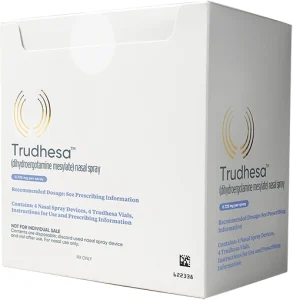
TM Owner Impel Pharmaceuticals
Trudhesa 0.725mg Nasal Spray
Global Shipping : Reliable Global Distribution Network
Express Delivery : Priority Shipping for Every Order
Secure Payments : Trusted Payment Protection System
 Disclaimer

Secure Handling
24/7 Worldwide Support

Global Access
Worldwide Access to Health

Cold-Chain Expert
Excellence in Cold-Chain

Trusted Supply
Certified Medical Supply
Indications & Clinical Uses
- Trudhesa 0.725mg/spray (dihydroergotamine mesylate), made by Impel Pharmaceuticals (the company formerly named Impel NeuroPharma, renamed in April 2022), is approved in the US for the acute treatment of migraine with or without aura in adults; it is not approved for migraine prevention and should not be used for hemiplegic or basilar migraine.
- Each dose is 1.45mg, delivered as one spray (0.725mg) into each nostril using the Trudhesa Precision Olfactory Delivery (POD) nasal device.
- Trudhesa carries a boxed warning: serious, potentially life-threatening reduction in blood flow to the limbs (peripheral ischaemia) can occur if it is taken together with a strong CYP3A4 inhibitor, so these combinations must be avoided.
- It is a nasally delivered form of dihydroergotamine, distinct from injectable DHE and from oral or nasal triptans, and must not be combined with another ergot-type or triptan-type migraine medicine within 24 hours.
Side Effects
- The most common Trudhesa side effects are rhinitis (nasal irritation, affecting roughly 1 in 4 users), nausea, an altered sense of taste, and application-site reactions in the nose; dizziness, sore throat, vomiting, drowsiness and diarrhoea have also been reported.
- Trudhesa's boxed warning covers serious and sometimes life-threatening peripheral ischaemia - cold, pale or painful fingers, toes or other extremities - when it is combined with a strong CYP3A4 inhibitor such as certain protease inhibitors, macrolide antibiotics or antifungal medicines; stop Trudhesa and seek urgent care if these symptoms occur.
- As with other ergot-type medicines, chest pain, tingling, numbness or signs of a heart or vascular event need immediate medical attention.
- Report a persistent bad taste, worsening nasal irritation, or any sign of an allergic reaction, such as swelling of the face or throat.
Precautions & Warnings
- Trudhesa must not be used by anyone with ischaemic heart disease, coronary artery vasospasm (including Prinzmetal's angina), uncontrolled high blood pressure, peripheral arterial disease, or within a short time of vascular surgery, and it must not be combined with a strong CYP3A4 inhibitor because of the boxed-warning risk of peripheral ischaemia.
- It must not be taken within 24 hours of another ergot-type medicine or a triptan, and should not be combined with other vasoconstrictors.
- Trudhesa should be avoided in sepsis, severe hepatic or renal impairment, and in known hypersensitivity to ergot alkaloids.
- Its effects in pregnancy have not been established, and dihydroergotamine can affect uterine contractions, so it should generally be avoided during pregnancy; discuss breastfeeding with a healthcare provider, as it passes into breast milk.
- Use with caution in patients with risk factors for peripheral vascular disease, such as heavy smoking.
Avoid Interactions
- Strong CYP3A4 inhibitors - including ritonavir and other HIV protease inhibitors, ketoconazole and itraconazole, and macrolide antibiotics such as clarithromycin and erythromycin - must not be combined with Trudhesa, as this combination has caused serious, sometimes fatal, peripheral and cerebral ischaemia.
- Moderate CYP3A4 inhibitors should be used with caution and close monitoring.
- Do not take Trudhesa within 24 hours of another dihydroergotamine or ergotamine-containing medicine, or of a triptan-type migraine drug, because of additive vasoconstriction.
- Beta-blockers and nicotine can also increase vasoconstriction when combined with Trudhesa, and SSRIs/SNRIs have rarely been linked to weakness, hyperreflexia and poor coordination when combined with ergot medicines.
- Tell your healthcare provider about every prescription, over-the-counter and herbal medicine you take before using Trudhesa.
References
Frequently Asked Questions
Trudhesa (dihydroergotamine mesylate) treats a migraine attack, with or without aura, in adults once it has started. It is not used to prevent migraines and is not suitable for hemiplegic or basilar migraine. Each dose delivers one spray into each nostril.
Use Trudhesa as soon as a migraine starts: one spray (0.725 mg) into each nostril for a 1.45 mg dose. You can repeat once after at least 1 hour if needed, up to 2 doses in 24 hours and 3 doses in 7 days.
Common Trudhesa side effects include nasal irritation, nausea and an altered sense of taste. Its boxed warning covers serious reduced blood flow to the limbs when combined with certain drugs; stop Trudhesa and get urgent care for cold, pale or painful fingers or toes.
Avoid strong CYP3A4 inhibitors, such as ritonavir, ketoconazole and clarithromycin, which raise the risk of dangerous reduced blood flow with Trudhesa. Do not take another ergot medicine or a triptan within 24 hours of using Trudhesa.
Store Trudhesa at room temperature, 20°C to 25°C; do not refrigerate or freeze it. Once you open a Trudhesa vial, discard it after 8 hours, even if some medicine remains, and keep it out of children's reach.
Trudhesa is generally not recommended in pregnancy, since dihydroergotamine can affect the uterus and its safety in pregnancy has not been established. Tell your healthcare provider if you are pregnant, trying to conceive, or breastfeeding before using Trudhesa.

Trusted & Reliable – Your Partner in Global Distribution.
We provide comprehensive lines of pharmaceutical products to support all your healthcare distribution needs.


