

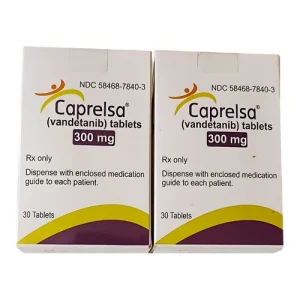
TM Owner Sanofi Genzyme
Vandetanib Oral 300mg Tablet
Global Shipping : Reliable Global Distribution Network
Express Delivery : Priority Shipping for Every Order
Secure Payments : Trusted Payment Protection System
 Disclaimer

Secure Handling
24/7 Worldwide Support

Global Access
Worldwide Access to Health

Cold-Chain Expert
Excellence in Cold-Chain

Trusted Supply
Certified Medical Supply
Indications & Clinical Uses
- Vandetanib (marketed as CAPRELSA) is indicated for treatment of symptomatic or progressive medullary thyroid cancer (MTC) in patients with unresectable locally advanced or metastatic disease.
- This is an oral kinase inhibitor targeting RET, EGFR, and VEGFR pathways.
- The approved strength is 300 mg film-coated tablets.
- Note: the brand name in this listing (Vandetanib Oral) does not match the approved brand name (CAPRELSA), though the active ingredient and indication are correct.
- Treatment requires baseline and periodic QTc monitoring.
Side Effects
- Vandetanib carries a black box warning for QT prolongation risk: the drug can prolong QT interval, and torsades de pointes and sudden death have occurred.
- Most common adverse reactions include diarrhea/colitis (57%), rash (53%), acneiform dermatitis (35%), hypertension (33%), and nausea (33%).
- Serious reactions include interstitial lung disease, hemorrhage, heart failure, and stroke risk.
- Monitor for QTc prolongation via ECG.
- Report chest pain, severe diarrhea, shortness of breath, or skin rash immediately.
Precautions & Warnings
- Vandetanib is contraindicated in congenital long QT syndrome and in patients with hypocalcemia, hypokalemia, or hypomagnesemia (electrolyte abnormalities prolong QT).
- Do not use with drugs that prolong QT interval (antiarrhythmics, some antibiotics, some antiemetics).
- Strong CYP3A4 inducers like rifampicin decrease exposure by 40%.
- Strong CYP3A4 inhibitors increase vandetanib levels.
- Avoid St. John's wort.
- Monitor QTc interval via ECG at baseline and periodically.
- Assess renal and hepatic function before and during therapy.
- Pregnancy category X—absolute contraindication.
Avoid Interactions
- Avoid strong CYP3A4 inducers (rifampicin) which reduce vandetanib levels by 40%.
- Avoid QT-prolonging drugs including certain antiarrhythmics (sotalol, amiodarone), antibiotics (fluoroquinolones, macrolides), and antiemetics (ondansetron, granisetron).
- Strong CYP3A4 inhibitors (ketoconazole, ritonavir) increase vandetanib levels.
- Vandetanib increases digoxin and metformin levels—monitor for toxicity.
- Tell your doctor about all medications.
- Avoid St. John's wort and grapefruit juice.
References
Frequently Asked Questions
Vandetanib (marketed as CAPRELSA) 300 mg treats symptomatic or progressive medullary thyroid cancer (MTC) in patients with unresectable locally advanced or metastatic disease. It is an oral kinase inhibitor blocking RET, EGFR, and VEGFR pathways. One tablet taken daily provides continuous targeted therapy for advanced thyroid cancer.
Take one CAPRELSA (vandetanib) 300 mg film-coated tablet by mouth once daily with or without food. Swallow whole; do not crush or chew. Regular blood work and heart monitoring (ECG) are required. Your doctor will assess kidney and liver function before and during treatment. Do not stop without consulting your doctor.
CAPRELSA has a black box warning for QT prolongation: it can lengthen heart rhythm intervals, causing dangerous arrhythmias (torsades de pointes) and sudden death. Baseline ECG and periodic monitoring are essential. Do not use if you have long QT syndrome or low potassium, calcium, or magnesium. Seek immediate care for fainting or severe chest pain.
The most frequent side effects are diarrhea/colitis (57%), rash (53%), acne-like dermatitis (35%), high blood pressure (33%), and nausea (33%). Serious but less common side effects include lung inflammation, bleeding, heart failure, and stroke. Most patients experience diarrhea and skin rash. Report severe symptoms to your doctor.
Do not use if you have long QT syndrome or low potassium, calcium, or magnesium. Avoid QT-prolonging medications (certain antibiotics, heart drugs, anti-nausea drugs). Avoid strong CYP3A4 inducers (rifampicin) and St. John's wort. Do not use if pregnant (category X). Tell your doctor about all medications, especially heart and kidney drugs.
Baseline ECG and electrolyte panel (potassium, calcium, magnesium) are required. Periodic ECGs monitor QTc interval throughout treatment. Blood tests check kidney and liver function before and during therapy. Your doctor will schedule regular follow-ups. Do not miss scheduled tests—they ensure safe and effective therapy.

Trusted & Reliable – Your Partner in Global Distribution.
We provide comprehensive lines of pharmaceutical products to support all your healthcare distribution needs.


