

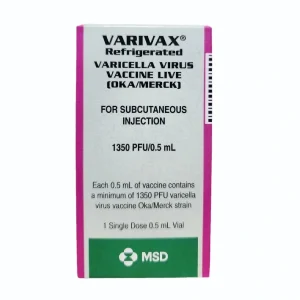
TM Owner Merck Sharp & Dohme LLC
Varivax 1350 PFU/0.5mL Injection, powder, lyophilized, for suspension
Global Shipping : Reliable Global Distribution Network
Express Delivery : Priority Shipping for Every Order
Secure Payments : Trusted Payment Protection System
 Disclaimer

Secure Handling
24/7 Worldwide Support

Global Access
Worldwide Access to Health

Cold-Chain Expert
Excellence in Cold-Chain

Trusted Supply
Certified Medical Supply
Indications & Clinical Uses
- Varivax (varicella virus vaccine live; at least 1350 plaque-forming units per 0.5 mL dose, Merck Sharp & Dohme LLC) is a live attenuated vaccine for active immunisation to prevent chickenpox (varicella) in people aged 12 months and older.
- It is supplied as a freeze-dried powder that is stored frozen, mixed with the supplied diluent and given by a healthcare provider as a 0.5 mL injection into muscle or under the skin.
- Children aged 12 months to 12 years receive a first dose at 12 to 15 months and a second dose at 4 to 6 years (at least 3 months apart); people aged 13 years and older receive two doses at least 4 weeks apart.
- It can also be used after exposure and in outbreak control.
- Do not confuse it with Varilrix (GSK), a different varicella vaccine with its own potency and schedule.
Side Effects
- In children aged 1 to 12 years after one dose, injection-site complaints occurred in about 19% and fever of 38.9°C or higher in about 15%; a varicella-like rash occurred at the injection site in about 3% and elsewhere on the body in about 4%.
- In adolescents and adults, injection-site complaints affected about 24% after dose 1 and 33% after dose 2, and fever affected about 10% per dose.
- Other reported effects include upper respiratory illness, cough, irritability, headache and muscle aches.
- Rare serious reactions reported include encephalitis, Guillain-Barre syndrome, low platelets and Stevens-Johnson syndrome.
- The label has no boxed warning.
- Seek urgent help for breathing difficulty, swelling of the face or throat, seizures or a widespread blistering rash.
Precautions & Warnings
- Varivax must not be given to anyone with a severe allergy to any component (including neomycin and gelatin) or to a previous dose, with immunodeficiency or immunosuppression from disease or treatment, with a moderate or severe fever illness (above 38.5°C), with untreated active tuberculosis, or who is pregnant.
- Pregnancy must be avoided for 3 months after vaccination.
- Vaccination is deferred when there is a family history of immunodeficiency until immune competence is confirmed.
- Vaccinated people should avoid close contact for up to 6 weeks with high-risk susceptible people such as newborns, pregnant women without chickenpox history and immunocompromised people.
- Varivax may temporarily reduce tuberculin skin test sensitivity.
- Store frozen at -50°C to -15°C; mixed vaccine must be used within 30 minutes and never frozen.
Avoid Interactions
- Increase risk: salicylates (aspirin) should be avoided for 6 weeks after vaccination in children and adolescents because of Reye syndrome, and immunosuppressive treatments make the live vaccine unsafe.
- May reduce effect: immune globulins and blood products, which should not be given at the same time and need the intervals recommended by vaccination guidelines; and tuberculin skin testing, which should be done before vaccination or at least 4 weeks after.
- Other live vaccines can be given at the same visit or must be separated by at least 1 month (measles-containing vaccines) or 3 months (other varicella-containing vaccines in children).
- Inactivated vaccines can be given at separate injection sites.
- Tell your healthcare provider about all medicines, supplements, transfusions and recent vaccines.
References
Frequently Asked Questions
Varivax (varicella virus vaccine live) prevents chickenpox in people aged 12 months and older. It is a weakened live virus vaccine given by injection. It may not protect everyone. Two doses are given, and it is injected by a healthcare provider.
Varivax is mixed from freeze-dried powder and injected as 0.5 mL into muscle or under the skin by a healthcare provider. Children get doses at 12 to 15 months and 4 to 6 years. Those aged 13 and older get two doses at least 4 weeks apart.
Common Varivax side effects are injection-site pain, swelling or redness, fever and a mild chickenpox-like rash. Rarely, encephalitis or severe allergic reactions occur. Seek urgent help for breathing difficulty, throat swelling, seizures or a widespread blistering rash after vaccination. No boxed warning is on the label.
After Varivax, avoid aspirin and other salicylates for 6 weeks. Avoid close contact for up to 6 weeks with newborns, pregnant women and immunocompromised people who have not had chickenpox. Avoid pregnancy for 3 months. Do not have a tuberculin skin test within 4 weeks of vaccination.
Varivax (live varicella vaccine) must not be given if you have a severe allergy to neomycin, gelatin or a past dose, a weakened immune system, a moderate or severe fever, untreated tuberculosis, or pregnancy. Tell your healthcare provider about transfusions and immune globulin, which can interfere with the vaccine.
No. Varivax is a live vaccine and is contraindicated in pregnancy, and pregnancy must be avoided for 3 months afterwards. A pregnancy registry has not shown extra miscarriage or birth defects after accidental exposure. Tell your healthcare provider if you are or may be pregnant.

Trusted & Reliable – Your Partner in Global Distribution.
We provide comprehensive lines of pharmaceutical products to support all your healthcare distribution needs.


