

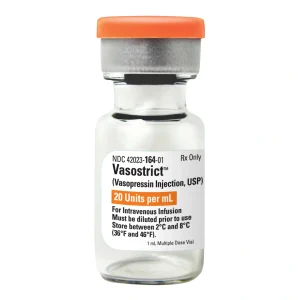
TM Owner Endo Pharmaceuticals
Vasopressin 20 units/mL IV Injection
Global Shipping : Reliable Global Distribution Network
Express Delivery : Priority Shipping for Every Order
Secure Payments : Trusted Payment Protection System
 Disclaimer

Secure Handling
24/7 Worldwide Support

Global Access
Worldwide Access to Health

Cold-Chain Expert
Excellence in Cold-Chain

Trusted Supply
Certified Medical Supply
Indications & Clinical Uses
- Vasopressin 20 units/mL injection contains vasopressin, a synthetic form of the natural antidiuretic hormone that narrows blood vessels (a vasopressor).
- The Endo-labelled generic label could not be fetched, so this text follows the US Vasostrict label (Par Health USA / Endo USA) and other US vasopressin 20 units/mL labels.
- In the US it is approved to increase blood pressure in adults with vasodilatory shock (for example septic or post-cardiotomy shock) who remain low in blood pressure despite fluids and catecholamines.
- It is given only in hospital by trained healthcare professionals as an intravenous infusion, and the 20 units/mL vial must be diluted before use.
- It is not the same as a ready-to-use premixed vasopressin bag or as desmopressin.
Side Effects
- The most common reactions in the label are decreased cardiac output, slow heartbeat (bradycardia), fast or irregular heart rhythms (tachyarrhythmias), low blood sodium (hyponatremia) and reduced blood supply (ischemia) to the heart, gut and skin or fingers and toes; frequencies are not stated.
- Other reported problems include hemorrhagic shock, right heart failure, acute kidney injury and limb or bowel ischemia.
- After the infusion stops, a reversible diabetes insipidus (passing large amounts of dilute urine) can occur.
- The label carries no boxed warning.
- Because the medicine is given by an infusion under monitoring, staff will watch for chest pain, cold or discoloured limbs, and changes in urine output, and will adjust or stop the infusion if needed.
Precautions & Warnings
- Vasopressin must not be used in anyone with a known allergy to vasopressin; the 10 mL multiple-dose vials also contain chlorobutanol and must not be used in people allergic to it.
- The infusion is titrated by the care team to blood pressure, and it can lower cardiac output, so heart function is watched.
- Tissue ischemia (heart, gut, skin) is a recognised risk.
- Electrolytes such as sodium are checked, and after stopping the medicine, urine output and sodium are monitored for diabetes insipidus.
- In pregnancy it may cause uterine contractions, and clearance rises about four- to five-fold by the third trimester, so dosing may need adjusting; there is no human data.
- Vials must be diluted in normal saline or 5% dextrose before infusion.
Avoid Interactions
- Medicines that increase the pressor effect or its risks: catecholamines (additive effect, so haemodynamic monitoring is advised), indomethacin (may prolong the effect of vasopressin and roughly double how long it lasts), ganglionic blockers, and medicines that can cause SIADH such as SSRIs, haloperidol and methyldopa.
- Medicines that reduce the effect: those that can cause diabetes insipidus, such as lithium and demeclocycline.
- Pharmacy point: dilute only with normal saline or 5% dextrose; discard diluted solution after 18 hours at room temperature or 24 hours refrigerated.
- The care team should be told about all medicines and supplements you take.
References
Frequently Asked Questions
Vasopressin injection (vasopressin) is a hospital medicine that raises blood pressure in adults with vasodilatory shock, such as septic shock, whose blood pressure stays low despite fluids and catecholamines. It is given by a drip into a vein by trained staff, and the dose is adjusted to your blood pressure response.
Vasopressin injection (vasopressin) is given only in hospital as a continuous intravenous infusion. The 20 units/mL vial is diluted in normal saline or 5% dextrose first. Staff start with a low dose and change it every 10 to 15 minutes according to your blood pressure.
Vasopressin injection (vasopressin) commonly causes reduced heart output, a slow or irregular heartbeat, low blood sodium and reduced blood flow to the heart, gut, skin or fingers and toes. Tell staff at once about chest pain, or cold or pale limbs. Doctors may reduce or stop the infusion if this happens.
Tell the team about all your medicines before Vasopressin injection (vasopressin). Indomethacin can prolong its effect, and catecholamines, SSRIs, haloperidol and methyldopa can raise it. Lithium and demeclocycline can reduce it. Vasopressin must not be used if you are allergic to it, or to chlorobutanol in the 10 mL vial.
During Vasopressin injection (vasopressin) treatment, staff monitor blood pressure, heart rate, heart output and signs of poor blood flow such as cold limbs, along with blood sodium. After it is stopped, they check urine output and sodium for diabetes insipidus, which is reversible.
Yes. Vasopressin injection (vasopressin) 20 units/mL vials must be diluted in normal saline or 5% dextrose, to 0.1 or 1 unit/mL, before infusion. Ready-made premixed bags need no dilution and are a different product. Diluted solution is discarded after 18 hours at room temperature or 24 hours refrigerated.

Trusted & Reliable – Your Partner in Global Distribution.
We provide comprehensive lines of pharmaceutical products to support all your healthcare distribution needs.


