

TM Owner Merck Sharp & Dohme LLC
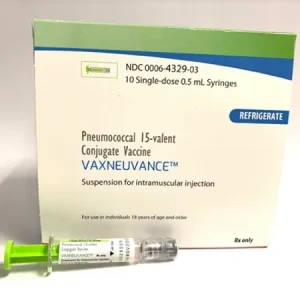
Vaxneuvance 0.5ml Injection
Global Shipping : Reliable Global Distribution Network
Express Delivery : Priority Shipping for Every Order
Secure Payments : Trusted Payment Protection System
 Disclaimer

Secure Handling
24/7 Worldwide Support

Global Access
Worldwide Access to Health

Cold-Chain Expert
Excellence in Cold-Chain

Trusted Supply
Certified Medical Supply
Indications & Clinical Uses
- Vaxneuvance 0.5 mL is a 15-valent pneumococcal conjugate vaccine, in which polysaccharides from 15 types of Streptococcus pneumoniae (1, 3, 4, 5, 6A, 6B, 7F, 9V, 14, 18C, 19A, 19F, 22F, 23F and 33F) are linked to CRM197 carrier protein and adsorbed.
- In the United States it is approved for active immunisation to prevent invasive pneumococcal disease in people aged 6 weeks and older; the label does not claim protection against ear infection or pneumonia.
- Babies usually have four doses at 2, 4, 6 and 12 to 15 months, older children have one to three doses depending on history, and adults have a single dose.
- It is given by a healthcare provider as an intramuscular injection from a single-dose prefilled syringe.
- Other pneumococcal vaccines cover different sets of types.
Side Effects
- In babies, very common effects include irritability (about 57 to 63 percent), drowsiness (about 24 to 48 percent), pain at the injection site (about 26 to 40 percent) and fever of 38°C or above (about 13 to 20 percent).
- In children aged 2 to 17 years, injection-site pain, muscle aches and swelling are most common.
- In adults, injection-site pain affects about two thirds to three quarters of people, with tiredness and muscle aches also common.
- Serious allergic reactions can occur; seek urgent help for difficulty breathing, swelling of the face or throat, or a widespread rash.
- Premature babies may have pauses in breathing (apnoea) after vaccination.
- The US label carries no boxed warning.
- Reactions are usually short-lived.
Precautions & Warnings
- Vaxneuvance must not be given to anyone who has had a severe allergic reaction, such as anaphylaxis, to any of its components or to diphtheria toxoid; treatment for anaphylaxis must be available at the time of vaccination.
- In premature babies, the risk of apnoea is considered when deciding on timing, and effectiveness in premature infants has not been established.
- People with a weakened immune system, including those on immunosuppressive treatment, may respond less well.
- There are no adequate studies in pregnant women, although animal studies showed no harm to the foetus, and it is not known whether the vaccine passes into breast milk, so your provider will weigh benefit and risk.
- Store the syringe refrigerated at 2°C to 8°C, protect from light, and do not freeze.
- The syringe tip cap and plunger stopper are not made with natural rubber latex.
Avoid Interactions
- Immunosuppressive treatment may reduce the immune response, so protection may be weaker.
- The label supports giving Vaxneuvance at the same visit as routine childhood and adult vaccines, and a 4-dose series that was started with a lower-valency pneumococcal conjugate vaccine can be completed with Vaxneuvance.
- Different pneumococcal vaccines cover different types, so follow your provider's schedule rather than mixing products yourself.
- Tell your healthcare provider about all medicines and supplements you take, any past reaction to a vaccine or to a diphtheria-containing vaccine, and any condition that affects your immune system, including HIV infection or sickle cell disease.
References
Frequently Asked Questions
Vaxneuvance is a 15-valent pneumococcal conjugate vaccine that helps prevent invasive disease caused by Streptococcus pneumoniae in people aged 6 weeks and older. It covers 15 pneumococcal types. The US label does not claim protection against ear infection or pneumonia.
Vaxneuvance is given by a healthcare provider as a 0.5 mL injection into the muscle. Babies usually have four doses, at 2, 4, 6 and 12 to 15 months. Older children need one to three doses depending on their history. Adults aged 18 and over have a single dose.
Vaxneuvance commonly causes pain at the injection site, plus irritability, drowsiness and fever in babies, and muscle aches and tiredness in older children and adults. Serious allergic reactions are possible, so seek urgent help for breathing difficulty or facial swelling. Premature babies may have breathing pauses. There is no boxed warning.
Do not have Vaxneuvance if you or your child has had a severe allergic reaction, such as anaphylaxis, to any of its components or to diphtheria toxoid. Tell the provider about any weakened immune system, because protection may be lower, and about premature birth in babies.
Yes, the label supports giving Vaxneuvance with routine childhood and adult vaccines. A four-dose series started with a lower-valency pneumococcal conjugate vaccine can be finished with Vaxneuvance. Immunosuppressive medicines may reduce your response, so tell your provider about every medicine you take.
There are no adequate studies of Vaxneuvance in pregnant women, although animal studies showed no harm to the foetus, and it is unknown whether it passes into breast milk. Your healthcare provider will weigh the benefits and risks with you before vaccination.

Trusted & Reliable – Your Partner in Global Distribution.
We provide comprehensive lines of pharmaceutical products to support all your healthcare distribution needs.


