

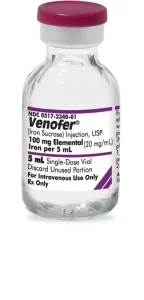
TM Owner American Regent
Venofer 100mg/5mL Injection
Global Shipping : Reliable Global Distribution Network
Express Delivery : Priority Shipping for Every Order
Secure Payments : Trusted Payment Protection System
 Disclaimer

Secure Handling
24/7 Worldwide Support

Global Access
Worldwide Access to Health

Cold-Chain Expert
Excellence in Cold-Chain

Trusted Supply
Certified Medical Supply
Indications & Clinical Uses
- Venofer 100mg/5mL is an intravenous iron replacement medicine containing iron sucrose (20 mg/mL) in a single-dose vial.
- In the US it is indicated for the treatment of iron deficiency anaemia in patients with chronic kidney disease (CKD), including those on haemodialysis, peritoneal dialysis or not on dialysis; use in children is described in a separate paediatric section of the label.
- It is given only by a healthcare provider in a clinic, dialysis unit or hospital, by slow intravenous injection or intravenous infusion.
- It must not be given any other way.
- Typical adult schedules in the US label are 100 mg per haemodialysis session, 200 mg on five occasions over 14 days in non-dialysis CKD, or three divided infusions over 28 days in peritoneal dialysis.
Side Effects
- Common side effects reported in at least 2% of adults include diarrhoea, nausea, vomiting, headache, dizziness, low blood pressure (hypotension), itching, pain in the arm or leg, joint pain, back pain and muscle cramps.
- Low blood pressure was most frequent in haemodialysis patients (about 39%).
- MedlinePlus also lists constipation, tiredness, taste changes, fever and irritation at the injection site.
- Serious hypersensitivity reactions, including anaphylactic-type reactions, can occur, as can clinically significant hypotension.
- The label has no boxed warning.
- Tell your care team immediately if you develop difficulty breathing, swelling of the face or throat, hives, fainting, chest pain or an irregular heartbeat during or after an infusion.
Precautions & Warnings
- Venofer is contraindicated in anyone with known hypersensitivity to it.
- Because serious hypersensitivity can occur, you should be observed for at least 30 minutes after each dose.
- Blood pressure is watched during and after administration because clinically significant hypotension can occur.
- It must not be given to patients with evidence of iron overload.
- Venofer must only be given intravenously, by slow injection over 2 to 5 minutes or by infusion.
- Published data after the first trimester have not shown harm to mother or baby, but data for the first trimester are insufficient; untreated iron deficiency anaemia in pregnancy should be treated, so discuss with your provider.
- Tell your provider if you are breastfeeding.
Avoid Interactions
- Medicines that reduce efficacy: Venofer may reduce the absorption of oral iron preparations taken at the same time, so oral iron is usually not needed alongside it unless your provider advises.
- Do not take other iron products without asking your provider.
- Medicines that increase risk: the fetched US label lists no other specific drug interactions, but medicines that lower blood pressure could add to the hypotension risk, so mention them to the care team.
- Do not start or stop any medicine, including over-the-counter iron products, without checking with your care team.
- Tell your prescriber about all medicines, herbal products and supplements you take.
References
Frequently Asked Questions
Venofer (iron sucrose) is an intravenous iron treatment for iron deficiency anaemia in people with chronic kidney disease, whether or not they are on dialysis. It replaces iron so your body can make red blood cells. A healthcare provider gives it in a clinic, dialysis unit or hospital.
Venofer (iron sucrose) is given only into a vein by a healthcare provider, either as a slow injection over 2 to 5 minutes or as an infusion. In haemodialysis, the usual adult dose is 100 mg per session. Other kidney-disease groups receive 200 mg to 400 mg doses on set schedules.
Common Venofer side effects include diarrhoea, nausea, vomiting, headache, dizziness, low blood pressure, itching, cramps and limb, joint or back pain. Serious allergic (anaphylactic-type) reactions can happen. Tell staff at once if you have trouble breathing, face or throat swelling, hives, chest pain or fainting.
Do not receive Venofer if you have had an allergic reaction to it or have iron overload. Venofer can reduce absorption of oral iron tablets, so do not take extra iron products unless your provider advises. Venofer must only be given into a vein, never any other way.
Your care team should watch you for at least 30 minutes after each Venofer dose for signs of a serious allergic reaction. They also check your blood pressure, because Venofer can lower it. Tell staff straight away if you feel dizzy, itchy, breathless or unwell.
Published data after the first trimester have not shown harm to mother or baby, but first-trimester data are insufficient. Untreated iron deficiency anaemia in pregnancy should be treated, so Venofer (iron sucrose) may be used if your provider judges it appropriate. Tell your provider if you are pregnant, planning pregnancy or breastfeeding.

Trusted & Reliable – Your Partner in Global Distribution.
We provide comprehensive lines of pharmaceutical products to support all your healthcare distribution needs.


