

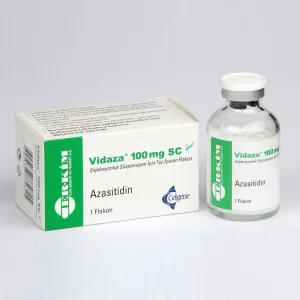
TM Owner Celgene
Vidaza 100mg Injection
Global Shipping : Reliable Global Distribution Network
Express Delivery : Priority Shipping for Every Order
Secure Payments : Trusted Payment Protection System
 Disclaimer

Secure Handling
24/7 Worldwide Support

Global Access
Worldwide Access to Health

Cold-Chain Expert
Excellence in Cold-Chain

Trusted Supply
Certified Medical Supply
Indications & Clinical Uses
- Vidaza 100 mg (azacitidine for injection) is a nucleoside metabolic inhibitor, a hypomethylating anticancer medicine, supplied as a single-dose vial of freeze-dried powder that is made up before use.
- In the US it is approved for adults with certain subtypes of myelodysplastic syndrome (refractory anaemia, refractory anaemia with ringed sideroblasts, refractory anaemia with excess blasts, RAEB in transformation and chronic myelomonocytic leukaemia) and for children aged 1 month and older with newly diagnosed juvenile myelomonocytic leukaemia (JMML).
- The adult starting dose is 75 mg/m2 daily for 7 days, given by injection under the skin or by intravenous infusion.
- Vidaza is prepared and given only by trained healthcare professionals.
- It must not be substituted for oral azacitidine, because the indications and dosing regimen differ.
Side Effects
- In adults given Vidaza under the skin, the most common effects, each seen in more than 30% of people, are nausea, anaemia, low platelets (thrombocytopenia), vomiting, fever, low white cells (leukopenia), diarrhoea, redness at the injection site, constipation, low neutrophils (neutropenia) and bruising.
- Given into a vein, petechiae (tiny red skin spots), rigors, weakness and low potassium are also common.
- In children with JMML the most common effects were fever, rash, upper respiratory tract infection and anaemia.
- Serious risks include severe low blood counts, liver toxicity in people with severe existing liver disease, kidney toxicity ranging from raised creatinine to kidney failure and death, tumour lysis syndrome and harm to an unborn baby.
- The current US label carries no boxed warning.
- Report fever, signs of infection, unusual bleeding or bruising, reduced urine or yellow skin promptly.
Precautions & Warnings
- Vidaza is contraindicated in people with advanced malignant liver tumours and in anyone allergic to azacitidine or mannitol.
- Blood counts, liver function and kidney function need to be watched during treatment, and people at risk of tumour lysis syndrome need close attention.
- Vidaza can cause fetal harm: women who can become pregnant should use effective contraception during treatment and for 6 months after the last dose, and men with female partners should use contraception during treatment and for 3 months after.
- Do not breastfeed during treatment or for 1 week after the last dose.
- Animal data suggest fertility could be affected.
- For injection under the skin, sites are rotated (thigh, abdomen or upper arm) at least one inch from an old site.
- Unopened vials are stored at 25°C, with excursions to 15°C to 30°C.
- Never swap Vidaza for oral azacitidine.
Avoid Interactions
- The label reports that no formal clinical drug interaction studies have been conducted with Vidaza.
- Laboratory data indicate that azacitidine does not inhibit major cytochrome P450 enzymes or transporters at clinically relevant concentrations, so no specific medicines are named that increase or reduce its effect.
- Even so, tell your healthcare provider about every prescription medicine, over-the-counter product, herbal remedy and supplement you use, because other treatments given for blood disorders can also lower blood counts or affect the liver and kidneys.
- Vidaza must not be substituted for oral azacitidine.
- After the powder is reconstituted for injection under the skin, the suspension has a short use time: up to 1 hour at room temperature, or longer if made with cold diluent and refrigerated, so it is prepared close to the time of the dose.
References
Frequently Asked Questions
Vidaza (azacitidine) treats certain types of myelodysplastic syndrome in adults, including chronic myelomonocytic leukaemia, and newly diagnosed juvenile myelomonocytic leukaemia (JMML) in children aged 1 month and older. It is a chemotherapy-type medicine that helps the bone marrow make healthier blood cells.
Vidaza (azacitidine) is given by a healthcare professional as an injection under the skin or as an intravenous infusion. The usual adult starting dose is 75 mg/m2 once daily for 7 days. Injection sites are rotated between thigh, abdomen and upper arm.
Vidaza (azacitidine) very commonly causes nausea, vomiting, diarrhoea, constipation, fever, injection-site redness and bruising. It also lowers blood counts, causing anaemia, low platelets and low white cells. Tell your team quickly about fever, infection, unusual bleeding, reduced urine or yellow skin.
No. Vidaza (azacitidine for injection) must not be substituted for oral azacitidine tablets. The two products have different approved uses and different dosing regimens, so a prescriber must choose the exact product and schedule. Your prescriber must choose the exact product, dose and schedule, and pharmacy staff should check that Vidaza is what was ordered.
During Vidaza (azacitidine) treatment your team checks blood counts, liver function and kidney function. The medicine can lower red cells, white cells and platelets, and can harm the liver in people with severe existing liver disease and the kidneys. Tell your team about any existing liver disease or kidney problems before treatment starts.
No. Vidaza (azacitidine) can cause fetal harm. Women who could become pregnant should use effective contraception during treatment and for 6 months after the last dose. Men with female partners should use it during treatment and for 3 months after. Do not breastfeed during treatment or for 1 week afterwards.

Trusted & Reliable – Your Partner in Global Distribution.
We provide comprehensive lines of pharmaceutical products to support all your healthcare distribution needs.


