

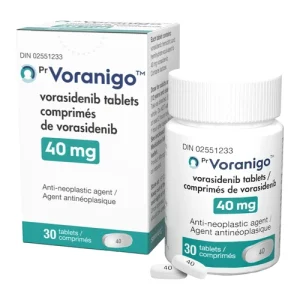
TM Owner Servier
Vorasidenib 40mg Tablet (film-coated)
Global Shipping : Reliable Global Distribution Network
Express Delivery : Priority Shipping for Every Order
Secure Payments : Trusted Payment Protection System
 Disclaimer

Secure Handling
24/7 Worldwide Support

Global Access
Worldwide Access to Health

Cold-Chain Expert
Excellence in Cold-Chain

Trusted Supply
Certified Medical Supply
Indications & Clinical Uses
- This entry is listed as vorasidenib citrate 40 mg capsules, but no capsule form exists: the only approved vorasidenib product is Voranigo, a film-coated tablet, and the information here comes from the Voranigo label (Servier).
- Vorasidenib is an oral inhibitor of the mutant IDH1 and IDH2 enzymes.
- In the US it is approved for adults and children aged 12 years and older with Grade 2 astrocytoma or oligodendroglioma with a susceptible IDH1 or IDH2 mutation, following surgery.
- In the EU it is authorised for adults and adolescents aged 12 years and older weighing at least 40 kg after surgery only, when no immediate further therapy is needed.
- The dose is 40 mg once daily (20 mg for US patients under 40 kg) until progression or unacceptable toxicity.
- It is specialist-supervised, self-administered oral treatment.
Side Effects
- The most common side effects in the US label (15% or more) are fatigue (about 37%), COVID-19 (33%), muscle and joint pain (26%), diarrhoea (25%) and seizures (16%).
- In the EU information, raised liver enzymes are the most frequent finding: ALT increased (59.3%), AST increased (45.5%), GGT increased (37.7%), fatigue (36.5%) and diarrhoea (24.6%).
- The most important serious risk is liver injury: transaminase elevations can lead to liver failure.
- Contact your healthcare provider promptly for yellowing of the skin or eyes, dark urine, severe tiredness, abdominal pain, nausea or vomiting, or an increase in seizures.
- The label carries no boxed warning.
- Do not take an extra dose if you vomit after a tablet.
Precautions & Warnings
- Liver function tests are done before treatment, every 2 weeks for the first 2 months, then monthly for the first 2 years and when clinically needed; treatment may be paused, reduced or stopped if enzymes rise.
- Voranigo can cause fetal harm and should not be used in pregnancy; females who can become pregnant need effective non-hormonal contraception during treatment and for 3 months after the last dose (the EU information adds that partners of men should also use contraception, and that hormonal methods need extra barrier protection), because it may make hormonal contraceptives ineffective.
- Do not breastfeed during treatment and for 2 months after the last dose.
- No dose change is needed for mild or moderate liver impairment; severe impairment has not been studied.
- The US label has no contraindications; the EU lists only hypersensitivity.
- It is approved from age 12 years; not studied in younger children.
- Tell your prescriber if seizures worsen.
- The EU label finds negligible effect on driving.
Avoid Interactions
- Increase exposure or toxicity: avoid strong and moderate CYP1A2 inhibitors, which raise vorasidenib levels and the risk of liver injury.
- Reduce efficacy: avoid moderate CYP1A2 inducers and tobacco smoking, which lower vorasidenib levels.
- Vorasidenib may reduce the effect of medicines broken down by CYP3A, so avoid combinations where lower levels would reduce their effectiveness, and it may make hormonal contraceptives less effective, so use non-hormonal methods.
- Take tablets with or without food at about the same time each day.
- Tell your healthcare provider about all prescription and over-the-counter medicines, herbal products and supplements, and about smoking, before starting or changing anything.
References
Frequently Asked Questions
Vorasidenib (vorasidenib) treats Grade 2 astrocytoma or oligodendroglioma with a susceptible IDH1 or IDH2 mutation after surgery. In the US it is approved from age 12 years; in the EU, for adults and adolescents 12 and over weighing at least 40 kg, when no immediate further treatment is needed.
Take Vorasidenib (vorasidenib) by mouth once daily, with or without food, at the same time each day. The dose is 40 mg for adults and patients weighing 40 kg or more, and 20 mg for US patients under 40 kg. Treatment continues until the disease progresses or side effects become unacceptable.
Common Vorasidenib side effects are fatigue, COVID-19, muscle and joint pain, diarrhoea and seizures. The main serious risk is liver injury, so blood tests are needed. Call your provider for yellow skin or eyes, dark urine or worsening seizures. The label has no boxed warning.
Avoid strong or moderate CYP1A2 inhibitors, moderate CYP1A2 inducers and tobacco smoking while taking Vorasidenib (vorasidenib). It may also make hormonal contraceptives less effective, so use non-hormonal contraception. Tell your prescriber about all medicines and supplements, and check before starting anything new.
If you miss a dose of Vorasidenib (vorasidenib), take it as soon as possible within 6 hours. If more than 6 hours have passed, skip it and take the next dose at the usual time. If you vomit after a dose, do not take a replacement. Store at 20°C to 25°C.
No. Vorasidenib (vorasidenib) can harm an unborn baby. Females who can become pregnant need effective non-hormonal contraception during treatment and for 3 months after the last dose. Do not breastfeed during treatment and for 2 months after. Liver blood tests are also required regularly.

Trusted & Reliable – Your Partner in Global Distribution.
We provide comprehensive lines of pharmaceutical products to support all your healthcare distribution needs.


