

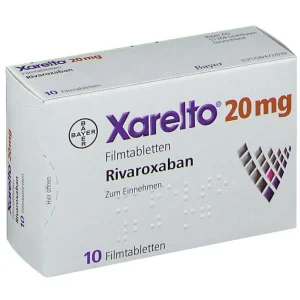
TM Owner Bayer
Xarelto 20mg Tablet
Global Shipping : Reliable Global Distribution Network
Express Delivery : Priority Shipping for Every Order
Secure Payments : Trusted Payment Protection System
 Disclaimer

Secure Handling
24/7 Worldwide Support

Global Access
Worldwide Access to Health

Cold-Chain Expert
Excellence in Cold-Chain

Trusted Supply
Certified Medical Supply
Indications & Clinical Uses
- Xarelto 20 mg tablets contain rivaroxaban, an oral direct factor Xa inhibitor anticoagulant (blood thinner).
- In adults it is used to reduce the risk of stroke and systemic embolism in non-valvular atrial fibrillation, to treat deep vein thrombosis (DVT) and pulmonary embolism (PE), and to reduce the risk of recurrent DVT and PE; other Xarelto strengths are used for other uses such as prevention after hip or knee surgery and in coronary or peripheral artery disease.
- The 20 mg tablet is normally taken once daily with the evening meal, and after 21 days of 15 mg twice daily when treating DVT or PE.
- Xarelto comes in 2.5, 10, 15 and 20 mg tablets and an oral suspension, so the strength must match the prescribed indication and must not be substituted.
- Marketed by Janssen in the US and by Bayer in the EU.
- It is taken at home.
Side Effects
- The main side effect is bleeding.
- Common effects (1 in 100 to 1 in 10 people) include anaemia, dizziness, headache, eye haemorrhage, low blood pressure, bruising and haematoma, nosebleeds, coughing blood, bleeding gums, stomach or bowel bleeding, abdominal pain, indigestion, nausea, constipation, diarrhoea, vomiting, raised liver enzymes, itching, rash, blood in urine, heavy periods and reduced kidney function.
- BOXED WARNING (US): premature discontinuation of any oral anticoagulant, including Xarelto, increases the risk of thrombotic events; and epidural or spinal haematomas can occur in patients receiving neuraxial anaesthesia or spinal puncture, which may cause long-term or permanent paralysis.
- Get urgent help for serious or fatal bleeding signs such as black stools, vomiting blood, severe headache, or new back pain, numbness or leg weakness.
Precautions & Warnings
- Do not stop Xarelto early without medical advice, because stopping raises the risk of clots and stroke; if it must be stopped, another anticoagulant may be needed.
- Tell every doctor and dentist you take Xarelto, especially before a spinal puncture or epidural, as spinal or epidural haematoma can cause permanent paralysis.
- Do not use it with active pathological bleeding or after a severe allergic reaction.
- EU and UK labels also contraindicate liver disease with coagulopathy, pregnancy, breastfeeding and other anticoagulants; the US label says to use in pregnancy only if benefit outweighs risk.
- Avoid it in prosthetic heart valves and triple-positive antiphospholipid syndrome.
- Avoid in moderate to severe liver impairment (Child-Pugh B or C); avoid in most uses if creatinine clearance is below 15 mL/min, and the dose is adjusted in atrial fibrillation at 50 mL/min or below.
- Dizziness or fainting: do not drive.
- Take the 20 mg tablet with food.
Avoid Interactions
- Increase in bleeding or exposure: combined P-gp and strong CYP3A4 inhibitors, including azole antifungals such as ketoconazole and HIV protease inhibitors such as ritonavir, raise rivaroxaban levels and are best avoided.
- Other anticoagulants (heparin, warfarin and similar) must not be combined except when switching under supervision.
- NSAIDs and antiplatelet medicines, and SSRIs or SNRIs antidepressants, further increase the risk of bleeding.
- Reduced efficacy: combined P-gp and strong CYP3A4 inducers such as rifampicin can lower rivaroxaban exposure by about half and should be avoided.
- The 15 mg and 20 mg tablets must be taken with food to be absorbed properly.
- Tell your healthcare provider and pharmacist about every prescription, non-prescription and herbal medicine you use.
References
Frequently Asked Questions
Xarelto 20 mg (rivaroxaban) is a blood thinner for adults. It lowers stroke risk in non-valvular atrial fibrillation, treats deep vein thrombosis and pulmonary embolism, and reduces the risk of those clots returning. Other Xarelto strengths are used for other conditions, so do not swap tablets.
Take Xarelto 20 mg (rivaroxaban) once daily with your evening meal, as prescribed. The 15 mg and 20 mg tablets must be taken with food. When treating DVT or PE, the 20 mg dose starts after 21 days of 15 mg twice daily. Do not change strength on your own.
Bleeding is the main Xarelto (rivaroxaban) side effect, including nosebleeds, bleeding gums, bruising, blood in urine and heavy periods. Anaemia, dizziness, headache and stomach upset are also common. Seek urgent help for black stools, vomiting blood, severe headache, or any serious or unstoppable bleeding.
Avoid other anticoagulants, and take NSAIDs and antiplatelet medicines only on medical advice, as they raise bleeding risk with Xarelto (rivaroxaban). Avoid combined P-gp and strong CYP3A4 inhibitors, such as azole antifungals and HIV protease inhibitors, and inducers such as rifampicin. Tell every doctor and dentist you take it.
Xarelto (rivaroxaban) carries a US boxed warning: stopping any oral anticoagulant early increases the risk of blood clots and stroke. Never stop Xarelto unless your healthcare provider tells you to. If it must be stopped, you may need another anticoagulant to stay protected.
The US boxed warning says people taking Xarelto (rivaroxaban) who have an epidural, spinal anaesthesia or spinal puncture can develop a spinal or epidural haematoma, which may cause long-term or permanent paralysis. Report new back pain, numbness or leg weakness immediately, and tell doctors you take Xarelto before any spinal procedure.

Trusted & Reliable – Your Partner in Global Distribution.
We provide comprehensive lines of pharmaceutical products to support all your healthcare distribution needs.


