

TM Owner Sun Pharma
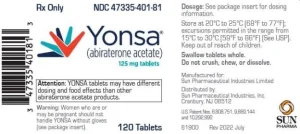
Yonsa 125mg Tablet
Global Shipping : Reliable Global Distribution Network
Express Delivery : Priority Shipping for Every Order
Secure Payments : Trusted Payment Protection System
 Disclaimer

Secure Handling
24/7 Worldwide Support

Global Access
Worldwide Access to Health

Cold-Chain Expert
Excellence in Cold-Chain

Trusted Supply
Certified Medical Supply
Indications & Clinical Uses
- Yonsa (abiraterone acetate) is a CYP17 inhibitor tablet for prostate cancer, taken by mouth.
- The sheet lists 500 mg, which is the daily dose of four 125 mg Yonsa tablets; each tablet contains 125 mg and the pack holds 120 tablets.
- Yonsa is approved in the US in combination with methylprednisolone for the treatment of patients with metastatic castration-resistant prostate cancer.
- The recommended dose is 500 mg (four 125 mg tablets) once daily together with methylprednisolone 4 mg twice daily, and it may be taken with or without food.
- Yonsa is a different formulation from other abiraterone acetate products, with different dosing and food effects, so it must not be swapped for them unless your prescriber changes the dose instructions.
Side Effects
- The most common side effects (10% or more of patients) were tiredness, joint swelling or discomfort, swelling (oedema), hot flushes, diarrhoea, vomiting, cough, high blood pressure, breathlessness, urinary tract infection and bruising.
- Blood test changes seen in more than 20% include anaemia, raised alkaline phosphatase, high triglycerides and cholesterol, high blood sugar, raised liver enzymes (AST/ALT), low phosphate and low potassium.
- Serious effects include mineralocorticoid excess (high blood pressure, low potassium and fluid retention), adrenal insufficiency, severe or fatal liver toxicity, low blood sugar with certain diabetes medicines, and more fractures and deaths when combined with radium Ra 223 dichloride.
- Yonsa has no boxed warning.
- Report yellowing skin, dark urine, severe tiredness, dizziness, muscle weakness or swelling.
Precautions & Warnings
- The label lists no contraindications.
- Blood pressure and potassium are checked at least monthly, and liver tests every 2 weeks for the first 3 months, then monthly.
- In moderate liver impairment (Child-Pugh B) the dose is reduced to 125 mg once daily with closer liver test monitoring; do not use in severe impairment (Child-Pugh C).
- No dose change is needed for kidney impairment.
- Yonsa must be taken with methylprednisolone.
- It can harm an unborn baby: men with female partners who could become pregnant should use effective contraception during treatment and for 3 weeks after the last dose, and pregnant women should not handle damaged tablets without protection.
- Store at 20°C to 25°C (excursions 15°C to 30°C).
Avoid Interactions
- Reduce efficacy: strong CYP3A4 inducers should be avoided; if unavoidable, the Yonsa dosing frequency is increased (to twice daily) under prescriber direction.
- Increase toxicity: Yonsa raises levels of CYP2D6 substrates, so avoid them or reduce their dose, and CYP2C8 substrates need monitoring for toxicity.
- Combining with radium Ra 223 dichloride increases fractures and mortality.
- Certain diabetes medicines can cause low blood sugar, so blood sugar should be monitored.
- Food: unlike other abiraterone acetate products, Yonsa can be taken with or without food.
- Tell your healthcare provider about all prescription, over-the-counter and herbal medicines you use.
References
Frequently Asked Questions
Yonsa (abiraterone acetate) treats metastatic castration-resistant prostate cancer in combination with methylprednisolone. It is taken by mouth as tablets. Each Yonsa tablet contains 125 mg, and the full daily dose is four tablets (500 mg) once a day, taken with methylprednisolone 4 mg twice daily.
Take four Yonsa (abiraterone acetate) 125 mg tablets once daily, with or without food, together with methylprednisolone 4 mg twice daily. Do not change the dose or switch to other abiraterone products unless your prescriber tells you to. Your blood pressure, potassium and liver tests are monitored while you take it.
Common Yonsa side effects include tiredness, joint swelling, fluid retention, hot flushes, diarrhoea, vomiting, cough, high blood pressure and urinary infections. Serious risks are low potassium, adrenal insufficiency and liver damage. Report yellow skin, dark urine, dizziness, muscle weakness or swelling promptly.
Avoid strong CYP3A4 inducers with Yonsa (abiraterone acetate), because they lower its levels. Avoid combining it with radium Ra 223 dichloride, which increases fractures and deaths. It also raises levels of CYP2D6 and CYP2C8 medicines and can cause low blood sugar with some diabetes drugs.
While taking Yonsa (abiraterone acetate), your blood pressure and potassium are checked at least monthly. Liver function is tested every 2 weeks for the first 3 months, then monthly. Weekly checks apply during the first month if you have moderate liver impairment.
No. Yonsa (abiraterone acetate) is a different formulation with different dosing and food effects from other abiraterone acetate products. Yonsa is 125 mg tablets, taken as four tablets with or without food and with methylprednisolone. Do not switch without your prescriber's guidance.

Trusted & Reliable – Your Partner in Global Distribution.
We provide comprehensive lines of pharmaceutical products to support all your healthcare distribution needs.


