

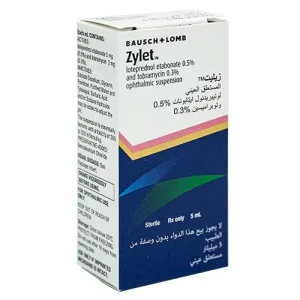
TM Owner Bausch & Lomb
Zylet 0.5%/0.3% Eye Drops
Global Shipping : Reliable Global Distribution Network
Express Delivery : Priority Shipping for Every Order
Secure Payments : Trusted Payment Protection System
 Disclaimer

Secure Handling
24/7 Worldwide Support

Global Access
Worldwide Access to Health

Cold-Chain Expert
Excellence in Cold-Chain

Trusted Supply
Certified Medical Supply
Indications & Clinical Uses
- Zylet 0.5%/0.3% is a sterile eye-drop suspension combining loteprednol etabonate 0.5%, a corticosteroid, with tobramycin 0.3%, an aminoglycoside antibiotic.
- It is prescribed for steroid-responsive inflammatory eye conditions where a corticosteroid is appropriate and there is a superficial bacterial eye infection or a risk of one.
- It is self-administered as eye drops: apply one or two drops into the conjunctival sac of the affected eye every four to six hours, and during the first 24 to 48 hours your prescriber may direct more frequent dosing, up to every one to two hours.
- It is a suspension, so it must be shaken vigorously before every use.
- Zylet is made by Bausch & Lomb and is supplied in 5 mL and 10 mL bottles.
Side Effects
- In studies, the most frequent reactions were eye redness (conjunctival injection, about 20%), superficial punctate keratitis, a surface irritation of the cornea (about 15%), increased eye pressure (10%, compared with 4% on the vehicle) and burning or stinging on instillation (9%).
- Prolonged steroid use can cause raised eye pressure with possible optic nerve damage, posterior subcapsular cataracts and delayed healing, and can hide or worsen an infection.
- Allergic reactions to tobramycin can occur.
- Stop using the drops and contact your healthcare provider if you develop eye pain, vision changes, swelling, itching or rash.
- The US label carries no boxed warning.
Precautions & Warnings
- Do not use Zylet if you have most viral diseases of the cornea or conjunctiva, including epithelial herpes simplex keratitis, vaccinia or varicella, or mycobacterial or fungal eye infections.
- If used for 10 days or longer, eye pressure should be checked.
- If your condition does not improve after 2 days, contact your prescriber, because infection may be masked.
- Avoid wearing soft contact lenses during treatment because of the preservative benzalkonium chloride.
- Stop use and seek advice if you develop signs of aminoglycoside sensitivity.
- There are no adequate studies in pregnant women, so discuss use in pregnancy with your provider.
- Store upright at 15 to 25 degrees C and protect from freezing.
Avoid Interactions
- Increase the effect or toxicity: the US Zylet label contains no drug-interaction statement, but using other corticosteroid or antibiotic products together with Zylet may add to the risk of raised eye pressure, cataracts or resistant infection, so tell your prescriber about all eye drops, ointments, steroids and antibiotics you use.
- Reduce the effect: none listed in the label.
- Non-drug interaction: soft contact lenses can absorb the benzalkonium chloride preservative, so do not wear them during treatment.
- Tell your healthcare provider about all medicines, including over-the-counter products and supplements, and keep a list of your eye and other medicines to show every prescriber and pharmacist.
References
Frequently Asked Questions
Zylet (loteprednol etabonate 0.5% and tobramycin 0.3%) eye drops treat steroid-responsive inflammatory eye conditions where a superficial bacterial eye infection is present or a risk of infection exists. It combines a corticosteroid with an antibiotic in one suspension and is used only on prescription.
Apply one or two drops of Zylet (loteprednol and tobramycin) into the affected eye every four to six hours. Your prescriber may direct more frequent drops in the first 24 to 48 hours. Shake the bottle vigorously before every use, because Zylet is a suspension.
Zylet (loteprednol and tobramycin) commonly causes eye redness, surface irritation of the cornea, raised eye pressure and burning or stinging. Long use can cause cataracts and glaucoma-type pressure rises. Stop and call your provider for eye pain, vision changes, swelling or rash.
Do not use Zylet (loteprednol and tobramycin) if you have most viral eye diseases, including herpes simplex keratitis, vaccinia or varicella, or fungal or mycobacterial eye infections. Avoid soft contact lenses during treatment, and tell your provider if you have had an allergic reaction to tobramycin.
Store Zylet (loteprednol and tobramycin) upright at 15 to 25 degrees C and protect it from freezing. Shake it vigorously before each use. Bottles come in 5 mL and 10 mL sizes. Do not let the dropper tip touch your eye, fingers or any surface, and keep the cap closed between uses.
Yes. If Zylet (loteprednol and tobramycin) is used for 10 days or longer, your eye pressure should be checked, because steroids can raise it and cause cataracts. If your eye has not improved after 2 days, contact your prescriber, as infection may be masked.

Trusted & Reliable – Your Partner in Global Distribution.
We provide comprehensive lines of pharmaceutical products to support all your healthcare distribution needs.


