

TM Owner Incyte
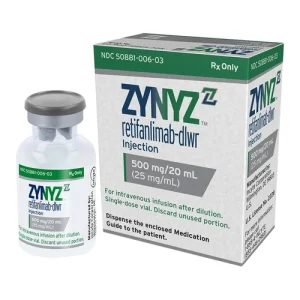
Zynyz 500 mg/20 mL Vial (Solution for Infusion)
Global Shipping : Reliable Global Distribution Network
Express Delivery : Priority Shipping for Every Order
Secure Payments : Trusted Payment Protection System
 Disclaimer

Secure Handling
24/7 Worldwide Support

Global Access
Worldwide Access to Health

Cold-Chain Expert
Excellence in Cold-Chain

Trusted Supply
Certified Medical Supply
Indications & Clinical Uses
- Zynyz 500 mg/20 mL (retifanlimab, called retifanlimab-dlwr in the US) is a PD-1 blocking antibody that helps the immune system attack cancer cells.
- In the US it is approved for adults with inoperable locally recurrent or metastatic squamous cell carcinoma of the anal canal, in combination with carboplatin and paclitaxel as first-line treatment, or alone after disease progression on or intolerance to platinum-based chemotherapy, and alone for metastatic or recurrent locally advanced Merkel cell carcinoma.
- In the EU it is authorised for adults with first-line Merkel cell carcinoma (alone) and first-line anal canal carcinoma (with carboplatin and paclitaxel).
- It is given only by intravenous infusion over 30 minutes in a hospital or clinic under specialist supervision, every 3 or 4 weeks.
Side Effects
- With chemotherapy for anal cancer, the most common reactions (at least 20%) are tiredness, nerve damage causing numbness or tingling (peripheral neuropathy), nausea, hair loss, diarrhoea and muscle and joint pain.
- When used alone, common reactions (at least 10%) include tiredness, muscle and joint pain, diarrhoea, itching, rash, infections and bleeding.
- Zynyz can cause serious or fatal immune-mediated reactions in any organ, including lung inflammation (pneumonitis), colitis, hepatitis, hormone gland problems, kidney inflammation and severe skin reactions, as well as infusion-related reactions.
- The US label has no boxed warning.
- Tell your care team straight away about new cough, shortness of breath, severe diarrhoea, yellow skin or eyes, rash, or fever or chills during infusion.
Precautions & Warnings
- Zynyz can cause fetal harm.
- Women who can become pregnant should use effective contraception during treatment and for 4 months after the last dose, and should not breastfeed during that time.
- Complications, including severe graft-versus-host disease, can occur in people who have had or will have an allogeneic stem cell transplant, so tell your team about any transplant history.
- Your care team may slow, interrupt or stop infusions for infusion-related reactions, and may withhold treatment or give corticosteroids for immune-mediated reactions.
- Zynyz is for intravenous infusion only, after dilution, and is not for self-administration.
- Unopened vials are stored by the hospital pharmacy refrigerated at 2°C to 8°C in the original carton, never frozen or shaken.
- The US label has no boxed warning.
Avoid Interactions
- Agents that increase risk or toxicity: the US label has no drug interactions section and no formal interaction studies are described.
- When Zynyz is combined with carboplatin and paclitaxel, side effects of both chemotherapy medicines, such as nerve damage and low blood counts, can add to those of Zynyz.
- Agents that may reduce efficacy: the label does not list any specific interacting medicines, but your team will still review everything you take.
- Tell your healthcare provider about all prescription medicines, over-the-counter products and supplements you use, and about any past or planned stem cell transplant.
References
Frequently Asked Questions
Zynyz (retifanlimab) is a PD-1 immunotherapy given for anal canal squamous cell carcinoma, with carboplatin and paclitaxel as first-line treatment, and for Merkel cell carcinoma, a rare skin cancer. In the US it can also be used alone after platinum chemotherapy for anal cancer.
Zynyz (retifanlimab) is given by a healthcare professional as an intravenous infusion over 30 minutes. For anal cancer the dose is 500 mg every 4 weeks or 375 mg every 3 weeks. For Merkel cell carcinoma it is 500 mg every 4 weeks.
Common Zynyz side effects include tiredness, nausea, diarrhoea, hair loss, rash, itching and muscle or joint pain. Zynyz can also cause serious immune reactions in the lungs, bowel, liver, hormone glands, kidneys and skin, and infusion reactions. Report cough, breathlessness, severe diarrhoea or yellow skin promptly.
Avoid pregnancy and breastfeeding with Zynyz (retifanlimab). Use effective contraception during treatment and for 4 months after the last dose, and do not breastfeed for the same period. Tell your team about any stem cell transplant, past or planned, and all medicines you use.
During a Zynyz (retifanlimab) infusion, the diluted medicine runs into a vein over 30 minutes. Staff watch for infusion reactions such as fever or chills and can slow, pause or stop the infusion. Vials are kept refrigerated at 2°C to 8°C by the hospital pharmacy.
Yes. Zynyz (retifanlimab) can cause fetal harm when given to a pregnant woman. Women who can become pregnant should use effective contraception during treatment and for 4 months after the last dose, and should not breastfeed for that same period. Discuss any pregnancy plans with your oncology team first.

Trusted & Reliable – Your Partner in Global Distribution.
We provide comprehensive lines of pharmaceutical products to support all your healthcare distribution needs.


